
如何在动态血糖监测之外采取行动:拉丁美洲专家关于持续葡萄糖监测(CGM)数据解读的建议
How to take action beyond ambulatory glucose profile: Latin American expert recommendations on CGM data interpretation.
作者信息
Calliari Luis Eduardo, Contreras Sepúlveda Álvaro, Coronel-Restrepo Nicolás, Kabakian Laura, Lamounier Rodrigo N, Picasso Emma, Proietti Adrian, Ramírez-Rincón Alex, Yépez-Rodriguez Alicia E
机构信息
Department of Pediatrics, Santa Casa School of Medical Sciences, São Paulo, Brasil.
Clínica Universidad de los Andes, Santiago, Chile.
出版信息
Diabetol Metab Syndr. 2025 May 8;17(1):149. doi: 10.1186/s13098-025-01702-y.
PURPOSE
This expert consensus provides a standardized methodology for interpreting continuous glucose monitoring (CGM) data to optimize diabetes management. It aims to help healthcare professionals recognize glycemic patterns and apply targeted interventions based on real-time glucose metrics.
METHODS
A systematic literature review informed expert panel discussions. Specialists from Latin America assessed CGM interpretation challenges, reviewed key metrics, and reached consensus through an anonymous voting process. The recommendations align with international guidelines while addressing regional limitations in technology access and healthcare infrastructure.
RESULTS
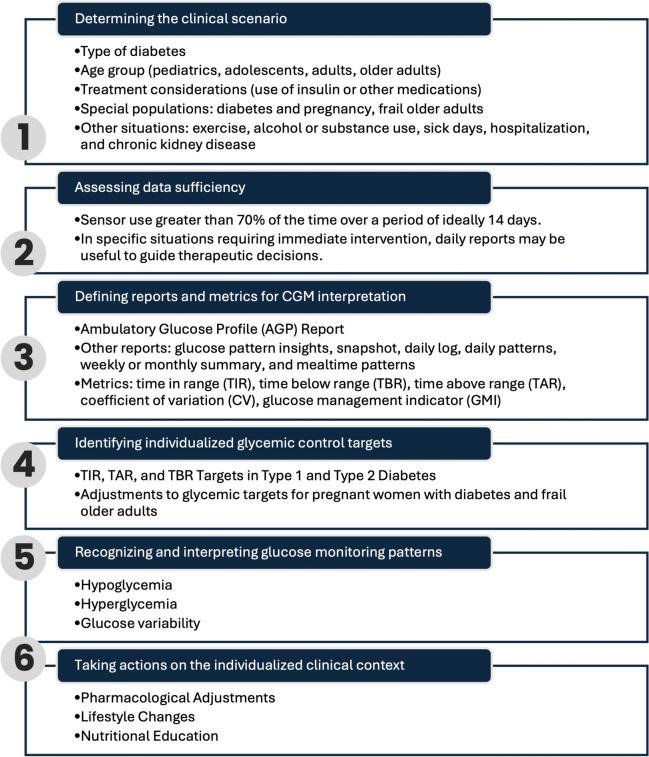
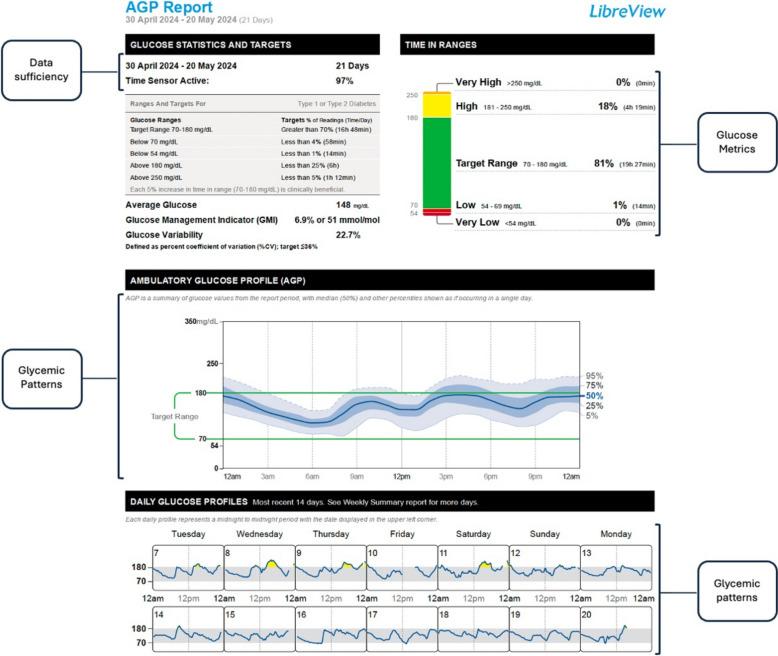
Reliable CGM data interpretation requires at least 70% sensor use over 14 days. The Ambulatory Glucose Profile (AGP) report serves as the primary tool, offering essential metrics such as time in range (TIR), time below range (TBR), time above range (TAR), coefficient of variation (CV), and glucose management indicator (GMI). Identifying hyperglycemia, hypoglycemia, and glucose variability allows for personalized treatment adjustments. The panel adopted international glycemic targets, adapting them to Latin American settings. The time in tight range (TITR) was considered but not included due to limited supporting evidence and regional barriers to advanced CGM technology.
CONCLUSIONS
Standardized CGM interpretation improves glycemic control and treatment decisions. These recommendations provide a structured approach to diabetes care, aiming to enhance clinical outcomes and address healthcare disparities in Latin America.
目的
本专家共识提供了一种标准化方法,用于解读连续血糖监测(CGM)数据以优化糖尿病管理。其旨在帮助医疗保健专业人员识别血糖模式,并根据实时血糖指标进行有针对性的干预。
方法
一项系统的文献综述为专家小组讨论提供了依据。来自拉丁美洲的专家评估了CGM解读的挑战,审查了关键指标,并通过匿名投票过程达成共识。这些建议与国际指南保持一致,同时解决了技术获取和医疗基础设施方面的区域限制问题。
结果
可靠的CGM数据解读需要在14天内至少使用传感器70%的时间。动态血糖图谱(AGP)报告是主要工具,提供诸如血糖在目标范围内时间(TIR)、低于目标范围时间(TBR)、高于目标范围时间(TAR)、变异系数(CV)和血糖管理指标(GMI)等关键指标。识别高血糖、低血糖和血糖变异性有助于进行个性化治疗调整。专家小组采用了国际血糖目标,并根据拉丁美洲的情况进行了调整。由于支持证据有限以及先进CGM技术的区域障碍,紧密血糖范围内时间(TITR)虽被考虑但未纳入。
结论
标准化的CGM解读可改善血糖控制和治疗决策。这些建议为糖尿病护理提供了一种结构化方法,旨在改善临床结局并解决拉丁美洲的医疗保健差异问题。

 Zotero 插件