
调节性细胞因子调节与COVID-19生存相关的早期同种型特异性反应。
Regulatory cytokines modulate early isotype-specific response associated with COVID-19 survival.
作者信息
Castro-Trujillo Sebastián, Castro-Meneses Juanita, Rojas María Clemencia, Castro-Amaya Marcela, Lastra Giovani, Narváez Carlos F
机构信息
División de Inmunología, Programa de Medicina, Facultad de Ciencias de la Salud, Universidad Surcolombiana, Neiva, Huila, Colombia.
Programa de Biología Aplicada, Facultad de Ciencias Exactas y Naturales, Universidad Surcolombiana, Neiva, Huila, Colombia.
出版信息
Front Immunol. 2025 Apr 24;16:1543626. doi: 10.3389/fimmu.2025.1543626. eCollection 2025.
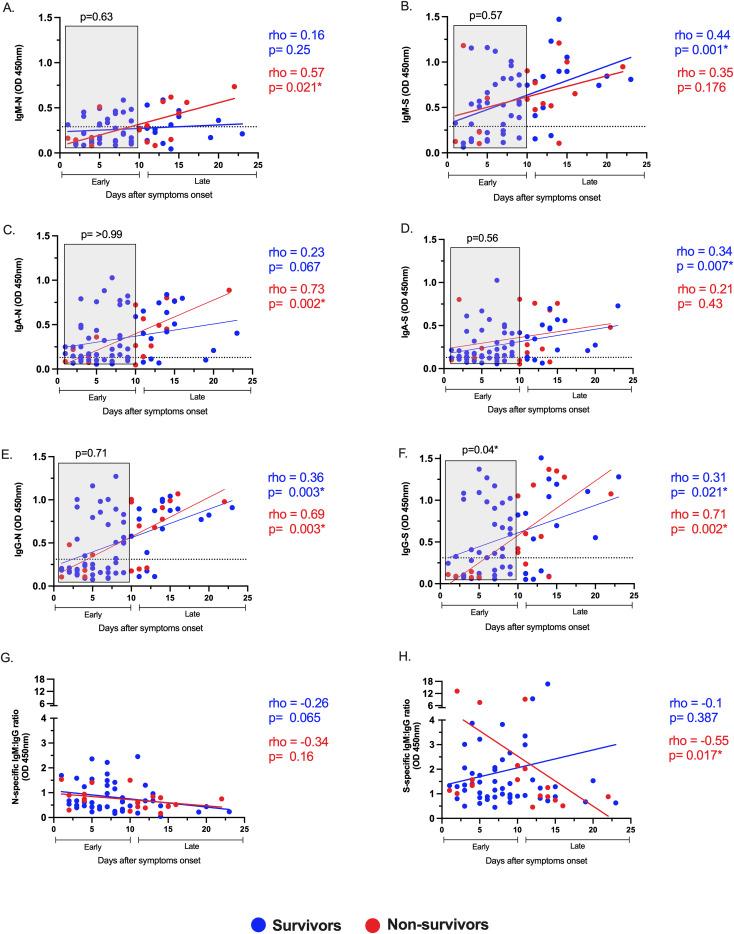
Identifying immune markers driving early and effective antibody response in patients with severe coronavirus disease 2019 (COVID-19) is critical due to the threat of future coronavirus pandemics, incomplete global vaccination, and suboptimal booster coverage. Patients with life-threatening severe acute respiratory syndrome coronavirus 2 (SARS-CoV-2) infection are characterized by dysregulated thromboinflammation and cytokine storm that could influence the isotype virus-specific antibody response and the subsequent clinical outcome. We investigated the association between COVID-19-related mortality with the dynamics, magnitude, and relative avidity of nucleoprotein (N), spike (S), and receptor-binding domain (RBD)-specific IgM, IgA, and IgG in circulation. We also assessed the relationship between the virus-specific antibody responses and cytokine patterns, as well as systemic and pulmonary thromboinflammation markers. This multicenter study included COVID-19 patients hospitalized early in the pandemic, classified as survivors (n=62) and non-survivors (n=17). We developed indirect enzyme-linked immunosorbent assays (ELISAs) to evaluate each virus-specific isotype using well-characterized outpatient COVID-19 (n=180) and pre-pandemic cohorts (n=111). The pro-inflammatory interleukin (IL)-6 and tumor necrosis factor (TNF)-α, as well as the regulatory IL-10, transforming growth factor (TGF)-β1, and soluble tumor necrosis factor receptor I (sTNFRI) levels were evaluated. The ELISAs performed highly for all virus-specific isotypes, although modest for IgM-N. Non-survivors increased N-specific, but no S-specific, IgM and IgA responses throughout the disease course and, more notably, a delayed class switching to IgG-S and IgG-RBD compared to survivors. No differences were observed in the virus-specific IgG relative avidity. Survivors exhibited an antibody response proportional to the degree of systemic and pulmonary thromboinflammation, whereas non-survivors showed those dissociated because of their uncontrolled severe thromboinflammation. Only the survivors showed a dominant regulatory cytokine pattern in the early phase of infection (<10 days after symptoms onset), which strongly correlated with developing IgG-S and IgG-RBD protective antibodies. We developed easy-to-use immune assays that enable patient monitoring and identify at-risk populations in low- to middle-income regions. Non-survivors displayed an ineffective N-mediated antibody response, marked by an inability to control inflammation and a compromised time-dependent class switching toward S and RBD-specific IgG. The regulatory cytokine axis, including TGF-β1, maybe a critical immune correlate of effective antibody-mediated immunity in COVID-19.
鉴于未来冠状病毒大流行的威胁、全球疫苗接种不完全以及加强针接种覆盖率不理想,识别驱动2019年冠状病毒病(COVID-19)患者早期有效抗体反应的免疫标志物至关重要。患有危及生命的严重急性呼吸综合征冠状病毒2(SARS-CoV-2)感染的患者具有血栓炎症失调和细胞因子风暴的特征,这可能会影响同种型病毒特异性抗体反应及随后的临床结果。我们研究了COVID-19相关死亡率与循环中核蛋白(N)、刺突蛋白(S)和受体结合域(RBD)特异性IgM、IgA和IgG的动态变化、幅度及相对亲和力之间的关联。我们还评估了病毒特异性抗体反应与细胞因子模式以及全身和肺部血栓炎症标志物之间的关系。这项多中心研究纳入了在疫情早期住院的COVID-19患者,分为幸存者(n = 62)和非幸存者(n = 17)。我们开发了间接酶联免疫吸附测定(ELISA),以使用特征明确的门诊COVID-19患者(n = 180)和疫情前队列(n = 111)评估每种病毒特异性同种型。评估了促炎白细胞介素(IL)-6和肿瘤坏死因子(TNF)-α,以及调节性IL-10、转化生长因子(TGF)-β1和可溶性肿瘤坏死因子受体I(sTNFRI)水平。ELISA对所有病毒特异性同种型的检测效果都很好,不过对IgM-N的检测效果一般。在整个病程中,非幸存者的N特异性IgM和IgA反应增加,但S特异性反应未增加,更值得注意的是,与幸存者相比,其向IgG-S和IgG-RBD的类别转换延迟。在病毒特异性IgG相对亲和力方面未观察到差异。幸存者表现出与全身和肺部血栓炎症程度成比例的抗体反应,而非幸存者由于严重血栓炎症失控,其抗体反应与之脱节。只有幸存者在感染早期(症状出现后<10天)表现出占主导地位的调节性细胞因子模式,这与产生IgG-S和IgG-RBD保护性抗体密切相关。我们开发了易于使用的免疫检测方法,可用于患者监测并识别低收入和中等收入地区的高危人群。非幸存者表现出无效的N介导的抗体反应,其特征是无法控制炎症以及向S和RBD特异性IgG的时间依赖性类别转换受损。包括TGF-β1在内的调节性细胞因子轴可能是COVID-19中有效抗体介导免疫的关键免疫相关因素。


 Zotero 插件