
通过乙醇溶液燃烧煅烧法制备用于吸附亚甲基蓝的镍锰铁氧体磁性纳米颗粒。
Preparation of Ni-Mn ferrites magnetic nanoparticles through the ethanol solution combustion-calcination process for the adsorption of methyl blue.
作者信息
Pan Zhongjun, Wang Zhou, Lv Zhixiang
机构信息
The People's Hospital of Danyang, Affiliated Danyang Hospital of Nantong University, Zhenjiang, P.R. China.
College of Vanadium and Titanium, Panzhihua University, Panzhihua, P.R. China.
出版信息
PLoS One. 2025 May 9;20(5):e0321741. doi: 10.1371/journal.pone.0321741. eCollection 2025.
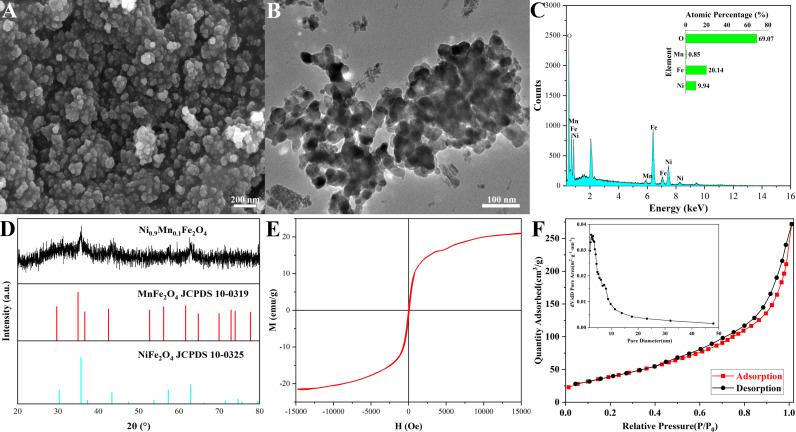
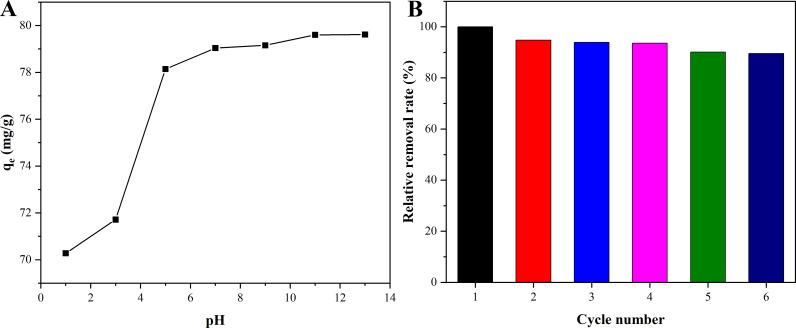
Ni-Mn ferrites magnetic nanoparticles (MNPs) were successfully prepared through the ethanol solution combustion-calcination process, and characterized by SEM, TEM, XRD, VSM, BET, and FTIR techniques. For smaller particle size and suitable magnetic property, the optimum element ratio of the material was Ni0.9Mn0.1Fe2O4, and the optimal preparation conditions were appropriate ethanol dosage to attain Fe3+ concentrations of approximately 0.85 M, calcination temperature of 400 °C, and calcination time of 2 h, their specific surface area was 136.5 m2/g, and their average particle size and saturation magnetization were 35 nm and 21.66 emu/g, respectively. The adsorption process of methyl blue (MB) onto Ni0.9Mn0.1Fe2O4 MNPs conformed to the pseudo-second-order adsorption kinetic model in the initial concentrations of 100-250 mg/L. In comparison with Langmuir and Freundlich adsorption isotherm models, the Temkin model (R2 = 0.9865) was observed to better demonstrate the state of MB onto Ni0.9Mn0.1Fe2O4 MNPs, revealing that the adsorption mechanism of MB onto Ni0.9Mn0.1Fe2O4 MNPs was the multi-molecular chemical process. The adsorption capacity of Ni0.9Mn0.1Fe2O4 MNPs for MB still maintained about 90% of the initial adsorbance after 6 times cyclic utilization of the nanoparticles by recalcination method, suggesting that Ni0.9Mn0.1Fe2O4 MNPs had excellent regeneration performance. In general, these results coupled with its environmental friendliness attributed the potential candidates for effluent remediation.
通过乙醇溶液燃烧 - 煅烧法成功制备了镍锰铁氧体磁性纳米颗粒(MNPs),并采用扫描电子显微镜(SEM)、透射电子显微镜(TEM)、X射线衍射(XRD)、振动样品磁强计(VSM)、比表面积分析仪(BET)和傅里叶变换红外光谱(FTIR)技术对其进行了表征。为了获得更小的粒径和合适的磁性,该材料的最佳元素比例为Ni0.9Mn0.1Fe2O4,最佳制备条件为:适当的乙醇用量以达到约0.85 M的Fe3+浓度、400℃的煅烧温度和2小时的煅烧时间,其比表面积为136.5 m2/g,平均粒径和饱和磁化强度分别为35 nm和21.66 emu/g。在100 - 250 mg/L的初始浓度下,甲基蓝(MB)在Ni0.9Mn0.1Fe2O4 MNPs上的吸附过程符合准二级吸附动力学模型。与朗缪尔(Langmuir)和弗伦德里希(Freundlich)吸附等温线模型相比,发现坦金(Temkin)模型(R2 = 0.9865)能更好地描述MB在Ni0.9Mn0.1Fe2O4 MNPs上的吸附状态,表明MB在Ni0.9Mn0.1Fe2O4 MNPs上的吸附机制是多分子化学过程。通过再煅烧法对纳米颗粒进行6次循环利用后,Ni0.9Mn0.1Fe2O4 MNPs对MB的吸附容量仍保持约初始吸附量的90%,表明Ni0.9Mn0.1Fe2O4 MNPs具有优异的再生性能。总体而言,这些结果及其环境友好性使其成为废水修复的潜在候选材料。



 Zotero 插件