
遗传学对帕金森病端粒长度的影响:一项对单卵双生子不一致性双胞胎的研究。
Genetics Influences Telomere Length in Parkinson's Disease: A Study in Monozygotic Discordant Twins.
作者信息
Straniero Letizia, Rimoldi Valeria, Cereda Emanuele, Soldà Giulia, Calandrella Daniela, Duga Stefano, Mazzetti Samanta, Cappelletti Graziella, Isaias Ioannis U, Pezzoli Gianni, Asselta Rosanna
机构信息
Department of Biomedical Sciences, Humanitas University, Pieve Emanuele, Milan, Italy.
IRCCS Humanitas Research Hospital, Rozzano, Milan, Italy.
出版信息
Mov Disord. 2025 Aug;40(8):1618-1624. doi: 10.1002/mds.30224. Epub 2025 May 9.
BACKGROUND
Parkinson's disease (PD) results from complex interactions among environmental, genetic, and aging factors. Telomeres, which ensure chromosome stability, naturally shorten with cell division, contributing to aging and cellular senescence. However, studies investigating telomere length (TL) in PD have produced inconsistent results.
OBJECTIVE
This study aims to explore the relationship between TL and PD using a unique PD-discordant monozygotic twin design, which minimizes confounding factors such as age, gender, and genetic background. We also examined the impact of PD-related genetic mutations on TL.
METHODS
We analyzed relative telomere length (RTL) in blood samples from 29 pairs of monozygotic twins discordant for PD. Data was stratified by disease duration, and we investigated the influence of genetic variants (GBA1 and LRRK2) on RTL.
RESULTS
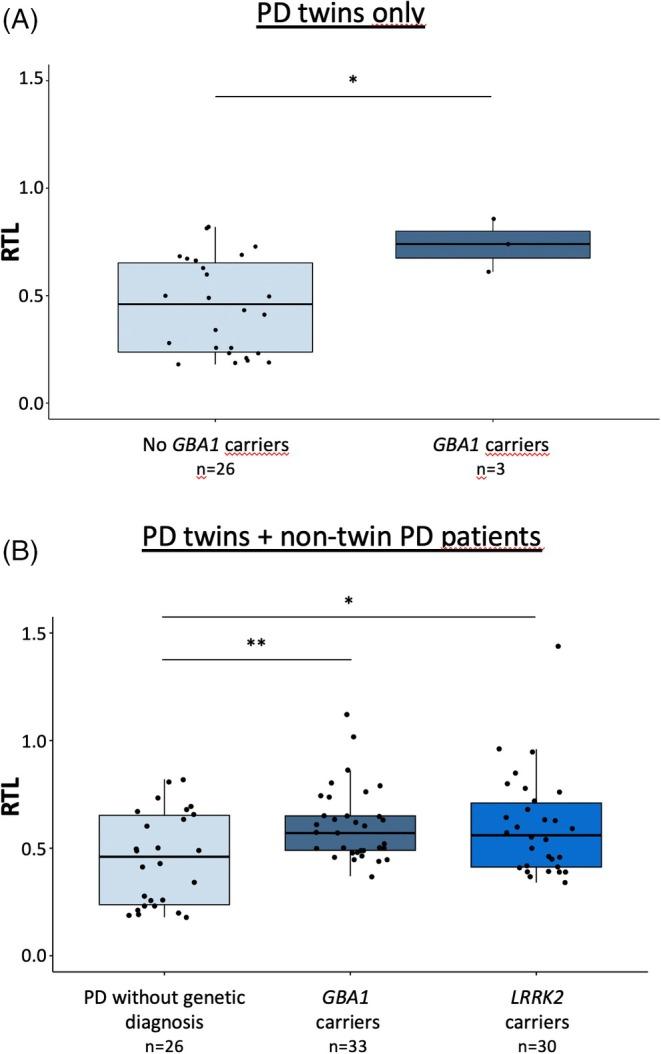
No significant difference in RTL was observed between PD-affected twins and their healthy co-twins overall. However, twins with longer disease duration (≥8 years) showed a significant decline in RTL (0.90 ± 0.18 vs. 1.07 ± 0.24; P = 0.046), which was more pronounced with a 10-year disease duration cutoff (0.85 ± 0.18 vs. 1.06 ± 0.22; P = 0.015). GBA1-mutated PD twins exhibited significantly longer RTL than non-mutated twins, a result replicated in non-twin GBA1 carriers and extended to LRRK2 carriers.
CONCLUSIONS
Our findings suggest that aging and cellular senescence primarily drive sporadic PD, whereas genetic forms are linked to disruptions in cellular pathways, such as lysosomal or mitochondrial functions. These insights highlight the role of genetics in telomere dynamics in PD. © 2025 The Author(s). Movement Disorders published by Wiley Periodicals LLC on behalf of International Parkinson and Movement Disorder Society.
背景
帕金森病(PD)是环境、遗传和衰老因素之间复杂相互作用的结果。端粒可确保染色体稳定性,会随着细胞分裂自然缩短,导致衰老和细胞衰老。然而,关于PD中端粒长度(TL)的研究结果并不一致。
目的
本研究旨在使用独特的PD不一致性同卵双胞胎设计来探索TL与PD之间的关系,该设计可最大限度地减少年龄、性别和遗传背景等混杂因素。我们还研究了PD相关基因突变对TL的影响。
方法
我们分析了29对PD不一致的同卵双胞胎血液样本中的相对端粒长度(RTL)。数据按病程分层,我们研究了基因变异(GBA1和LRRK2)对RTL的影响。
结果
总体而言,受PD影响的双胞胎与其健康的双胞胎同胞之间在RTL上未观察到显著差异。然而,病程较长(≥8年)的双胞胎显示RTL显著下降(0.90±0.18对1.07±0.24;P = 0.046),在病程截止为10年时更为明显(0.85±0.18对1.06±0.22;P = 0.015)。GBA1突变的PD双胞胎的RTL显著长于未突变的双胞胎,这一结果在非双胞胎GBA1携带者中得到重复,并扩展到LRRK2携带者。
结论
我们的研究结果表明,衰老和细胞衰老主要驱动散发性PD,而遗传形式与细胞途径的破坏有关,如溶酶体或线粒体功能。这些见解突出了遗传学在PD端粒动力学中的作用。© 2025作者。由Wiley Periodicals LLC代表国际帕金森和运动障碍协会出版的《运动障碍》。

 Zotero 插件