
多巴胺D受体激动剂可消除神经内分泌肿瘤血管生成,以抑制化疗难治性小细胞肺癌的进展。
Dopamine D receptor agonists abrogate neuroendocrine tumour angiogenesis to inhibit chemotherapy-refractory small cell lung cancer progression.
作者信息
Alam Sk Kayum, Pandit Anuradha, Wang Li, Mortazavi Farsani Seyedeh Sahar, Thiele Britteny A, Manoj Parvathy, Aubry Marie Christine, Verma Vivek, Rudin Charles M, Lo Ying-Chun, Hoeppner Luke H
机构信息
The Hormel Institute, University of Minnesota, Austin, MN, USA.
Division of Anatomic Pathology, Department of Laboratory Medicine and Pathology, Mayo Clinic, Rochester, MN, USA.
出版信息
Cell Death Dis. 2025 May 9;16(1):370. doi: 10.1038/s41419-025-07693-y.
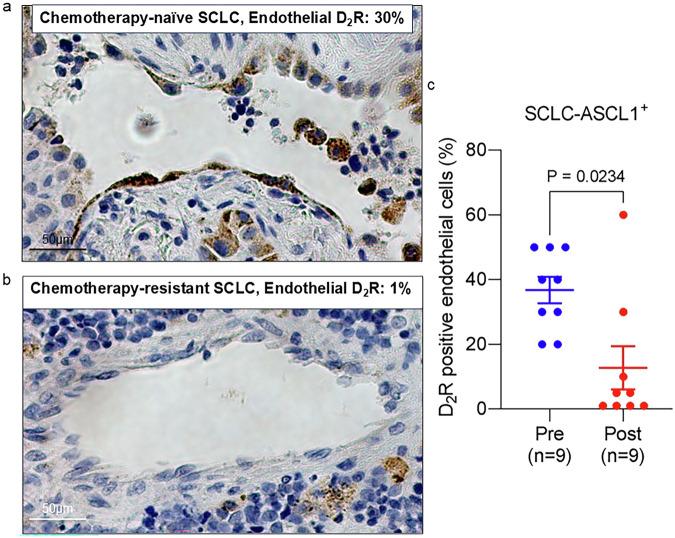
Small cell lung cancer (SCLC) is difficult to treat due to its aggressiveness, early metastasis, and rapid development of resistance to chemotherapeutic agents. Here, we show that treatment with a dopamine D receptor (DR) agonist reduces tumour angiogenesis in multiple in vivo xenograft models of human SCLC, thereby reducing SCLC progression. An FDA-approved DR agonist, cabergoline, also sensitized chemotherapy-resistant SCLC tumours to cisplatin and etoposide in patient-derived xenograft models of acquired chemoresistance in mice. Ex vivo, DR agonist treatment decreased tumour angiogenesis through increased apoptosis of tumour-associated endothelial cells, creating a less favourable tumour microenvironment that limited cancer cell proliferation. In paired SCLC patient-derived specimens, DR was expressed by tumour-associated endothelial cells obtained before treatment, but DR was downregulated in SCLC tumours that had acquired chemoresistance. DR agonist treatment of chemotherapy-resistant specimens restored expression of DR. Activation of dopamine signalling is thus a new strategy for inhibiting angiogenesis in SCLC and potentially for combatting chemotherapy-refractory SCLC progression.
小细胞肺癌(SCLC)因其侵袭性、早期转移以及对化疗药物迅速产生耐药性而难以治疗。在此,我们表明,在多种人SCLC体内异种移植模型中,用多巴胺D受体(DR)激动剂进行治疗可减少肿瘤血管生成,从而减少SCLC进展。一种经美国食品药品监督管理局(FDA)批准的DR激动剂卡麦角林,在小鼠获得性化疗耐药的患者来源异种移植模型中,也使化疗耐药的SCLC肿瘤对顺铂和依托泊苷敏感。在体外,DR激动剂治疗通过增加肿瘤相关内皮细胞的凋亡来减少肿瘤血管生成,从而营造出一个不利于癌细胞增殖的肿瘤微环境。在配对的SCLC患者来源标本中,治疗前获得的肿瘤相关内皮细胞表达DR,但在已获得化疗耐药性的SCLC肿瘤中DR表达下调。对化疗耐药标本进行DR激动剂治疗可恢复DR的表达。因此,激活多巴胺信号传导是抑制SCLC血管生成以及潜在对抗化疗难治性SCLC进展的一种新策略。


 Zotero 插件