
微量全血干血斑中内分泌蛋白的多重定量分析
Multiplex quantification of endocrine proteins in volumetric dried blood spots.
作者信息
Stauch William, Olausson Johan, Bendes Annika, Beck Olof, Schwenk Jochen M
机构信息
Science for Life Laboratory, Department of Protein Science, KTH Royal Institute of Technology, Stockholm, Sweden.
Department of Laboratory Medicine, Clinical Chemistry, Östersund Hospital, Östersund, Sweden.
出版信息
Clin Proteomics. 2025 May 9;22(1):18. doi: 10.1186/s12014-025-09539-3.
BACKGROUND
Circulating proteins are routinely quantified from liquid biopsies to deduce health and disease. Among these are endocrine protein hormones, which regulate human growth, development, metabolism, and reproduction. Most commonly, these proteins are analyzed in plasma or serum prepared from venous blood draws. Recently, devices for quantitative capillary sampling from a finger prick have emerged, but their utility for clinical testing remains to be explored.
METHODS
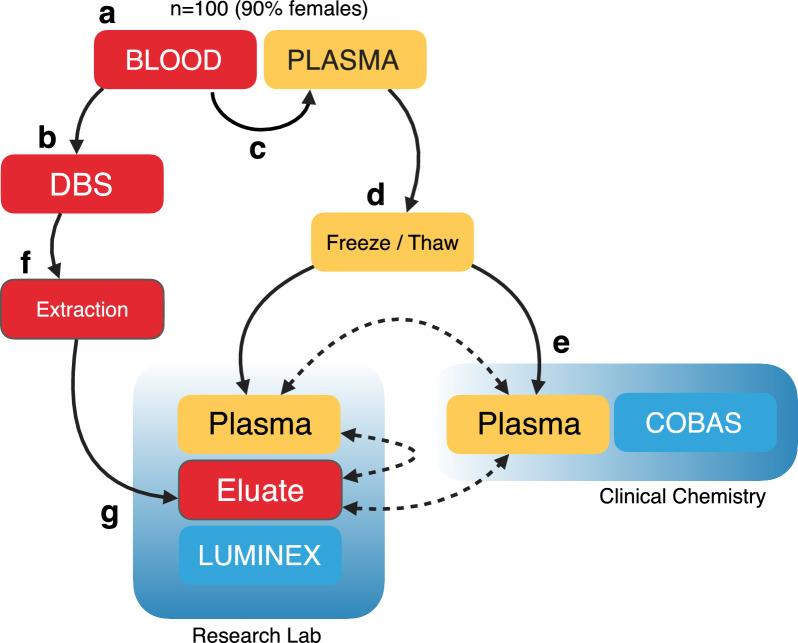
To study the analytical capabilities of quantitative dried blood spots (qDBS), we quantified the luteinizing hormone subunit beta (LHB), follicle-stimulating hormone subunit beta (FSHB), thyroid-stimulating hormone subunit beta (TSHB), prolactin (PRL), and growth hormone 1 (GH1) by multiplexed immunoassays. We determined the performance of the endocrine hormone assays in paired qDBS and EDTA plasma samples from 100 donors (90% females) aged 4 to 78. Lastly, we compared the protein levels with those from an accredited clinical chemistry laboratory.
RESULTS
The multiplexed analysis showed precise protein quantifications in qDBS (mean CV = 8.3%), high concordance with plasma levels (r = 0.88 to 0.99), and accuracy being matrix- and protein-dependent (recovery: 80-225%). Using the current protocol and sample dilutions, reported protein concentrations were 1.2 to 7.5 times higher in plasma than in qDBS eluates. Concentrations from multiplexed plasma assays agreed with the clinical data (r = 0.87 to 0.99) and decreased slightly when comparing clinical plasma data with multiplexed qDBS assays (r = 0.76 to 0.98). Significant increases in age-related FSHB and LHB levels were observed in females in all specimens and assays (p < 0.01).
CONCLUSIONS
This study shows the suitability of modern qDBS devices for quantifying clinically informative proteins in multiplexed assays and highlights the need for future work on specimen-specific optimization and standards. Volumetric DBS sampling offers new routines for accurate protein quantification for precision medicine.
背景
循环蛋白通常从液体活检中进行定量分析,以推断健康和疾病状况。其中包括内分泌蛋白激素,它们调节人体的生长、发育、新陈代谢和生殖。最常见的是,这些蛋白质在由静脉血抽取制备的血浆或血清中进行分析。最近,出现了用于手指针刺定量毛细血管采样的设备,但其在临床检测中的实用性仍有待探索。
方法
为了研究定量干血斑(qDBS)的分析能力,我们通过多重免疫测定法定量了促黄体生成素β亚基(LHB)、促卵泡生成素β亚基(FSHB)、促甲状腺激素β亚基(TSHB)、催乳素(PRL)和生长激素1(GH1)。我们测定了来自100名年龄在4至78岁的捐赠者(90%为女性)的配对qDBS和EDTA血浆样本中内分泌激素测定的性能。最后,我们将蛋白质水平与一家认可的临床化学实验室的水平进行了比较。
结果
多重分析显示qDBS中蛋白质定量精确(平均CV = 8.3%),与血浆水平高度一致(r = 0.88至0.99),准确性取决于基质和蛋白质(回收率:80 - 225%)。使用当前方案和样本稀释,报告的血浆中蛋白质浓度比qDBS洗脱液中高1.2至7.5倍。多重血浆测定的浓度与临床数据一致(r = 0.87至0.99),当将临床血浆数据与多重qDBS测定进行比较时略有下降(r = 0.76至0.98)。在所有标本和测定中,女性中与年龄相关的FSHB和LHB水平均显著升高(p < 0.01)。
结论
本研究表明现代qDBS设备适用于在多重测定中定量具有临床信息价值的蛋白质,并强调了未来针对标本特异性优化和标准开展工作的必要性。体积干血斑采样为精准医学中准确的蛋白质定量提供了新的常规方法。



 Zotero 插件