
揭示高血压和糖尿病双重流行趋势:对印度流行病学转型区特定性别患病率、风险及热点地区的横断面分析
Unveiling the twin epidemics of hypertension and diabetes: a cross-sectional analysis of sex-specific prevalence, risk, and hotspots in India's epidemiological transition zones.
作者信息
Singh Nishikant, Shukla Sudheer Kumar, John Pratheeba, Bajpai Rimjhim, Chugh Prince, Sengupta Rituparna, Pushkar Ritesh Ranjan, Yadav Nishant, Singh Navin, Sadanandan Rajeev
机构信息
Health Systems Transformation Platform, New Delhi, India.
PopulationCouncil Consulting Pvt. Ltd, New Delhi, India.
出版信息
BMC Public Health. 2025 May 10;25(1):1734. doi: 10.1186/s12889-025-22983-y.
BACKGROUND
The prevalence of hypertension and diabetes, which often coexist and significantly contribute to the burden of noncommunicable diseases (NCDs), is increasing in India. This study examines the sex-stratified prevalence, coexistence, and bidirectional risks of hypertension and diabetes across states with varying epidemiological transition levels (ETLs) and identifies high-burden hotspots.
METHODS
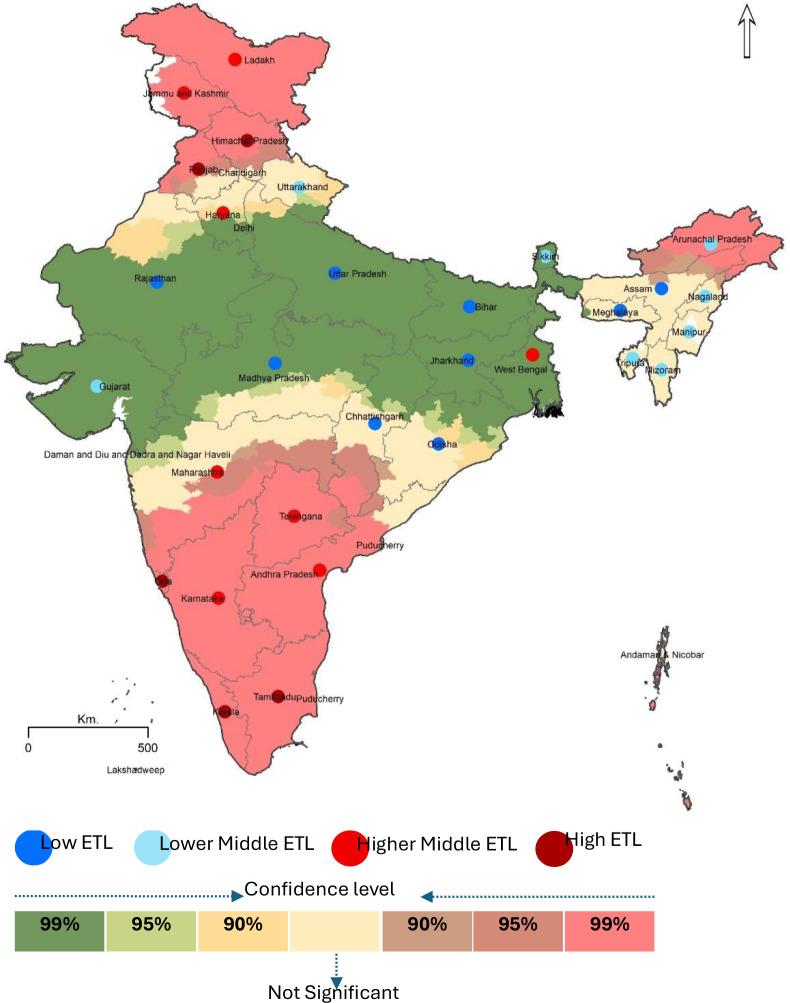
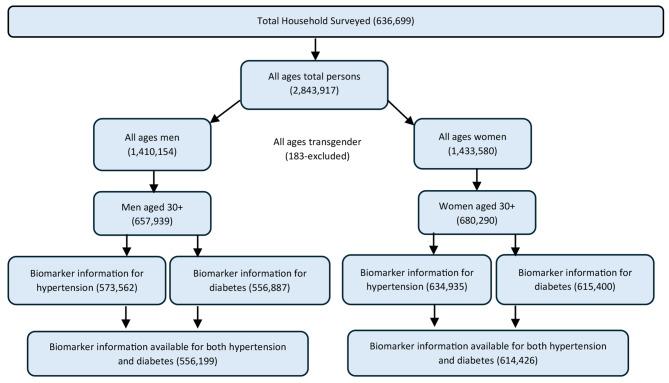
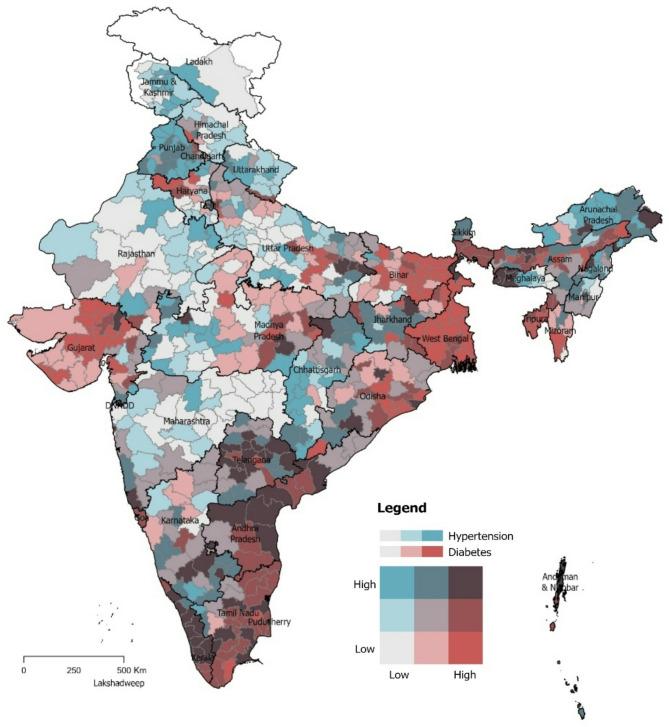
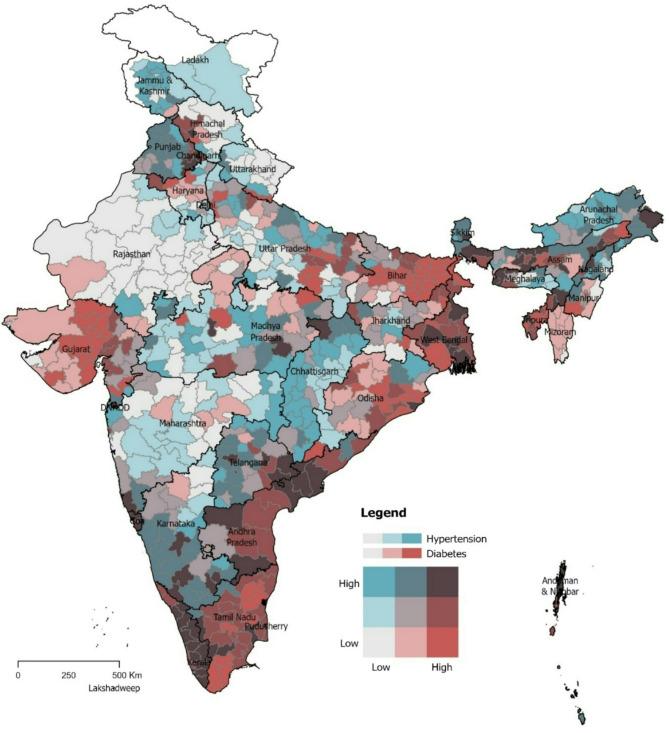
This study analysed data from the fifth round of the National Family Health Survey, covering 614,426 women and 556,199 men aged 30 years and above, with biomarker information on both diabetes and hypertension. The age-standardized prevalence was estimated, and adjusted risk ratios (ARRs) were obtained on multivariate logit scale. Bivariate maps, spatial autocorrelation and hotspot analyses were conducted using ArcGIS Pro to identify geographic clusters associated with twin epidemics.
RESULTS
Individuals diagnosed with hypertension or diabetes were, on average, nearly a decade older than those without. Hypertension prevalence was 30.3% (95%CI:30.14-30.48) among men and 28.6% (95%CI:28.47-28.79) among women, whereas diabetes prevalence was at 19.7% (95%CI:19.58-19.88) in men and 17.4% (95%CI:17.22-17.50) in women. Among individuals with diabetes, 43.1% (95%CI:42.67-43.53) of men and 43.9% (95%CI:43.48-44.36) of women had hypertension, whereas 28.1% (95%CI:27.75-28.37) of hypertensive men and 26.6% (95%CI:26.33-26.93) of hypertensive women were diabetic. Hotspots for twin epidemics were identified in coastal regions, including the southern states with high ETLs, as well as the northern states with high-ETLs and the country's northeastern region. ARR estimates revealed that the risk of hypertension among individuals with diabetes was 39% higher (95%CI:1.38-1.40) in men and 41% higher (95%CI:1.39-1.42) in women than in individuals without diabetes. Similarly, the risk of diabetes among individuals with hypertension was 51% higher (95%CI:1.49-1.52) in men and 55% higher (95%CI:1.53-1.57) in women than in individuals without hypertension.
CONCLUSION
Our findings highlight the progressive nature of the twin epidemics of diabetes and hypertension, with an increased risk of onset associated with advanced age. The presence of one condition substantially elevates the likelihood of developing the other, highlighting their bidirectional relationship. Achieving Sustainable Development Goal target 3.4 requires addressing these intersecting epidemics as a unified entity for effective management. Targeted interventions should prioritise high-burden hotspots for integrated care strategies to mitigate the twin epidemics of diabetes and hypertension.
背景
高血压和糖尿病的患病率在印度呈上升趋势,这两种疾病常同时存在,且对非传染性疾病(NCDs)负担有显著影响。本研究调查了不同流行病学转变水平(ETLs)的各邦中高血压和糖尿病按性别分层的患病率、共存情况及双向风险,并确定高负担热点地区。
方法
本研究分析了第五轮全国家庭健康调查的数据,涵盖614426名30岁及以上女性和556199名30岁及以上男性,这些人有关于糖尿病和高血压的生物标志物信息。估计年龄标准化患病率,并在多变量逻辑尺度上获得调整风险比(ARRs)。使用ArcGIS Pro进行双变量地图、空间自相关和热点分析,以识别与这两种流行病相关的地理集群。
结果
被诊断患有高血压或糖尿病的个体平均比未患病个体大近十岁。男性高血压患病率为30.3%(95%CI:30.14 - 30.48),女性为28.6%(95%CI:28.47 - 28.79);男性糖尿病患病率为19.7%(95%CI:19.58 - 19.88),女性为17.4%(95%CI:17.22 - 17.50)。在糖尿病患者中,43.1%(95%CI:42.67 - 43.53)的男性和43.9%(95%CI:43.48 - 44.36)的女性患有高血压;而在高血压男性中,28.1%(95%CI:27.75 - 28.37)患有糖尿病,高血压女性中这一比例为26.6%(95%CI:26.33 - 26.93)。在沿海地区发现了这两种流行病的热点地区,包括ETLs较高的南部各邦,以及ETLs较高的北部各邦和该国东北地区。ARR估计显示,糖尿病患者中男性患高血压的风险比无糖尿病者高39%(95%CI:1.38 - 1.40),女性高41%(95%CI:1.39 - 1.42)。同样,高血压患者中男性患糖尿病的风险比无高血压者高51%(95%CI:1.49 - 1.52),女性高55%(95%CI:1.53 - 1.57)。
结论
我们的研究结果突出了糖尿病和高血压这两种流行病的渐进性,发病风险随年龄增长而增加。一种疾病的存在会大幅增加患另一种疾病的可能性,凸显了它们的双向关系。实现可持续发展目标3.4需要将这些交叉流行疾病作为一个统一整体来应对,以进行有效管理。针对性干预应优先考虑高负担热点地区,制定综合护理策略,以减轻糖尿病和高血压这两种流行病的影响。



 Zotero 插件