
头皮针治疗中风的有效性及其与传统针刺的比较:系统评价概述与最新证据
Effectiveness of scalp acupuncture and comparison with traditional acupuncture for stroke: an overview of systematic reviews and updated evidence.
作者信息
Park Sun-Young, Heo In, Hwang Man-Suk, Hwang Eui-Hyoung, Shin Byung-Cheul
机构信息
School of Korean Medicine, Pusan National University, Yangsan, Republic of Korea.
Department of Korean Medicine Rehabilitation, Pusan National University Korean Medicine Hospital, Yangsan, Republic of Korea.
出版信息
Syst Rev. 2025 May 10;14(1):108. doi: 10.1186/s13643-025-02819-x.
BACKGROUND
Stroke recovery is a critical global-health priority; there is growing interest alternative therapies in scalp acupuncture (SA) to overcome the limitations of conventional treatments and improve outcomes. This study provides an overview of systematic reviews to evaluate the evidence on the effectiveness and safety of SA and to compare its therapeutic potential with traditional acupuncture (TA).
METHODS
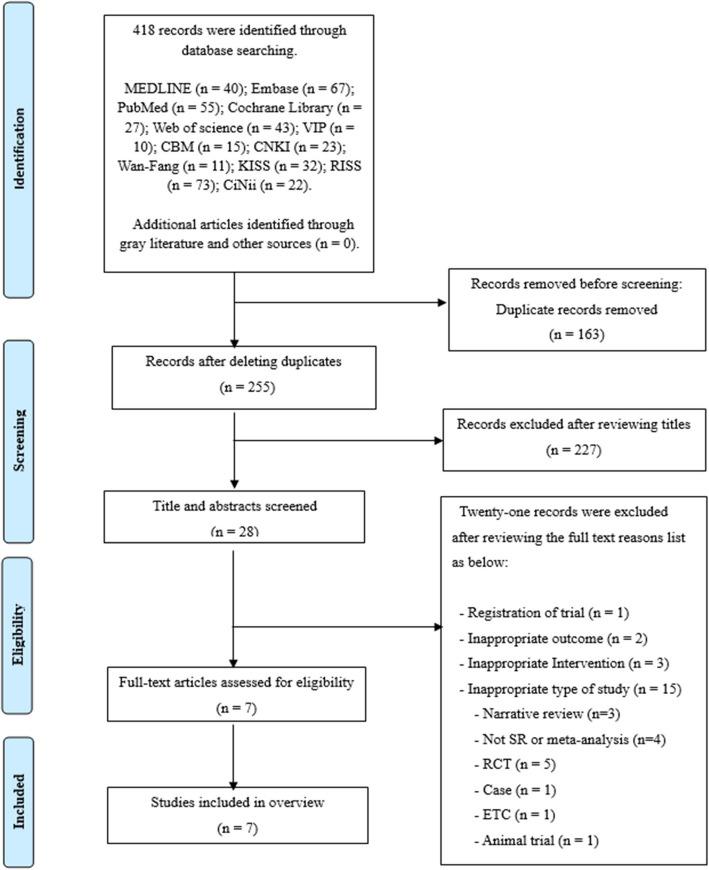
A systematic search of 12 databases was conducted to identify systematic reviews and meta-analyses, completed on September 30, 2023, was performed without language restrictions. Selection criteria included adult stroke patients treated with SA, focusing on comparisons of effectiveness and safety in neurological deficits, motor function, disability, and total efficacy rate. Two reviewers independently screened studies and assessed methodological quality using AMSTAR-2, ROBIS, PRISMA-A, and GRADE frameworks. Data were synthesized to compare SA and TA for stroke outcomes, using total searched SA studies and TA data from the Cochrane review, followed by an analysis of high-quality studies to enhance evidence reliability.
RESULTS
After overviewing seven systematic reviews, the certainty of evidence supporting the standalone effectiveness and safety of SA remains low owing to methodological shortcomings. However, SA showed a greater effect size in the neurological deficits (-0.96 vs -0.53) in total studies and high-quality studies (-0.92 vs -0.48). Regarding motor function, SA had a higher effect size in total studies (0.94 vs 0.70), but TA outperformed it in high-quality studies (0.39 vs 0.82). Regarding disability outcomes, TA had a slightly larger effect size in total studies (1.27 vs 1.06), whereas SA surpassed it in high-quality studies (1.65 vs. 1.16).
CONCLUSIONS
This overview highlights the potential of SA as an effective alternative therapy for stroke recovery, with high-quality studies demonstrating its effectiveness in improving neurological deficits and disability outcomes. This work guides clinicians on integrating SA for stroke recovery and offers insights for improving public health rehabilitation strategies. Despite limitations in the overall evidence owing to methodological shortcomings, the positive results from high-quality studies support SA as a possible approach for stroke recovery, underscoring the need for further rigorous research to strengthen its clinical application.
背景
中风康复是全球卫生领域的一项关键优先事项;人们越来越关注头皮针(SA)这种替代疗法,以克服传统治疗方法的局限性并改善治疗效果。本研究对系统评价进行了综述,以评估头皮针有效性和安全性的证据,并将其治疗潜力与传统针灸(TA)进行比较。
方法
对12个数据库进行了系统检索,以识别系统评价和荟萃分析,检索于2023年9月30日完成,不受语言限制。选择标准包括接受头皮针治疗的成年中风患者,重点是比较神经功能缺损、运动功能、残疾和总有效率方面的有效性和安全性。两名评价者独立筛选研究,并使用AMSTAR-2、ROBIS、PRISMA-A和GRADE框架评估方法学质量。综合数据以比较头皮针和传统针灸对中风结局的影响,使用检索到的所有头皮针研究以及来自Cochrane综述的传统针灸数据,随后对高质量研究进行分析以提高证据的可靠性。
结果
在综述了七项系统评价后,由于方法学上的缺陷,支持头皮针单独有效性和安全性的证据确定性仍然较低。然而,在所有研究和高质量研究中,头皮针在神经功能缺损方面的效应量更大(分别为-0.96和-0.53,-0.92和-0.48)。在运动功能方面,头皮针在所有研究中的效应量较高(0.94和0.70),但在高质量研究中传统针灸表现更优(0.39和0.82)。在残疾结局方面,传统针灸在所有研究中的效应量略大(1.27和1.06),而头皮针在高质量研究中超过了它(1.65和1.16)。
结论
本综述强调了头皮针作为中风康复有效替代疗法的潜力,高质量研究证明其在改善神经功能缺损和残疾结局方面的有效性。这项工作为临床医生将头皮针纳入中风康复提供了指导,并为改善公共卫生康复策略提供了见解。尽管由于方法学缺陷,整体证据存在局限性,但高质量研究的积极结果支持头皮针作为中风康复的一种可能方法,强调需要进一步进行严格研究以加强其临床应用。
 Zotero 插件