
全氟和多氟烷基物质暴露与代谢综合征之间的年龄特异性关联:一项横断面研究。
Age-specific associations between per- and polyfluoroalkyl substances exposure and metabolic syndrome: a cross-sectional study.
作者信息
Lin Luanxun, Lin Xiaoqin, Chang Shuaidan, Xing Yiqing, Zhou Tao, Yang Chunxue
机构信息
School of Public Health (Shenzhen), Sun Yat-sen University, Gongchang RD No. 66, Shenzhen, Guangdong, 518107, PR China.
出版信息
Lipids Health Dis. 2025 May 10;24(1):174. doi: 10.1186/s12944-025-02582-x.
BACKGROUND
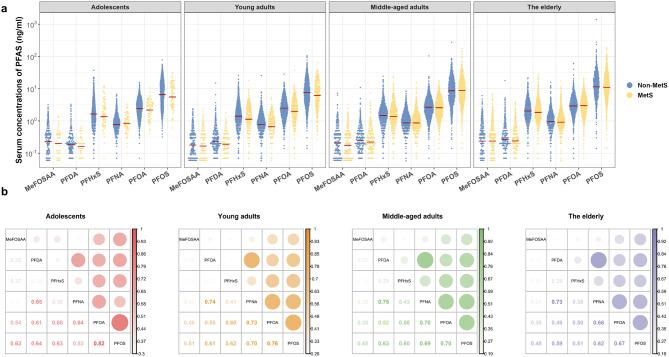
The widespread presence of per-and polyfluoroalkyl substances (PFAS) has raised global health concerns. This study aims to determine the age-specific relationships of PFAS compounds with metabolic syndrome (MetS) and its components.
METHODS
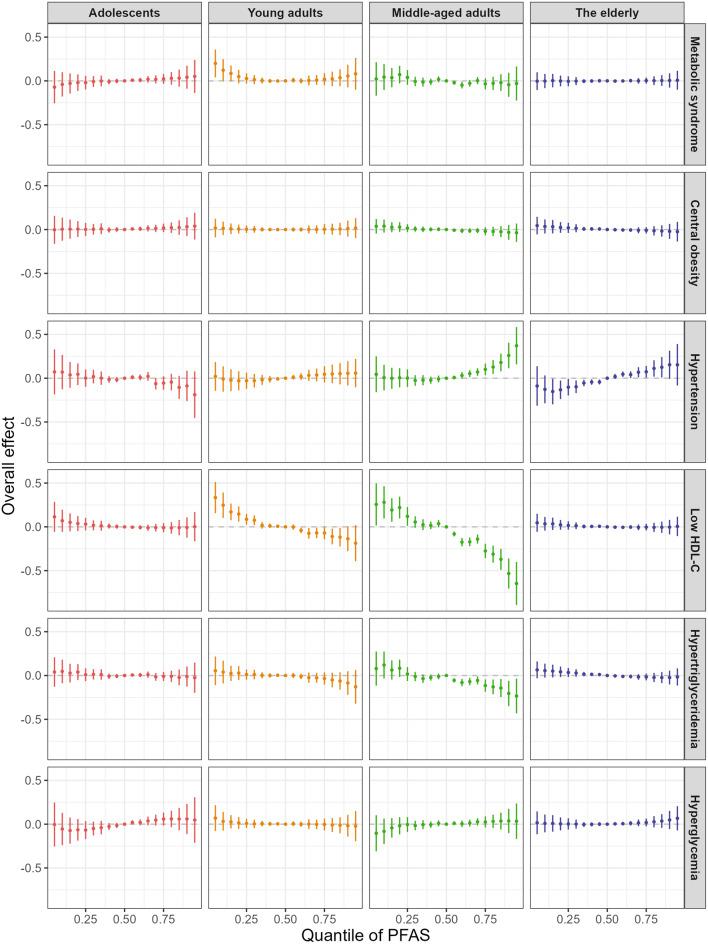
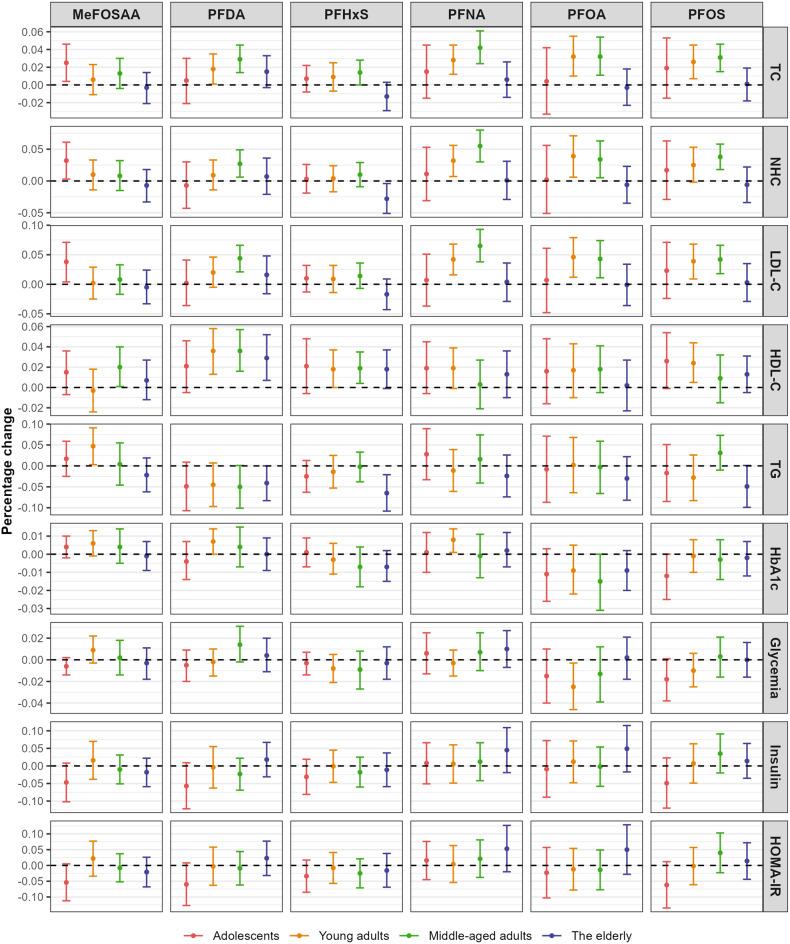
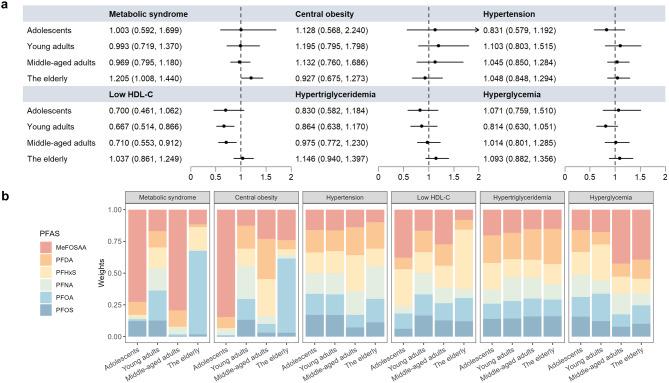
We used data from the National Health and Nutrition Examination Survey (NHANES) in 2003-2018. Modified Poisson regression was employed to estimate associations between individual PFAS compounds and prevalence of MetS, as well as its components. Multiple linear regression analyses were performed to examine the associations between PFAS congeners and metabolic markers, including lipid and glucose homeostasis traits. Additionally, weighted quantile sum (WQS) regression and Bayesian kernel machine regression (BKMR) models were conducted to investigate the joint effects of PFAS mixtures on the prevalence of MetS and its components across different age groups.
RESULTS
A total of 5850 participants were included for analysis. In the Modified Poisson regression model, ln-transformed perfluorononanoic acid (PFNA) level was positively correlated with MetS prevalence in adolescents (prevalence ratio [PR] = 1.42; 95% CI: 1.01-1.99). Conversely, ln-transformed perfluorohexanesulfonic acid (PFHxS) and ln-transformed 2-(N-Methylperfluorooctane sulfonamido) acetic acid (MeFOSAA) were negatively associated with the risks of MetS in young adults (PR = 0.86, 95% CI: 0.76-0.98) and middle-aged adults (PR = 0.88, 95% CI: 0.79-0.98), respectively. Notably, individual PFAS exposure was positively associated with levels of total cholesterol, low-density lipoprotein, non-high-density lipoprotein, and high-density lipoprotein in young and middle-aged adults. However, overall effect analyses using WQS and BKMR showed no significant associations of PFAS mixture with MetS in any age group. Nonetheless, in middle-aged adults, PFAS mixture was adversely correlated with hypertriglyceridemia and positively linked to a greater risk of hypertension and increased high-density lipoprotein cholesterol levels.
CONCLUSIONS
Our study highlighted the complex relationships between PFAS exposure and the risks of MetS and its components across different age groups. Co-exposure to PFAS was particularly linked to dyslipidemia in young and middle-aged adults. Prospective studies are needed for better comprehension of the causative impact of PFAS on the risks of MetS.
背景
全氟和多氟烷基物质(PFAS)的广泛存在引发了全球对健康的关注。本研究旨在确定PFAS化合物与代谢综合征(MetS)及其组分之间的年龄特异性关系。
方法
我们使用了2003 - 2018年美国国家健康与营养检查调查(NHANES)的数据。采用修正泊松回归来估计个体PFAS化合物与MetS患病率及其组分之间的关联。进行多元线性回归分析以检验PFAS同系物与代谢标志物之间的关联,包括脂质和葡萄糖稳态特征。此外,进行加权分位数和(WQS)回归以及贝叶斯核机器回归(BKMR)模型,以研究PFAS混合物对不同年龄组MetS患病率及其组分的联合影响。
结果
共纳入5850名参与者进行分析。在修正泊松回归模型中,ln转换后的全氟壬酸(PFNA)水平与青少年的MetS患病率呈正相关(患病率比[PR] = 1.42;95%置信区间:1.01 - 1.99)。相反,ln转换后的全氟己烷磺酸(PFHxS)和ln转换后的2 -(N - 甲基全氟辛烷磺酰胺基)乙酸(MeFOSAA)分别与年轻人(PR = 0.86,95%置信区间:0.76 - 0.98)和中年成年人(PR = 0.88,95%置信区间:0.79 - 0.98)的MetS风险呈负相关。值得注意的是,个体PFAS暴露与年轻人和中年成年人的总胆固醇、低密度脂蛋白、非高密度脂蛋白和高密度脂蛋白水平呈正相关。然而,使用WQS和BKMR进行的总体效应分析表明,PFAS混合物与任何年龄组的MetS均无显著关联。尽管如此,在中年成年人中,PFAS混合物与高甘油三酯血症呈负相关,与高血压风险增加和高密度脂蛋白胆固醇水平升高呈正相关。
结论
我们的研究强调了PFAS暴露与不同年龄组MetS风险及其组分之间的复杂关系。PFAS共同暴露尤其与年轻人和中年成年人的血脂异常有关。需要进行前瞻性研究以更好地理解PFAS对MetS风险的因果影响。


 Zotero 插件