
衰老、多种疾病并存与生活质量:一项基于印度纵向衰老研究的中介分析
Ageing, multimorbidity, and quality of life: a mediation analysis using longitudinal ageing study in India.
作者信息
Singh Bharti, Kumar Ajay
机构信息
Department of Survey Research and Data Analytics, International Institute for Population Sciences (IIPS), Mumbai, India.
Department of Biostatistics and Epidemiology, International Institute for Population Sciences (IIPS), Mumbai, India.
出版信息
Front Public Health. 2025 Apr 25;13:1562479. doi: 10.3389/fpubh.2025.1562479. eCollection 2025.
BACKGROUND
The ageing population in India is growing rapidly, but the decline in healthy life expectancy is more pronounced. This trend has been compounded and constituted by poor quality of life (QoL), with the salient underlying role of multimorbidity as the leading risk factor. This study primarily aimed to assess the intermediating role of multimorbidity as the risk factor for exogenous socioeconomic and demographic factors on QoL.
METHODS
This study used data from 73,396 individuals aged 45 years and above from the Longitudinal Ageing Study in India (LASI), Wave - 1, 2017-18. Multimorbidity was defined as the simultaneous existence of two or more chronic conditions in an individual. The QoL score was constructed using Principal Component Analysis (PCA) by utilizing 21 factors under six domains (physical health, psychological health, social relationship, environmental satisfaction, life satisfaction and general health), with the composite QoL score ranging from 0 to 100. Further, the Structural equation model (SEM) was used to assess the role of multimorbidity as the intermediating risk factor for exogenous factors on QoL.
RESULTS
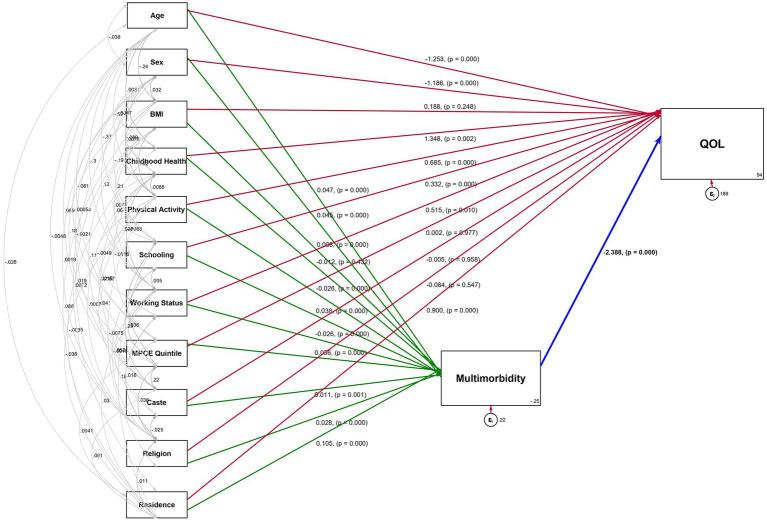
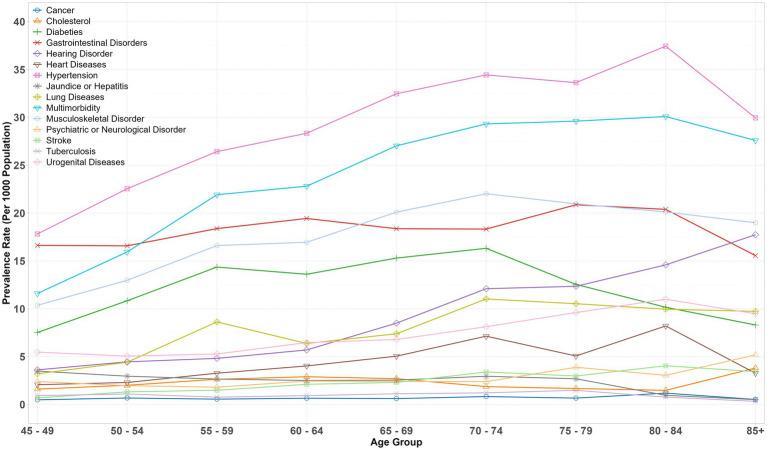
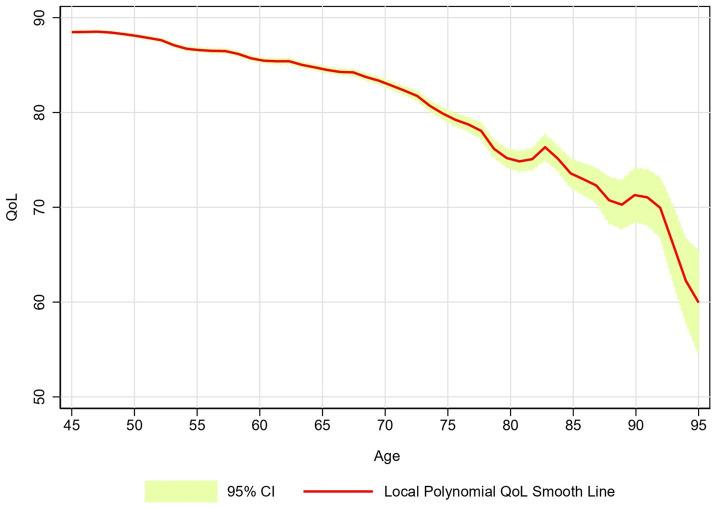
Distributions of morbidities burden were skewed toward non-communicable diseases (NCDs) and sequentially escalated multimorbidity burden was observed among the oldest of old age groups. After the age of 75, there was a steep decline in the gradient of QoL score. The SEM results showed a substantial rise in multimorbidity burden leading to poor QoL with a magnitude of = -2.39, < 0.001. Age and sex of the respondents exhibited a significant negative impact on QoL, impacting it directly ( = -1.25; = -1.19) as well as indirectly through multimorbidity ( = -0.11). In contrast, childhood health demonstrated a solely direct impact on QoL, with no significant indirect pathway through multimorbidity. This study further revealed that urban residence had a pronounced positive direct effect on QoL ( = 0.9, < 0.001).
CONCLUSION
This study underscores the role of multimorbidity as a key mediator between socioeconomic and demographic factors on QoL among older adults in India. With the increasing prevalence of multimorbidity, policies should prioritize integrated geriatric healthcare services. Strengthening healthcare for early screening and affordable chronic disease management is essential.
背景
印度的老年人口正在迅速增长,但健康预期寿命的下降更为明显。这种趋势因生活质量(QoL)低下而加剧并形成,其中多重疾病作为主要风险因素起着显著的潜在作用。本研究主要旨在评估多重疾病作为外源性社会经济和人口因素对生活质量的风险因素的中介作用。
方法
本研究使用了来自印度纵向老龄化研究(LASI)2017 - 18年第1波的73396名45岁及以上个体的数据。多重疾病被定义为个体同时存在两种或更多种慢性病。生活质量得分通过主成分分析(PCA)构建,利用六个领域(身体健康、心理健康、社会关系、环境满意度、生活满意度和总体健康)下的21个因素,综合生活质量得分范围为0至100。此外,结构方程模型(SEM)用于评估多重疾病作为外源性因素对生活质量的中介风险因素的作用。
结果
疾病负担分布向非传染性疾病(NCDs)倾斜,并且在最年长的年龄组中观察到多重疾病负担依次上升。75岁以后,生活质量得分梯度急剧下降。结构方程模型结果显示,多重疾病负担大幅上升导致生活质量变差,幅度为 = -2.39, < 0.001。受访者的年龄和性别对生活质量表现出显著的负面影响,直接影响( = -1.25; = -1.19)以及通过多重疾病间接影响( = -0.11)。相比之下,儿童期健康仅对生活质量有直接影响,没有通过多重疾病的显著间接途径。本研究进一步表明,城市居住对生活质量有显著的正向直接影响( = 0.9, < 0.001)。
结论
本研究强调了多重疾病作为印度老年人社会经济和人口因素对生活质量的关键中介作用。随着多重疾病患病率的增加,政策应优先考虑综合老年医疗保健服务。加强早期筛查和负担得起的慢性病管理的医疗保健至关重要。
 Zotero 插件