
≥50岁美国成年人复合膳食抗氧化指数与白内障之间的关联:一项基于2003 - 2008年美国国家健康与营养检查调查的横断面研究
Association between composite dietary antioxidant index and cataract in American adults aged ≥50 years: A cross-sectional study from NHANES 2003-2008.
作者信息
Zhang Quyan, Xia Xiaobo
机构信息
Eye Center of Xiangya Hospital, Central South University, Changsha, Hunan, China.
Hunan Key Laboratory of Ophthalmology, Central South University, Changsha, Hunan, China.
出版信息
Medicine (Baltimore). 2025 May 9;104(19):e42425. doi: 10.1097/MD.0000000000042425.
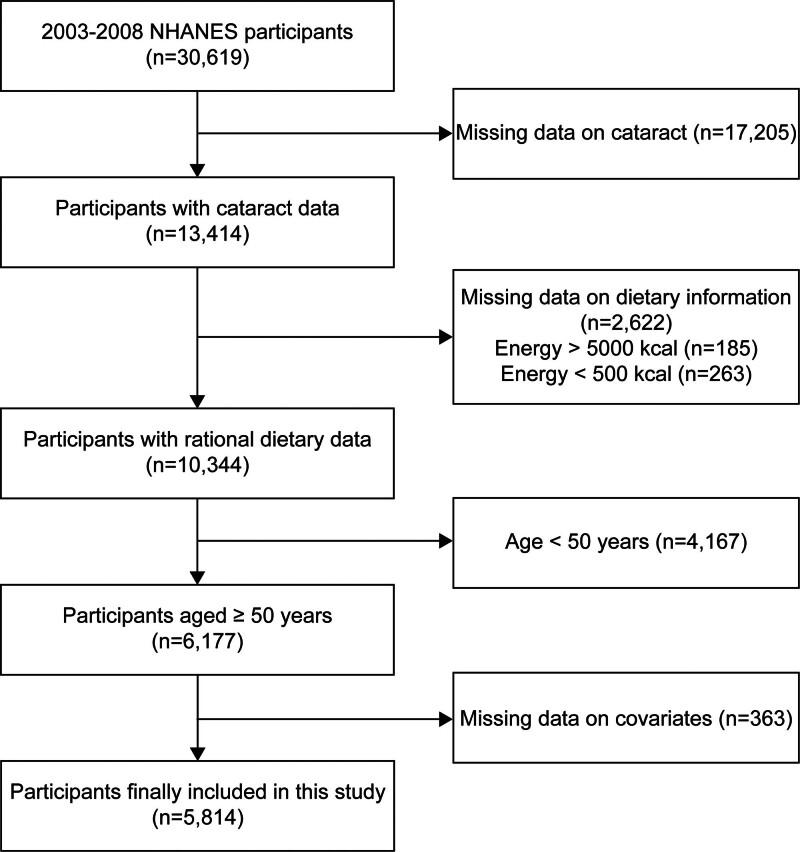
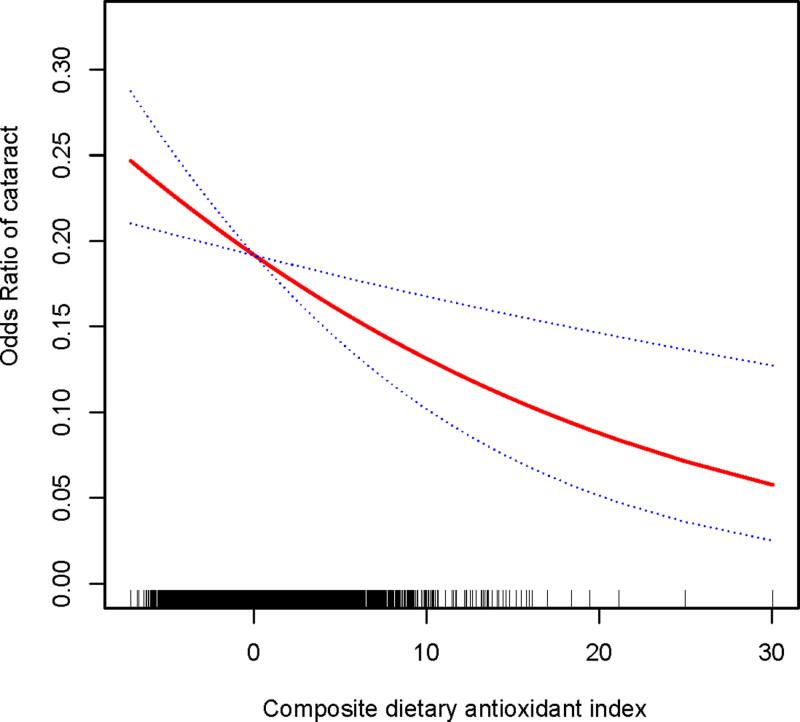
Oxidative stress is one of the crucial pathogeneses of cataract. The composite dietary antioxidant index (CDAI) represents the antioxidant capacity of one's diet. The aim of this study was to explore the association between the CDAI and cataract. The data were obtained from the National Health and Nutrition Examination Survey 2003 to 2008. A weighted multiple logistic regression, generalized weighted models, and smoothed fitted curves were performed to investigate the association between the CDAI and cataract. A total of 5814 participants aged ≥50 years with complete data were included in the study. According to the fully adjusted model, the odds ratio (95% confidence interval) for the association between the CDAI and cataract was 0.95 (0.93, 0.98). After dividing continuous CDAI into tertiles, consistent negative associations between CDAI and cataract were observed in the highest tertile compared to the lowest tertile (odds ratio = 0.77; 95% confidence interval, 0.62-0.95). The CDAI components (zinc, magnesium, vitamin A, and vitamin E) were also negatively associated with cataract odds in the fully adjusted model. Subgroup analysis showed inconsistent associations among subgroups, but no statistically significant interaction effects were found. This cross-sectional study revealed that a higher CDAI was associated with lower odds of cataract. These findings may contribute to cataract prevention through antioxidant dietary patterns.
氧化应激是白内障的关键发病机制之一。复合膳食抗氧化指数(CDAI)代表了一个人饮食的抗氧化能力。本研究的目的是探讨CDAI与白内障之间的关联。数据来源于2003年至2008年的美国国家健康与营养检查调查。采用加权多元逻辑回归、广义加权模型和平滑拟合曲线来研究CDAI与白内障之间的关联。共有5814名年龄≥50岁且数据完整的参与者纳入本研究。根据完全调整模型,CDAI与白内障之间关联的比值比(95%置信区间)为0.95(0.93,0.98)。将连续的CDAI分为三分位数后,与最低三分位数相比,在最高三分位数中观察到CDAI与白内障之间存在一致的负相关(比值比 = 0.77;95%置信区间,0.62 - 0.95)。在完全调整模型中,CDAI的组成成分(锌、镁、维生素A和维生素E)也与白内障患病几率呈负相关。亚组分析显示亚组间的关联不一致,但未发现具有统计学意义的交互作用。这项横断面研究表明,较高的CDAI与较低的白内障患病几率相关。这些发现可能有助于通过抗氧化饮食模式预防白内障。

 Zotero 插件