
PH8等位基因的自然变异改善了水稻的株型和耐寒性。
Natural Variation of PH8 Allele Improves Architecture and Cold Tolerance in Rice.
作者信息
Chen Cheng, Zhang Xia, Chen Jialin, Xu Mingjia, Zhao Weiying, Wang Yangkai, Chen Zhuo, Xiong Jiawei, Yuan Hua, Chen Weilan, Tu Bin, Li Ting, Kang Liangzhu, Tang Shiwen, Wang Yuping, Ma Bingtian, Li Shigui, Qin Peng
机构信息
Rice Research Institute, Sichuan Agricultural University, Chengdu, 611130, China.
Industrial Crop Research Institute, Sichuan Academy of Agricultural Science, Chengdu, 610300, China.
出版信息
Rice (N Y). 2025 May 13;18(1):35. doi: 10.1186/s12284-025-00793-5.
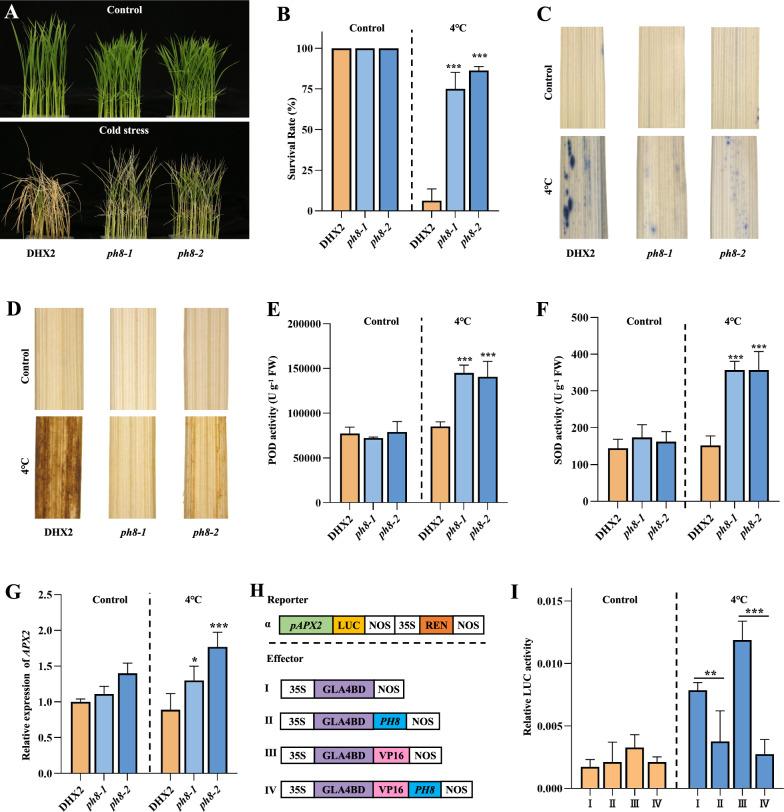
Empirical breeding efforts targeting cold tolerance and ideal plant architecture have significantly improved yield and facilitated the geographic expansion of japonica rice cultivation. However, the genetic drivers and underlying molecular mechanisms of these traits remain insufficiently understood. Here, we identify Plant Height 8 (PH8) as a key gene regulating both plant stature and cold stress response in rice. Genome wide association analysis (GWAS), supported by functional validation, shows that loss of PH8 reduces plant height without affecting other agronomic traits. Notably, we found that PH8 also negatively regulates cold tolerance. A prevalent haplotype, PH8, exhibits reduced PH8 expression due to natural variation in its promoter region, resulting in shorter plants and enhanced cold tolerance. Selective sweep and geographic distribution analyses indicate that PH8 originated in high-latitude regions and underwent strong directional selection during modern japonica improvement. Functional assays demonstrate that PH8 enhances cold tolerance via improved reactive oxygen species (ROS) scavenging by repressing APX2, an antioxidant gene involved in ROS detoxification. Our findings reveal PH8 as a dual regulator of plant architecture and cold stress adaptation, and highlight PH8 as a historically selected allele that contributed to the climatic adaptation and geographical expansion of japonica rice.
针对耐寒性和理想株型的经验性育种工作显著提高了产量,并促进了粳稻种植的地理扩张。然而,这些性状的遗传驱动因素和潜在分子机制仍未得到充分了解。在这里,我们鉴定出株高8(PH8)是调控水稻株高和冷胁迫响应的关键基因。全基因组关联分析(GWAS)在功能验证的支持下表明,PH8缺失会降低株高而不影响其他农艺性状。值得注意的是,我们发现PH8也负向调控耐寒性。一种常见单倍型PH8,由于其启动子区域的自然变异而导致PH8表达降低,从而产生更矮的植株并增强耐寒性。选择性清除和地理分布分析表明,PH8起源于高纬度地区,并在现代粳稻改良过程中经历了强烈的定向选择。功能分析表明,PH8通过抑制APX2(一种参与活性氧解毒的抗氧化基因)来改善活性氧(ROS)清除,从而增强耐寒性。我们的研究结果揭示了PH8是植物株型和冷胁迫适应性的双重调节因子,并突出了PH8作为一个历史上被选择的等位基因,它有助于粳稻的气候适应和地理扩张。


 Zotero 插件