
不可切除肝细胞癌不同介入治疗策略的网状Meta分析
A network meta-analysis of different interventional treatment strategies for unresectable hepatocellular carcinoma.
作者信息
Le Xing-Yan, Feng Jun-Bang, Yu Xiao-Li, Li Sui-Li, Zhang Xiaocai, Li Jiaqing, Li Chuan-Ming
机构信息
Medical Imaging Department, Chongqing Emergency Medical Center, Chongqing University Central Hospital, School of Medicine, Chongqing University, No. 1 Jiankang Road, Chongqing, 400014, China.
Medical Imaging Department, The 956th Hospital of the Chinese People's Liberation Army, Xizang, China.
出版信息
BMC Gastroenterol. 2025 May 12;25(1):360. doi: 10.1186/s12876-025-03980-2.
BACKGROUND
The optimal clinical management of unresectable hepatocellular carcinoma (uHCC) is challenging for clinicians. Bayesian network meta-analysis was conducted to compare the efficacy and safety of different interventional strategies for uHCC.
METHODS
A systematic search was conducted in PubMed, Embase, the Cochrane Library, Web of Science, and CNKI databases. Bayesian network meta-analysis was applied to evaluate the disease control rate (DCR), 1-year survival rate and 2-year survival rate, as well as the incidence of serious adverse events associated with seven interventional strategies. Odds ratios (ORs) were estimated using pairwise and network meta-analysis with random effects. Treatment rankings utilized surface under the cumulative ranking curve (SUCRA), whereas heterogeneity was examined via I-square and meta-regression.
RESULTS
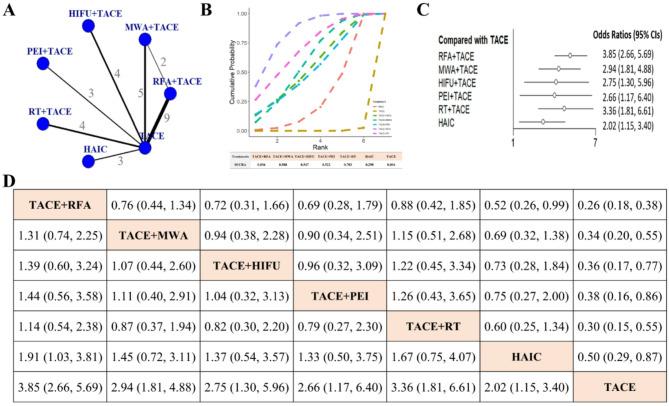
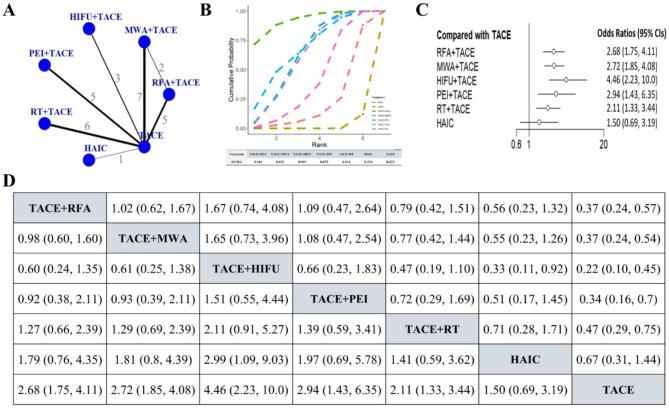
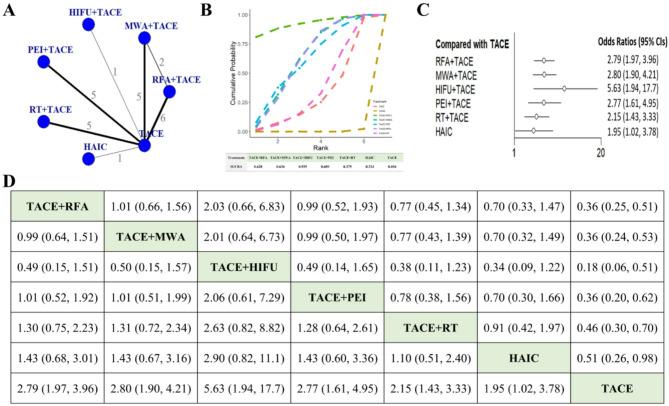
A total of 40 randomized controlled studies were included. Compared with transarterial chemoembolization (TACE) alone, all of the combination treatments, including TACE with radiofrequency ablation (RFA), microwave ablation (MWA), high-intensity focused ultrasound (HIFU), percutaneous ethanol injection (PEI), and radiotherapy (RT), significantly improved the DCR. TACE combined with RFA was observed to be superior to hepatic arterial infusion chemotherapy (HAIC) (OR: 1.91; 95% CI: 1.03-3.81) and TACE (OR: 3.85; 95% CI: 2.66-5.69), with the highest probability (SUCRA 0.836). TACE combined with HIFU ranks highest 1-year survival (SUCRA 0.919) and 2-year survival (SUCRA 0.925) rates, and also exhibited a better 1-year survival rate than HAIC (OR: 2.99; 95% CI: 1.09-9.03). Compared with TACE alone, HAIC exhibited a greater DCR (OR: 2.02; 95% CI: 1.15-3.40) and a potential advantage in 2-year survival (OR: 1.95; 95% CI: 1.02-3.78). No significant differences in serious adverse events were observed across treatments.
CONCLUSIONS
Compared with TACE alone, combined treatments for uHCC patients demonstrates better efficacy and survival. Moreover, compared with TACE and HAIC, TACE combined with RFA provides better efficacy, whereas TACE combined with HIFU offers the highest 1-year survival rate. HAIC alone outperforms TACE in DCR and 2-year survival rate.
背景
不可切除肝细胞癌(uHCC)的最佳临床管理对临床医生来说具有挑战性。进行了贝叶斯网络荟萃分析,以比较uHCC不同介入策略的疗效和安全性。
方法
在PubMed、Embase、Cochrane图书馆、Web of Science和中国知网数据库中进行系统检索。应用贝叶斯网络荟萃分析评估疾病控制率(DCR)、1年生存率和2年生存率,以及与七种介入策略相关的严重不良事件发生率。使用随机效应的成对和网络荟萃分析估计优势比(OR)。治疗排名采用累积排名曲线下面积(SUCRA),而异质性则通过I方和荟萃回归进行检验。
结果
共纳入40项随机对照研究。与单纯经动脉化疗栓塞术(TACE)相比,所有联合治疗,包括TACE联合射频消融(RFA)、微波消融(MWA)、高强度聚焦超声(HIFU)、经皮乙醇注射(PEI)和放疗(RT),均显著提高了DCR。观察到TACE联合RFA优于肝动脉灌注化疗(HAIC)(OR:1.91;95%CI:1.03 - 3.81)和TACE(OR:3.85;95%CI:2.66 - 5.69),概率最高(SUCRA 0.836)。TACE联合HIFU在1年生存率(SUCRA 0.919)和2年生存率(SUCRA 0.925)方面排名最高,并且1年生存率也优于HAIC(OR:2.99;95%CI:1.09 - 9.03)。与单纯TACE相比,HAIC表现出更高的DCR(OR:2.02;95%CI:1.15 - 3.40)以及在2年生存率方面的潜在优势(OR:1.95;95%CI:1.02 - 3.78)。各治疗组在严重不良事件方面未观察到显著差异。
结论
与单纯TACE相比,uHCC患者的联合治疗显示出更好的疗效和生存率。此外,与TACE和HAIC相比,TACE联合RFA疗效更佳,而TACE联合HIFU的1年生存率最高。单纯HAIC在DCR和2年生存率方面优于TACE。


 Zotero 插件