
噬菌体通过调节共生微生物群间接维持番茄植株的病原体防御能力。
Phages indirectly maintain tomato plant pathogen defense through regulation of the commensal microbiome.
作者信息
Debray Reena, Conover Asa, Koskella Britt
机构信息
Department of Primate Behavior and Evolution, Max Planck Institute for Evolutionary Anthropology, 04103 Leipzig, Germany.
Department of Integrative Biology, University of California, Berkeley, 94720 Berkeley, CA, United States.
出版信息
ISME Commun. 2025 Apr 18;5(1):ycaf065. doi: 10.1093/ismeco/ycaf065. eCollection 2025 Jan.
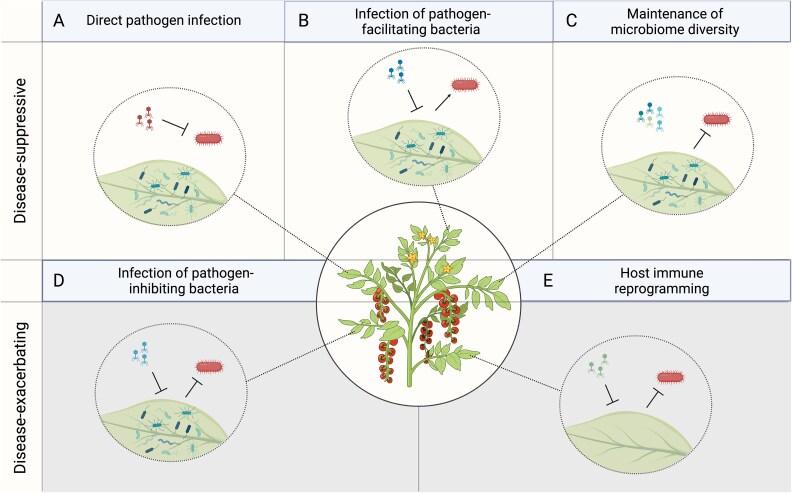
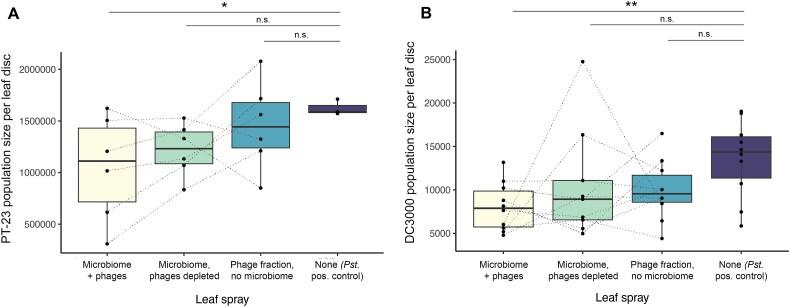
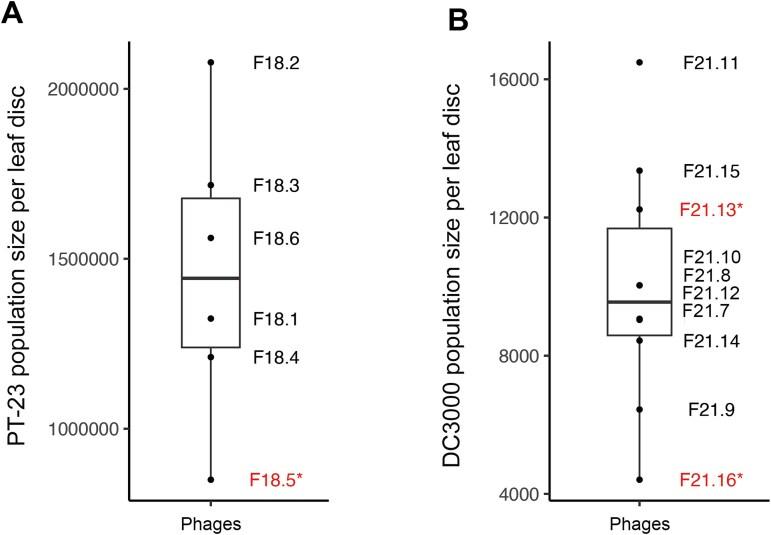
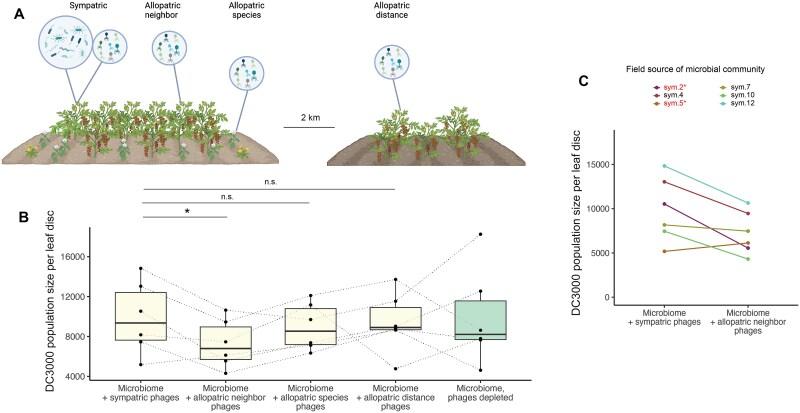
As parasites of bacteria, phages can regulate microbiome diversity and composition and may therefore affect susceptibility to pathogens and disease. Many infectious diseases are associated with altered bacteriophage communities, but observational studies alone do not allow us to determine when altered phage community composition is a contributor to disease risk, a response to infection, or simply an indicator of dysbiosis. To address this question directly, we used size-selective filtration to deplete plant-associated microbial communities of phages, then challenged plants with the bacterial pathogen . Plants with phage-depleted microbiomes were more susceptible to infection, an effect that could not be explained by direct effects of the phage communities on either or the plant host. Moreover, the presence of phages was most impactful when the phage communities were isolated from neighboring field locations rather than from the same host plant as the bacteria, possibly suggesting that moderate rates of lysis maintain a community structure that is most resistant to pathogen invasion. Overall, our results support the idea that phage communities contribute to plant defenses by modulating the microbiome.
作为细菌的寄生体,噬菌体可以调节微生物群落的多样性和组成,因此可能影响对病原体和疾病的易感性。许多传染病都与噬菌体群落的改变有关,但仅靠观察性研究无法让我们确定噬菌体群落组成的改变何时会导致疾病风险、是对感染的反应,还是仅仅是生态失调的一个指标。为了直接解决这个问题,我们使用尺寸选择性过滤来去除植物相关微生物群落中的噬菌体,然后用细菌病原体对植物进行挑战。噬菌体耗尽的微生物群落的植物更容易受到感染,这种影响无法用噬菌体群落对细菌或植物宿主的直接作用来解释。此外,当噬菌体群落是从邻近的田间位置而不是从与细菌相同的宿主植物中分离出来时,噬菌体的存在影响最大,这可能表明适度的裂解率维持了对病原体入侵最具抵抗力的群落结构。总体而言,我们的结果支持这样一种观点,即噬菌体群落通过调节微生物群落来促进植物防御。

 Zotero 插件