
使用局部枸橼酸抗凝的持续静脉-静脉血液滤过期间高碳酸氢盐置换液与pH值恢复正常的时间:一项回顾性单中心队列研究
High bicarbonate replacement fluid and time to pH normalization during continuous veno-venous hemofiltration with regional citrate anticoagulation: a retrospective single-center cohort study.
作者信息
Mayerhöfer Timo, Köglberger Paul, Perschinka Fabian, Lehner Georg F, Schilchegger Lisa, Bellmann Romuald, Peer Andreas, Zassler Birgit, Schauflinger Sebastian, Joannidis Michael
机构信息
Division of Intensive Care and Emergency Medicine, Department of Internal Medicine, Medical University Innsbruck, Innsbruck, Austria.
Institute of Anesthesiology and Critical Care Medicine, Klinikum Wels, Wels, Austria.
出版信息
Clin Kidney J. 2025 Apr 26;18(5):sfaf117. doi: 10.1093/ckj/sfaf117. eCollection 2025 May.
BACKGROUND
In critically ill patients, acid-base disorders are common before start of continuous renal replacement therapy. The aim of this study was to determine the influence of a high bicarbonate replacement fluid (30 mmol/L, Phoxilium) on underlying acid-base disturbances.
METHODS
This single-center retrospective study included patients treated with continuous veno-venous hemofiltration (CVVH) at a medical ICU from January 2018 to May 2019. All patients received CVVH with regional citrate anticoagulation (RCA) and a high bicarbonate RF (Phoxilium). Patients were categorized based on their initial pH. Acid-base parameters were closely monitored over 72 h at pre-specified intervals.
RESULTS
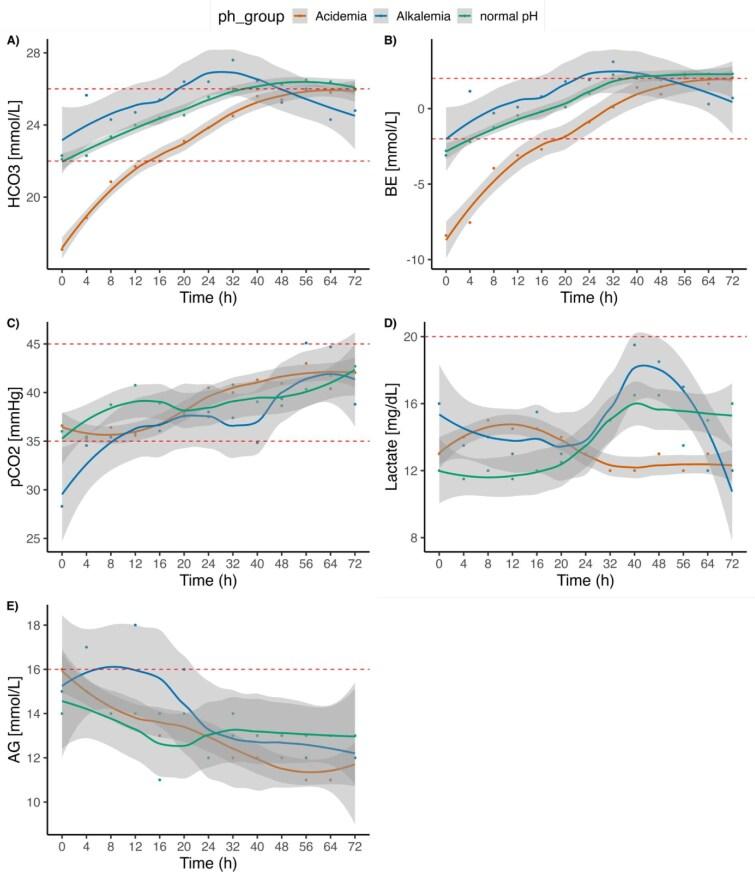
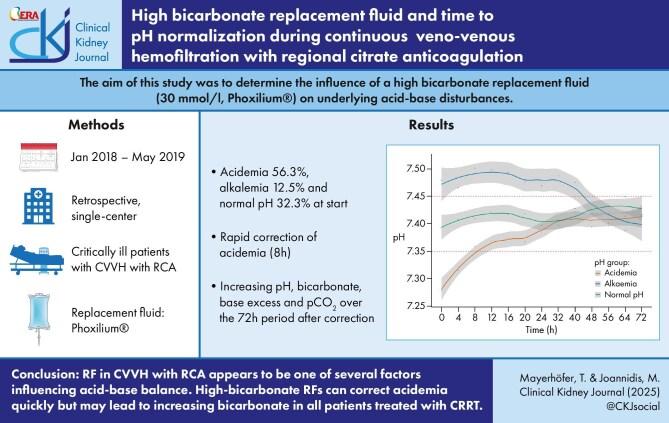
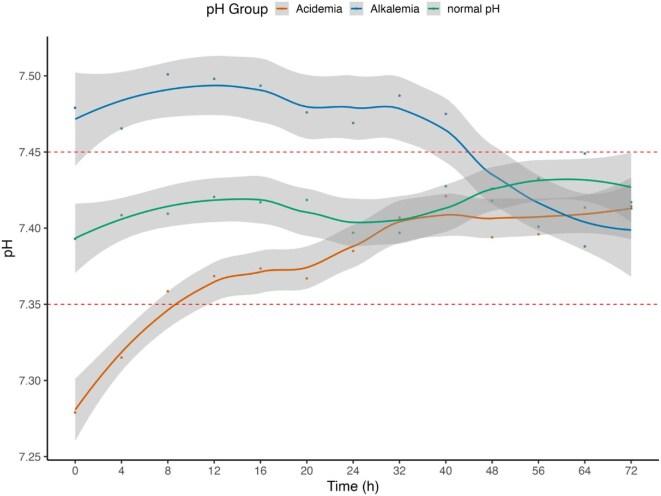
The study included 64 patients with a median age of 68 years. At the start of CVVH, 56.3% ( = 36) had acidemia, 12.5% ( = 8) had alkalemia and 32.3% ( = 20) had a normal pH. The median pH of patients with acidemia [0 h: 7.28 (interquartile range 7.23-7.33)] was corrected quickly to the normal range within 8 h [7.36 (interquartile range 7.29-7.4)]. The median pH of patients with alkalemia took longer (48 h) to reach normal values and patients with a normal pH showed a further pH increase within the normal range over the 72 h. All patients showed an increasing bicarbonate and base excess from 24 to 72 h.
CONCLUSIONS
The RF in CVVH with RCA appears to be one of several factors influencing acid-base balance. Patients with different pre-existing acid-base disorders showed distinct correction kinetics. Prospective studies are needed to determine the clinical relevance of these findings and to optimize RF composition for better patient outcomes.
背景
在重症患者中,酸碱紊乱在开始连续性肾脏替代治疗之前很常见。本研究的目的是确定高碳酸氢盐置换液(30 mmol/L,Phoxilium)对潜在酸碱紊乱的影响。
方法
这项单中心回顾性研究纳入了2018年1月至2019年5月在一家医学重症监护病房接受连续性静脉-静脉血液滤过(CVVH)治疗的患者。所有患者均接受采用局部枸橼酸抗凝(RCA)的CVVH和高碳酸氢盐置换液(Phoxilium)。患者根据其初始pH值进行分类。在预先设定的时间间隔内对酸碱参数进行72小时的密切监测。
结果
该研究纳入了64例患者,中位年龄为68岁。在CVVH开始时,56.3%(n = 36)有酸血症,12.5%(n = 8)有碱血症,32.3%(n = 20)pH值正常。酸血症患者的中位pH值[0小时:7.28(四分位间距7.23 - 7.33)]在8小时内迅速纠正至正常范围[7.36(四分位间距7.29 - 7.4)]。碱血症患者的中位pH值达到正常范围所需时间更长(48小时),而pH值正常的患者在72小时内pH值在正常范围内进一步升高。所有患者从24小时至72小时碳酸氢盐和碱剩余均增加。
结论
采用RCA的CVVH中的置换液似乎是影响酸碱平衡的几个因素之一。不同既往酸碱紊乱的患者表现出不同的纠正动力学。需要进行前瞻性研究以确定这些发现的临床相关性,并优化置换液成分以改善患者预后。
 Zotero 插件