
IgG4抗体在人类健康与疾病中的作用。
Role of IgG4 Antibodies in Human Health and Disease.
作者信息
Shi Li-Li, Xiong Peng, Yang Minglin, Ardicli Ozge, Schneider Stephan Raphael, Funch Anders Boutrup, Kiykim Ayca, Lopez Juan, Akdis Cezmi A, Akdis Mübeccel
机构信息
Swiss Institute of Allergy and Asthma Research (SIAF), University of Zurich, 7265 Davos, Switzerland.
Department of Otolaryngology-Head and Neck Surgery, Tongji Hospital, Tongji Medical College, Huazhong University of Science and Technology, Wuhan 430030, China.
出版信息
Cells. 2025 Apr 25;14(9):639. doi: 10.3390/cells14090639.
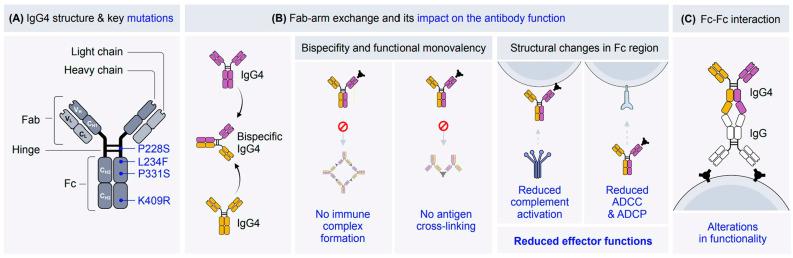
Immunoglobulin G4 (IgG4), a unique subclass of IgG antibodies, plays diverse roles in human health and disease. Its distinct features, such as Fab-arm exchange and specific mutations, confer reduced effector functions compared to other IgG subclasses. In health, IgG4 responses contribute to immune tolerance, particularly in the context of allergen-specific immunotherapy (AIT), where they can mediate tolerance to environmental antigens, inhibit IgE-dependent mast cell degranulation, and compete with IgE for allergen binding. This helps in attenuating allergic symptoms and is associated with increased levels of allergen-specific IgG4. However, in disease scenarios, the role of IgG4 is complex. IgG4 lacks complement fixation and, thus, shows a reduced ability to activate immune effector pathways, it was initially thought to be protective against autoimmune diseases. However, emerging evidence suggests that it can contribute to pathology. For instance, IgG4 autoantibodies against specific antigens can aggravate conditions in certain autoimmune disorders. In some cancers, it may play a role in immune evasion, with higher levels correlating with poor patient survival, albeit in others, its exact function remains elusive. Overall, understanding the precise role of IgG4 in various physiological and pathological conditions is crucial for developing targeted therapeutic strategies and improving patient outcomes.
免疫球蛋白G4(IgG4)是IgG抗体的一个独特亚类,在人类健康和疾病中发挥着多种作用。与其他IgG亚类相比,其独特特征,如Fab臂交换和特定突变,导致效应功能降低。在健康状态下,IgG4反应有助于免疫耐受,特别是在过敏原特异性免疫疗法(AIT)的背景下,它可以介导对环境抗原的耐受,抑制IgE依赖的肥大细胞脱颗粒,并与IgE竞争过敏原结合。这有助于减轻过敏症状,并与过敏原特异性IgG4水平升高有关。然而,在疾病情况下,IgG4的作用很复杂。IgG4缺乏补体固定作用,因此激活免疫效应途径的能力降低,最初被认为对自身免疫性疾病有保护作用。然而,新出现的证据表明它可能导致病理变化。例如,针对特定抗原的IgG4自身抗体可加重某些自身免疫性疾病的病情。在一些癌症中,它可能在免疫逃逸中起作用,较高水平与患者生存率低相关,尽管在其他癌症中,其确切功能仍然难以捉摸。总体而言,了解IgG4在各种生理和病理条件下的确切作用对于制定靶向治疗策略和改善患者预后至关重要。

 Zotero 插件