
2020 - 2023年美国用于儿科感染诊断的16S核糖体RNA基因聚合酶链反应及测序
16S Ribosomal RNA Gene PCR and Sequencing for Pediatric Infection Diagnosis, United States, 2020-2023.
作者信息
Li Guyu, Reis Christopher A, Kruc Rebecca M, Zhang Ziyuan, Streck Nicholas T, Ristagno Elizabeth H, Mandrekar Jay, Wolf Matthew J, Gaensbauer James T, Patel Robin
出版信息
Emerg Infect Dis. 2025 May;31(13):129-136. doi: 10.3201/eid3113.241101.
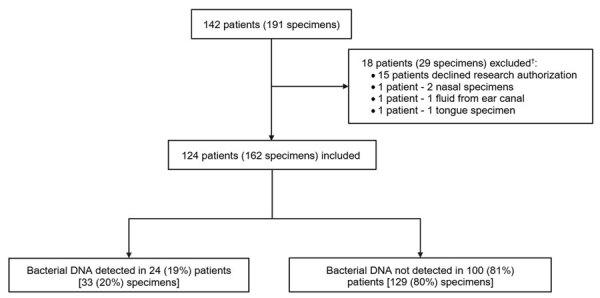
Gene PCR and sequencing using 16S ribosomal RNA (rRNA) can help diagnose challenging bacterial infections. Data on the optimal clinical settings for this type of testing are limited. We performed a retrospective study at Mayo Clinic, Rochester, Minnesota, USA, with typically sterile specimens from children that underwent 16S rRNA PCR testing during September 2020-December 2023. Of 162 tests performed on 124 patients, 20% were positive; 58% of positive samples were from culture-negative specimens. Fluid specimens were >3 times as likely to test positive as tissue specimens (odds ratio 3.07 [95% CI 1.32-7.11]; p = 0.007), and pleural fluid demonstrated the highest positivity rate (50%). Of 33 positive results, 4 (12%) specimens qualified for reporting to the state health department for communicable diseases. Those single-laboratory findings demonstrate that the highest positivity rate of 16S rRNA PCR and sequencing is pleural fluid, although many specimen types tested positive.
使用16S核糖体RNA(rRNA)进行基因聚合酶链反应(PCR)和测序有助于诊断具有挑战性的细菌感染。关于这类检测的最佳临床应用场景的数据有限。我们在美国明尼苏达州罗切斯特市的梅奥诊所进行了一项回顾性研究,研究对象为2020年9月至2023年12月期间接受16S rRNA PCR检测的儿童的通常无菌的标本。在对124例患者进行的162次检测中,20%呈阳性;58%的阳性样本来自培养阴性的标本。液体标本检测呈阳性的可能性是组织标本的3倍多(比值比3.07 [95%置信区间1.32 - 7.11];p = 0.007),且胸腔积液的阳性率最高(50%)。在33个阳性结果中,有4个(12%)标本符合向州卫生部门报告传染病的标准。这些单实验室研究结果表明,尽管许多标本类型检测呈阳性,但16S rRNA PCR和测序的最高阳性率出现在胸腔积液中。
 Zotero 插件