
非典型IκB(Bcl-3、IκB和IκBζ)在淋巴细胞及自身免疫中的调控与功能
Regulation and Function of the Atypical IκBs-Bcl-3, IκB, and IκBζ-in Lymphocytes and Autoimmunity.
作者信息
Kübelbeck Tanja, Wichmann Nina Olivera, Raj Timsse, Raj Cynthia, Ohnmacht Caspar, Hövelmeyer Nadine, Kramer Daniela, Heissmeyer Vigo
机构信息
Department of Dermatology, University Medical Center of the Johannes Gutenberg-University of Mainz, Mainz, Germany.
Center of Allergy and Environment (ZAUM), Technical University and Helmholtz Zentrum München, Munich, Germany.
出版信息
Eur J Immunol. 2025 May;55(5):e202451273. doi: 10.1002/eji.202451273.
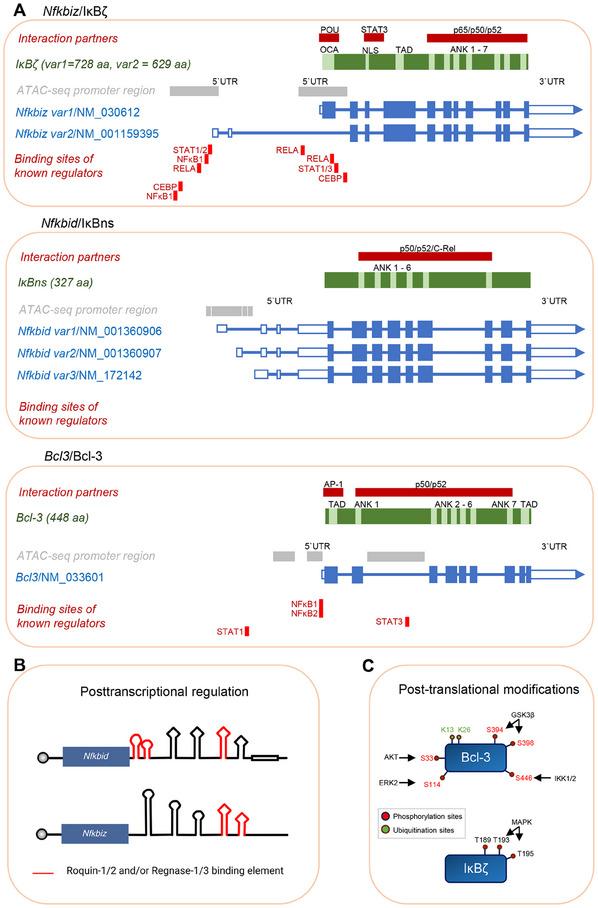
Signaling pathways involving NF-κB transcription factors have essential roles in inflammation, immunity, cell proliferation, differentiation, and survival. Classical IκB proteins, such as IκBα and IκBβ, bind to NF-κB via ankyrin repeats to sequester NF-κB in the cytoplasm and thus suppress NF-κB activity. Unlike these constitutively expressed classical IκBs, the expression of the atypical IκBs Bcl-3, IκB, and IκBζ is induced in immune cells after recognition of antigens, pathogen-associated molecular patterns (PAMPs) or cytokines, upon which they localize to the nucleus and form complexes with transcription factors and regulators on the DNA. Atypical, nuclear IκBs have been proposed to modulate NF-κB activity in a context-dependent manner as they can either inhibit or increase gene expression of a subset of NF-κB target genes. This complexity may be related to the molecular function of atypical IκBs, which bind to different transcription factor complexes and form a bridge to different cofactors or epigenetic modifiers. Recent research has identified novel target genes of atypical IκBs that include chemokines, cytokines, and master regulators of lymphocyte differentiation, underscoring prominent roles in adaptive immune and autoimmune responses. Here, we summarize our current understanding of atypical IκBs in lymphocytes with a focus on their emerging role in autoimmunity.
涉及核因子κB(NF-κB)转录因子的信号通路在炎症、免疫、细胞增殖、分化和存活中发挥着重要作用。经典的IκB蛋白,如IκBα和IκBβ,通过锚蛋白重复序列与NF-κB结合,将NF-κB隔离在细胞质中,从而抑制NF-κB活性。与这些组成性表达的经典IκB不同,非典型IκB蛋白Bcl-3、IκBε和IκBζ在免疫细胞识别抗原、病原体相关分子模式(PAMP)或细胞因子后被诱导表达,随后它们定位于细胞核,并与DNA上的转录因子和调节因子形成复合物。有人提出,非典型的核IκB以一种依赖于上下文的方式调节NF-κB活性,因为它们既可以抑制也可以增加一部分NF-κB靶基因的基因表达。这种复杂性可能与非典型IκB的分子功能有关,它们与不同的转录因子复合物结合,并与不同的辅因子或表观遗传修饰因子形成桥梁。最近的研究确定了非典型IκB的新靶基因,包括趋化因子、细胞因子和淋巴细胞分化的主要调节因子,突出了它们在适应性免疫和自身免疫反应中的重要作用。在这里,我们总结了目前对淋巴细胞中非典型IκB的理解,重点关注它们在自身免疫中的新作用。

 Zotero 插件