
Token-Mol 1.0:基于大语言模型的标记化药物设计
Token-Mol 1.0: tokenized drug design with large language models.
作者信息
Wang Jike, Qin Rui, Wang Mingyang, Fang Meijing, Zhang Yangyang, Zhu Yuchen, Su Qun, Gou Qiaolin, Shen Chao, Zhang Odin, Wu Zhenxing, Jiang Dejun, Zhang Xujun, Zhao Huifeng, Ge Jingxuan, Wu Zhourui, Kang Yu, Hsieh Chang-Yu, Hou Tingjun
机构信息
College of Pharmaceutical Sciences, Zhejiang University, Hangzhou, 310058, Zhejiang, China.
Paul G. Allen School of Computer Science & Engineering, University of Washington, Seattle, WA, USA.
出版信息
Nat Commun. 2025 May 13;16(1):4416. doi: 10.1038/s41467-025-59628-y.
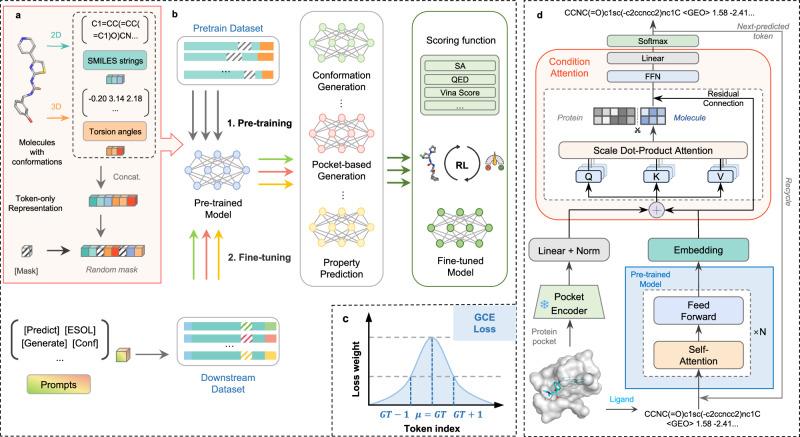
The integration of large language models (LLMs) into drug design is gaining momentum; however, existing approaches often struggle to effectively incorporate three-dimensional molecular structures. Here, we present Token-Mol, a token-only 3D drug design model that encodes both 2D and 3D structural information, along with molecular properties, into discrete tokens. Built on a transformer decoder and trained with causal masking, Token-Mol introduces a Gaussian cross-entropy loss function tailored for regression tasks, enabling superior performance across multiple downstream applications. The model surpasses existing methods, improving molecular conformation generation by over 10% and 20% across two datasets, while outperforming token-only models by 30% in property prediction. In pocket-based molecular generation, it enhances drug-likeness and synthetic accessibility by approximately 11% and 14%, respectively. Notably, Token-Mol operates 35 times faster than expert diffusion models. In real-world validation, it improves success rates and, when combined with reinforcement learning, further optimizes affinity and drug-likeness, advancing AI-driven drug discovery.
将大语言模型(LLMs)整合到药物设计中正在获得发展势头;然而,现有方法往往难以有效地纳入三维分子结构。在此,我们提出了Token-Mol,这是一种仅基于标记的三维药物设计模型,它将二维和三维结构信息以及分子特性编码为离散标记。基于变压器解码器构建并通过因果掩码进行训练,Token-Mol引入了专为回归任务定制的高斯交叉熵损失函数,在多个下游应用中实现了卓越性能。该模型超越了现有方法,在两个数据集上分子构象生成提高了超过10%和20%,同时在属性预测方面比仅基于标记的模型性能高出30%。在基于口袋的分子生成中,它分别将类药性和合成可及性提高了约11%和14%。值得注意的是,Token-Mol的运行速度比专家扩散模型快35倍。在实际验证中,它提高了成功率,并且与强化学习相结合时,进一步优化了亲和力和类药性,推动了人工智能驱动的药物发现。

 Zotero 插件