
航空旅行后空乘人员的DNA修复能力受到抑制。
Suppressed DNA repair capacity in flight attendants after air travel.
作者信息
Toprani Sneh M, Mordukhovich Irina, McNeely Eileen, Nagel Zachary D
机构信息
John B. Little Center of Radiation Sciences, Department of Environmental Health, Harvard T.H. Chan School of Public Health, Boston, MA, USA.
Department of Environmental Health, Harvard T.H. Chan School of Public Health, Boston, MA, USA.
出版信息
Sci Rep. 2025 May 13;15(1):16513. doi: 10.1038/s41598-025-98934-9.
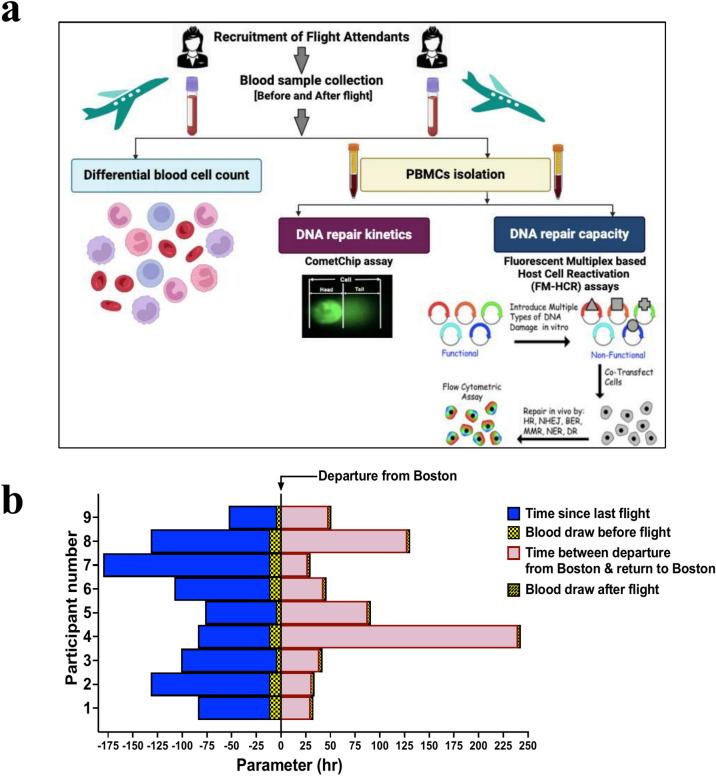
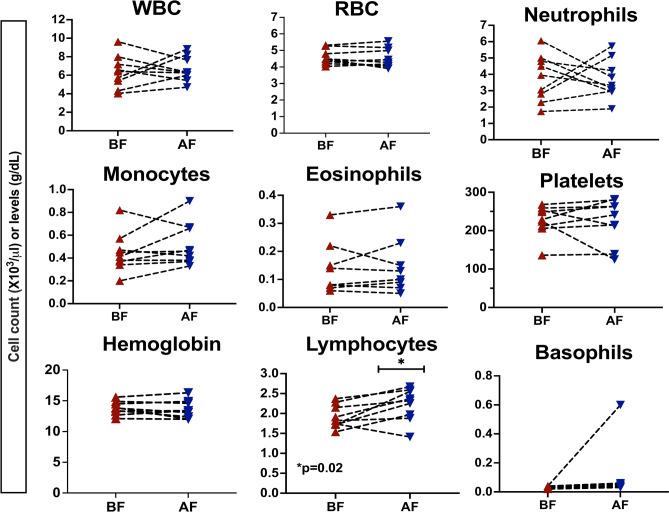
Elevated cancer risk and compromised reproductive health have been well documented in flight attendants (FA), but the etiology remains unknown. Many studies using cell and animal models suggest that air travel related exposures might plausibly explain the adverse health outcomes observed in flight crew, but our understanding of the underlying biological mechanisms is incomplete. During air travel, FA are constantly exposed to complex mixtures of mutagens in the flight cabin that may contribute to genomic instability by inducing DNA damage and interfering with DNA repair. Defects in DNA repair capacity (DRC) have been associated with risk of cancer and other diseases. To explore our hypothesis that alterations in DNA damage and repair in FA are related to flight travel, we conducted a pilot study of FA's DNA damage and assess global DNA repair efficiency pre and post flight. We collected venous blood samples from nine FA before and after flight. Differential blood cell counts were carried out to assess immune responses and functional assays were performed to assess the DNA damage response. The CometChip assay was employed to quantify baseline DNA damage and repair kinetics for DNA damage induced by X-rays. Fluorescence multiplex based host cell reactivation (FM-HCR) assays were utilized to assess DRC in five major DNA repair pathways. Our findings revealed a significant increase in lymphocyte counts as well as diminished repair of ionizing radiation induced DNA damage and excision of 8oxoG:C lesions in after flight samples. Our results illustrate the potential for using biological samples to identify molecular mechanisms that may implicate impaired genomic stability and altered immune responses in the etiology of excess cancer in FAs.
空乘人员患癌症风险升高和生殖健康受损已有充分记录,但病因仍不明。许多使用细胞和动物模型的研究表明,与航空旅行相关的暴露可能合理地解释了机组人员中观察到的不良健康结果,但我们对潜在生物学机制的理解并不完整。在航空旅行期间,空乘人员不断暴露于驾驶舱内的复杂诱变剂混合物中,这些诱变剂可能通过诱导DNA损伤和干扰DNA修复而导致基因组不稳定。DNA修复能力(DRC)缺陷与癌症和其他疾病的风险相关。为了探究我们的假设,即空乘人员DNA损伤和修复的改变与飞行旅行有关,我们对空乘人员的DNA损伤进行了一项试点研究,并评估飞行前后的全球DNA修复效率。我们在九名空乘人员飞行前后采集了静脉血样。进行了血细胞分类计数以评估免疫反应,并进行了功能测定以评估DNA损伤反应。采用彗星芯片测定法来量化基线DNA损伤以及X射线诱导的DNA损伤的修复动力学。基于荧光多重宿主细胞再活化(FM-HCR)测定法用于评估五个主要DNA修复途径中的DRC。我们的研究结果显示,飞行后样本中的淋巴细胞计数显著增加,同时电离辐射诱导的DNA损伤修复以及8-氧代鸟嘌呤:胞嘧啶(8oxoG:C)损伤的切除减少。我们的结果表明,利用生物样本识别分子机制的潜力,这些分子机制可能与空乘人员癌症高发病因中基因组稳定性受损和免疫反应改变有关。




 Zotero 插件