
25至40岁宫颈上皮内瘤变2级(CIN2)女性的风险分层与保守治疗
Risk stratification and conservative management of women aged 25-40 years with cervical intraepithelial neoplasia grade 2(CIN2).
作者信息
Wang Huanhua, Jin Ping
机构信息
Department of Gynecology, Shenzhen Maternity & Child Healthcare Hospital, Southern Medical University, No. 3012, Fuqiang Road, Futian District, Shenzhen, Guangdong Province, 518017, China.
出版信息
BMC Infect Dis. 2025 May 14;25(1):696. doi: 10.1186/s12879-025-11096-x.
BACKGROUND
Cervical intraepithelial neoplasia grade 2 (CIN2) can progress to CIN3 or worse (CIN3). Some patients diagnosed with CIN2 from a punch biopsy exhibit varied risks of occult CIN3 in the loop electrosurgical excision procedure (LEEP) specimens following treatment, underscoring the need for risk stratification.
METHODS
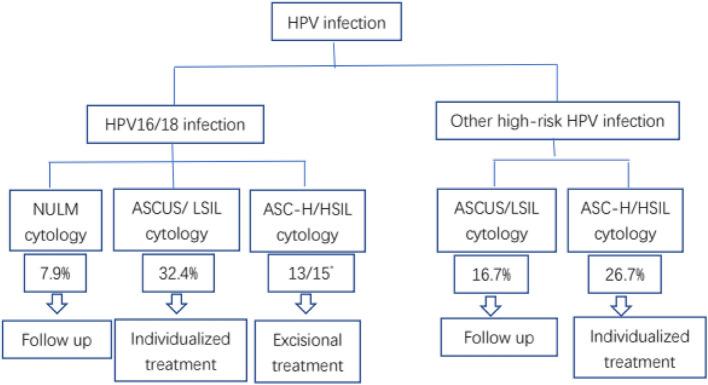
We conducted a retrospective observational study of 307 women aged ≤ 40 years, diagnosed with CIN2 via colposcopy-guided punch biopsy where the squamocolumnar junction was visible, and who underwent LEEP within three months. We compared the diagnoses from punch biopsies with the histology of the LEEP specimens and developed a stratified management algorithm based on identified risk factors.
RESULTS
The risk of CIN3 in the LEEP specimens for women aged 25-40 years was 24.9% (including one case of cervical microinvasive squamous cell carcinoma), significantly higher than in women under 25 years in univariate analysis (24.9% vs. 7.1%, P < 0.05). Multivariate analysis revealed HPV16/18 (OR 2.61, [95% CI 1.41-4.85]) and HSIL cytology (OR 4.14, [95% CI 2.03-8.47]) as independent risk factors.
CONCLUSION
Patients aged 25-40 years with CIN2 diagnosed in punch biopsy exhibited a substantial risk of CIN3 in LEEP specimens, warranting consideration for surgical intervention, particularly in those with HPV16/18 and HSIL cytology. Approximately 30% of CIN2 patients with HPV16/18 and ASC-US/LSIL, or other high-risk HPV types and HSIL cytology, also showed CIN3, suggesting that treatment should be individualized considering the patient's preferences and adherence. Conversely, the risk was low for those with HPV16/18 and normal cytology or other high-risk HPV types and ASC-US/LSIL, making conservative management a viable option. .
背景
宫颈上皮内瘤变2级(CIN2)可进展为CIN3或更严重病变(CIN3)。一些经穿刺活检诊断为CIN2的患者在接受治疗后的环形电切术(LEEP)标本中显示出隐匿性CIN3的风险各异,这凸显了风险分层的必要性。
方法
我们对307名年龄≤40岁的女性进行了一项回顾性观察研究,这些女性通过阴道镜引导下穿刺活检诊断为CIN2,且鳞柱交界可见,并在三个月内接受了LEEP手术。我们将穿刺活检的诊断结果与LEEP标本的组织学结果进行了比较,并基于识别出的风险因素制定了分层管理算法。
结果
25 - 40岁女性LEEP标本中CIN3的风险为24.9%(包括1例宫颈微浸润鳞状细胞癌),单因素分析显示显著高于25岁以下女性(24.9%对7.1%,P < 0.05)。多因素分析显示HPV16/18(比值比2.61,[95%置信区间1.41 - 4.85])和高级别鳞状上皮内病变(HSIL)细胞学结果(比值比4.14,[95%置信区间2.03 - 8.47])为独立风险因素。
结论
经穿刺活检诊断为CIN2的25 - 40岁患者在LEEP标本中显示出CIN3的显著风险,值得考虑手术干预,特别是对于那些HPV16/18阳性和HSIL细胞学结果的患者。大约30%的HPV16/18阳性且非典型鳞状细胞意义不明确/低级别鳞状上皮内病变(ASC-US/LSIL)或其他高危HPV类型且HSIL细胞学结果的CIN2患者也显示为CIN3,这表明应根据患者的偏好和依从性进行个体化治疗。相反,HPV16/18阳性且细胞学结果正常或其他高危HPV类型且ASC-US/LSIL的患者风险较低,保守管理是一个可行的选择。
 Zotero 插件