
急性髓系白血病中KMT2A重排的见解:从分子特征到靶向治疗
Insights into KMT2A rearrangements in acute myeloid leukemia: from molecular characteristics to targeted therapies.
作者信息
Zehtabcheh Sara, Soleimani Samarkhazan Hamed, Asadi Marjan, Zabihi Mitra, Parkhideh Sahar, Mohammadi Mohammad Hossein
机构信息
Student Research Committee, Department of Hematology and Blood Banking, School of Allied Medical Sciences, Shahid Beheshti University of Medical Sciences, Tehran, Iran.
Department of Hematology and Blood Banking, School of Allied Medical Sciences, Shahid Beheshti University of Medical Sciences, Tehran, Iran.
出版信息
Biomark Res. 2025 May 13;13(1):73. doi: 10.1186/s40364-025-00786-y.
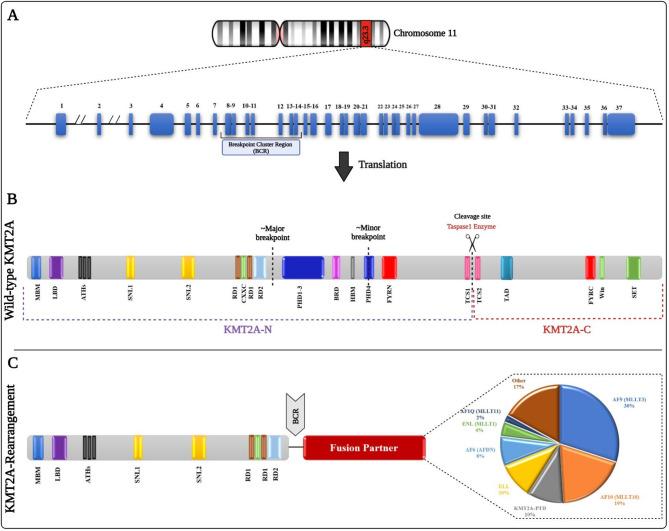
Acute myeloid leukemia (AML) with KMT2A rearrangements (KMT2A-r) represents a highly aggressive and prognostically unfavorable subtype of leukemia, often resistant to standard treatments and associated with high relapse rates. KMT2A-r, found in 3-10% of adult AML cases, disrupt epigenetic regulation by forming chimeric proteins that activate oncogenic pathways like HOXA and MEIS1. These fusion proteins recruit cofactors such as Menin and DOT1L, driving leukemogenesis through abnormal histone methylation. Diagnosing KMT2A-r AML requires precision, with traditional methods like FISH and RT-PCR being complemented by advanced technologies such as next-generation sequencing (NGS) and machine learning (ML). ML models, leveraging transcriptomic data, can predict KMT2A-r and identify biomarkers like LAMP5 and SKIDA1, improving risk stratification. Therapeutically, there is a shift from chemotherapy to targeted therapies. Menin inhibitors (e.g., Revumenib, Ziftomenib) disrupt the Menin-KMT2A interaction, suppressing HOXA/MEIS1 and promoting differentiation. DOT1L inhibitors (e.g., Pinometostat) show promise in combination therapies, while novel approaches like WDR5 inhibitors and PROTAC-mediated degradation are expanding treatment options. Despite progress, challenges remain, including optimizing minimal residual disease monitoring, overcoming resistance, and validating biomarkers. This review emphasizes the imperative to translate molecular insights into personalized therapeutic regimens, offering renewed hope for patients afflicted by this historically refractory malignancy.
伴有KMT2A重排(KMT2A-r)的急性髓系白血病(AML)是一种高度侵袭性且预后不良的白血病亚型,通常对标准治疗耐药,且复发率高。KMT2A-r在3%-10%的成人AML病例中被发现,它通过形成激活HOXA和MEIS1等致癌途径的嵌合蛋白来破坏表观遗传调控。这些融合蛋白招募诸如Menin和DOT1L等辅因子,通过异常的组蛋白甲基化驱动白血病发生。诊断KMT2A-r AML需要精确性,传统方法如荧光原位杂交(FISH)和逆转录聚合酶链反应(RT-PCR)需要由新一代测序(NGS)和机器学习(ML)等先进技术来补充。ML模型利用转录组数据可以预测KMT2A-r并识别像LAMP5和SKIDA1这样的生物标志物,从而改善风险分层。在治疗方面,正从化疗转向靶向治疗。Menin抑制剂(如瑞武尼布、齐夫托米尼布)破坏Menin-KMT2A相互作用,抑制HOXA/MEIS1并促进分化。DOT1L抑制剂(如匹诺司他)在联合治疗中显示出前景,而像WDR5抑制剂和PROTAC介导的降解等新方法正在扩大治疗选择。尽管取得了进展,但挑战依然存在,包括优化微小残留病监测、克服耐药性以及验证生物标志物。这篇综述强调了将分子见解转化为个性化治疗方案的必要性,为受这种历史上难治的恶性肿瘤折磨的患者带来了新的希望。

 Zotero 插件