
以及杀伤毒素:对葡萄汁生物保护的贡献。
and Killer Toxins: Contribution to Must Bioprotection.
作者信息
El Dana Fatima, David Vanessa, Hallal Mohammad Ali, Tourdot-Maréchal Raphaëlle, Hayar Salem, Colosio Marie-Charlotte, Alexandre Hervé
机构信息
UMR Procédés Alimentaires et Microbiologiques, Université de Bourgogne Europe, L'Institut Agro Dijon, INRAE, Laboratoire AFIM-IUVV, 21000 Dijon, France.
Doctoral School of Science and Technology, Platform for Research and Analysis in Environmental Science (EDST-PRASE), Lebanese University, Rafik Hariri Campus, Hadat-Baabda 1003, Lebanon.
出版信息
Foods. 2025 Apr 23;14(9):1462. doi: 10.3390/foods14091462.
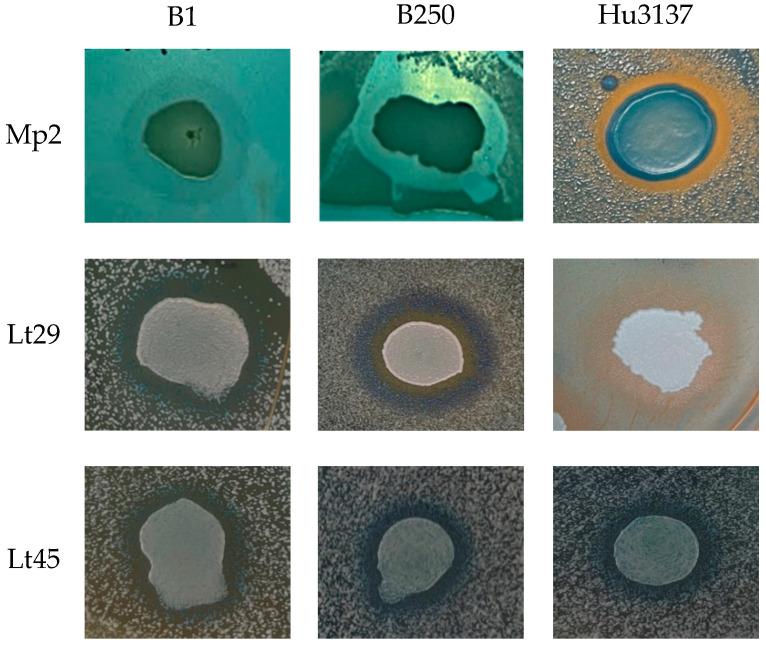
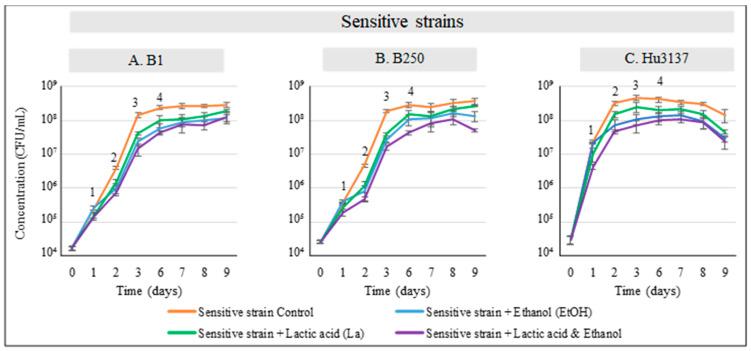
The spoilage of wine caused by and poses a significant challenge for winemakers, necessitating the development of effective and reliable strategies to control the growth of these yeasts, such as grape must bioprotection. Despite evidence that certain microorganisms can inhibit the growth of and , the specific mechanisms driving this inhibition remain unclear. The primary objective of this study is to elucidate the underlying mechanisms responsible for this inhibitory effect. We analyzed one (Mp2) and two (Lt29 and Lt45) strains, all of which demonstrated significant killing and inhibitory effects on (B1 and B250) and (Hu3137) in synthetic must at pH 3.5 and 22 °C. The effectiveness of these two strains exhibited varying inhibition kinetics. The strains were monitored for growth and metabolite production (L-lactic acid, ethanol, and acetic acid) in both single and co-cultures. The low levels of these metabolites did not account for the observed bioprotective effect, indicating a different mechanism at play, especially given the different growth profiles observed with added L-lactic acid and ethanol compared to direct bioprotectant addition. Following the production, purification, and quantification of killer toxins, different concentrations of toxins were tested, showing that the semi-purified Mp2Kt, Lt29Kt, and Lt45Kt toxins controlled the growth of both spoilage yeasts in a dose-dependent manner. These bioprotectant strains also showed compatibility with in co-cultures, suggesting their potential use alongside commercial starter cultures.
由[具体菌种1]和[具体菌种2]引起的葡萄酒变质给酿酒师带来了重大挑战,因此需要开发有效且可靠的策略来控制这些酵母的生长,比如葡萄汁生物保护。尽管有证据表明某些微生物可以抑制[具体菌种1]和[具体菌种2]的生长,但驱动这种抑制作用的具体机制仍不清楚。本研究的主要目的是阐明造成这种抑制作用的潜在机制。我们分析了一株[具体菌种1名称](Mp2)和两株[具体菌种2名称](Lt29和Lt45)菌株,在pH 3.5和22°C的合成葡萄汁中,所有这些菌株对[目标酵母1](B1和B250)和[目标酵母2](Hu3137)均表现出显著的杀灭和抑制作用。这两种菌株的有效性表现出不同的抑制动力学。对这些菌株在单培养和共培养中的生长及代谢产物生成(L-乳酸、乙醇和乙酸)进行了监测。这些代谢产物的低水平并不能解释所观察到的生物保护作用,这表明存在不同的作用机制,特别是考虑到与直接添加生物保护剂相比,添加L-乳酸和乙醇后观察到的不同生长曲线。在生产、纯化和定量杀伤毒素后,测试了不同浓度的毒素,结果表明半纯化的Mp2Kt、Lt29Kt和Lt45Kt毒素以剂量依赖的方式控制了两种腐败酵母的生长。这些生物保护菌株在共培养中也显示出与[商业发酵剂名称]的相容性,表明它们有可能与商业发酵剂一起使用。




 Zotero 插件