
低剂量氨基酸螯合微量矿物质对生长育肥猪生产性能、抗氧化能力及粪便排泄的影响
Impact of Low-Dose Amino Acid-Chelated Trace Minerals on Performance, Antioxidant Capacity, and Fecal Excretion in Growing-Finishing Pigs.
作者信息
Xiong Yunxia, Zhao Fei, Li Yaojie, Wu Qiwen, Xiao Huaqin, Cao Shuting, Yang Xuefen, Gao Kaiguo, Jiang Zongyong, Hu Shenglan, Wang Li
机构信息
State Key Laboratory of Swine and Poultry Breeding Industry, Key Laboratory of Animal Nutrition and Feed Science in South China Ministry of Agriculture, Heyuan Branch, Guangdong Laboratory for Lingnan Modern Agriculture, Guangdong Provincial Key Laboratory of Animal Breeding and Nutrition, Institute of Animal Science, Guangdong Academy of Agricultural Sciences, Guangzhou 510640, China.
DeBon Bio-Tech Co., Ltd., Hengyang 421500, China.
出版信息
Animals (Basel). 2025 Apr 24;15(9):1213. doi: 10.3390/ani15091213.
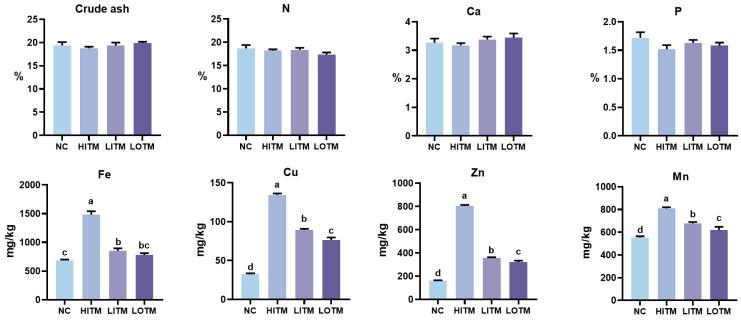
Our previous study has shown that replacing 100% inorganic trace minerals with 30% amino acid-chelated ones can enhance antioxidant capacity, improve nutrient digestibility, and reduce fecal excretion in growing-finishing pigs without compromising performance. This study aimed to further reduce the amino acid-chelated trace minerals content in pig diets and assess its impact. Seventy-two growing-finishing barrows (Duroc × Landrace × Yorkshire), with an initial average body weight of 67.04 ± 0.12 kg, were divided into four groups: negative control (NC, no additional trace minerals), high-dose inorganic trace minerals (HITM, 100% inorganic; 75 mg/kg Fe, 10 mg/kg Cu, 65 mg/kg Zn, 25 mg/kg Mn), and two low-dose groups (15 mg/kg Fe, 4 mg/kg Cu, 12.5 mg/kg Zn, 5 mg/kg Mn) receiving either inorganic sulfates (LITM) or amino acid-chelates (LOTM). The trial concluded when the body weight of pigs reached ~130 kg. Results showed that low-dose trace mineral substitution did not adversely affect growth performance, carcass traits, meat quality, or nutrient digestibility in growing-finishing pigs ( > 0.05). The LOTM pigs exhibited significantly higher serum glutathione peroxidase, liver total superoxide dismutase (T-SOD), and CuZn-SOD activities, muscle CuZn-SOD and catalase activities, and lower liver malondialdehyde content compared with LITM ( < 0.05). Muscle CuZn-SOD in LITM was lower than HITM ( < 0.05), but not in LOTM ( > 0.05). LOTM showed significantly higher muscle Fe content and lower muscle Mn content compared with HITM ( < 0.05), yet its muscle Mn level was higher than that of LITM ( < 0.05). Liver Zn content decreased in LITM compared with HITM ( < 0.05), but remained unchanged in LOTM ( > 0.05). Both LITM and LOTM significantly reduced fecal emissions of Fe, Cu, Zn, and Mn compared with HITM ( < 0.05), with greater reductions in Cu, Zn, and Mn in LOTM. In conclusion, low-dose substitution of inorganic or organic trace minerals did not negatively affect growth, carcass traits, meat quality, or nutrient digestibility in growing-finishing pigs, while it effectively reduced fecal heavy metal emissions. Organic trace minerals were more effective in enhancing antioxidant activity and trace mineral deposition.
我们之前的研究表明,用30%的氨基酸螯合微量矿物质替代100%的无机微量矿物质,可提高生长育肥猪的抗氧化能力、改善养分消化率并减少粪便排泄量,且不影响其生产性能。本研究旨在进一步降低猪日粮中氨基酸螯合微量矿物质的含量,并评估其影响。选用72头生长育肥阶段的公猪(杜洛克×长白×大白),初始平均体重为67.04±0.12千克,分为四组:阴性对照组(NC,不添加额外微量矿物质)、高剂量无机微量矿物质组(HITM,100%无机;75毫克/千克铁、10毫克/千克铜、65毫克/千克锌、25毫克/千克锰),以及两个低剂量组(15毫克/千克铁、4毫克/千克铜、12.5毫克/千克锌、5毫克/千克锰),分别饲喂无机硫酸盐(LITM)或氨基酸螯合物(LOTM)。试验在猪体重达到约130千克时结束。结果表明,低剂量微量矿物质替代对生长育肥猪的生长性能、胴体性状、肉质或养分消化率没有不利影响(P>0.05)。与LITM组相比,LOTM组猪的血清谷胱甘肽过氧化物酶、肝脏总超氧化物歧化酶(T-SOD)和铜锌超氧化物歧化酶活性、肌肉铜锌超氧化物歧化酶和过氧化氢酶活性显著更高,肝脏丙二醛含量更低(P<0.05)。LITM组肌肉铜锌超氧化物歧化酶低于HITM组(P<0.05),但LOTM组无此差异(P>0.05)。与HITM组相比,LOTM组肌肉铁含量显著更高,肌肉锰含量更低(P<0.05),但其肌肉锰水平高于LITM组(P<0.05)。与HITM组相比,LITM组肝脏锌含量降低(P<0.05),但LOTM组保持不变(P>0.05)。与HITM组相比,LITM组和LOTM组均显著降低了铁、铜、锌和锰的粪便排放量(P<0.05),LOTM组对铜、锌和锰的减排效果更显著。总之,低剂量替代无机或有机微量矿物质对生长育肥猪的生长、胴体性状、肉质或养分消化率没有负面影响,同时有效减少了粪便重金属排放。有机微量矿物质在增强抗氧化活性和微量矿物质沉积方面更有效。

 Zotero 插件