
聚维酮碘与过氧化氢联合使用可提高各单一制剂对……的抗生物膜活性。
Povidone-Iodine and Hydrogen Peroxide Combination Improves the Anti-Biofilm Activity of the Individual Agents on .
作者信息
Wan Le, Sankaranarayanan Jaishree, Lee Chan-Young, Zhou Hongyan, Yoon Taek-Rim, Seon Jong-Keun, Park Kyung-Soon
机构信息
Department of Orthopedic Surgery, Center for Joint Disease, Chonnam National University Medical School and Hospital, Hwasun-gun 58128, Republic of Korea.
Department of Heart Research Center, Chonnam National University Medical School and Hospital, Gwangju 61469, Republic of Korea.
出版信息
Int J Mol Sci. 2025 May 6;26(9):4390. doi: 10.3390/ijms26094390.
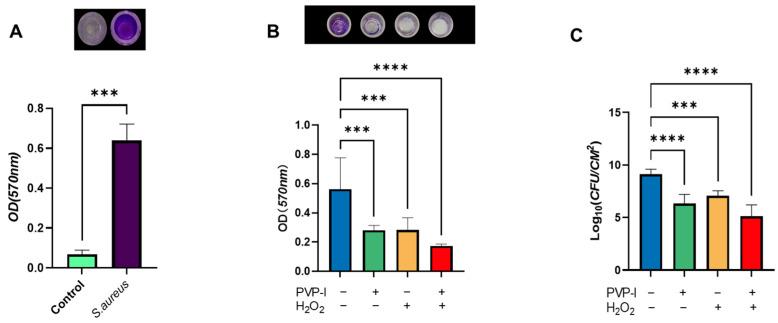
, particularly methicillin-resistant (MRSA), poses significant challenges in healthcare settings due to its ability to form biofilms on various surfaces. These biofilms enhance bacterial survival and increase resistance to conventional treatments, complicating infection control efforts. This study evaluated the efficacy of combined povidone-iodine (PVP-I) and hydrogen peroxide (HO) to disrupt pre-formed biofilms. A series of assays-including crystal violet staining, colony-forming unit (CFU) enumeration, gene expression analysis, and confocal laser scanning microscopy-were performed to assess the effects of each treatment individually and in combination. The combined treatment resulted in significantly greater reductions in biofilm biomass and viable bacteria compared with either agent alone. Gene expression analysis revealed downregulation of key biofilm-associated genes (, , , , and ), suggesting interference with biofilm stability and maintenance. While formal synergy quantification was not conducted, the observed effects suggest a potentially synergistic or additive interaction between the two agents. These findings support the use of dual antiseptic strategies as a promising approach to biofilm eradication and highlight the potential clinical utility of dual antiseptic strategies. However, we underscore the need for further optimization and safety evaluation.
特别是耐甲氧西林金黄色葡萄球菌(MRSA),由于其能够在各种表面形成生物膜,在医疗环境中构成了重大挑战。这些生物膜提高了细菌的存活率,并增加了对传统治疗的抗性,使感染控制工作变得复杂。本研究评估了聚维酮碘(PVP-I)和过氧化氢(HO)联合使用对破坏预先形成的金黄色葡萄球菌生物膜的功效。进行了一系列试验,包括结晶紫染色、菌落形成单位(CFU)计数、基因表达分析和共聚焦激光扫描显微镜检查,以单独和联合评估每种处理的效果。与单独使用任何一种药剂相比,联合处理导致生物膜生物量和活菌的减少显著更大。基因表达分析显示关键生物膜相关基因(、、、和)的下调,表明对生物膜稳定性和维持的干扰。虽然没有进行正式的协同作用定量,但观察到的效果表明两种药剂之间可能存在协同或相加相互作用。这些发现支持使用双重抗菌策略作为一种有前景的生物膜根除方法,并突出了双重抗菌策略的潜在临床应用价值。然而,我们强调需要进一步优化和安全性评估。
 Zotero 插件