
基于双能CT静脉期参数的影像组学模型预测胃肠道间质瘤中Ki-67水平
Radiomics model based on dual-energy CT venous phase parameters to predict Ki-67 levels in gastrointestinal stromal tumors.
作者信息
Liu Wen-Hua, Li Min, Ren Guo-Qiang, Tang Zhi-Yang, Shan Xiu-Hong, Yang Ben-Qiang
机构信息
Dalian Medical University, Dalian, Liaoning, China.
Department of Radiology, Jiangsu University affiliated People's Hospital (Zhenjiang First People's Hospital), Zhenjiang, Jiangsu, China.
出版信息
Front Oncol. 2025 Apr 29;15:1502062. doi: 10.3389/fonc.2025.1502062. eCollection 2025.
OBJECTIVE
To develop and validate a radiomics model based on the features of the Dual-Energy CT (DECT) venous phase iodine density maps and effective atomic number maps to predict Ki-67 expression levels in gastrointestinal stromal tumors (GISTs).
METHODS
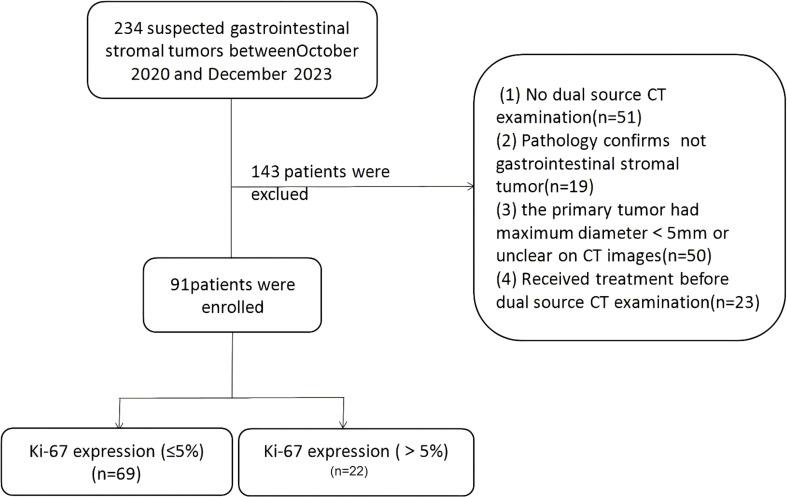
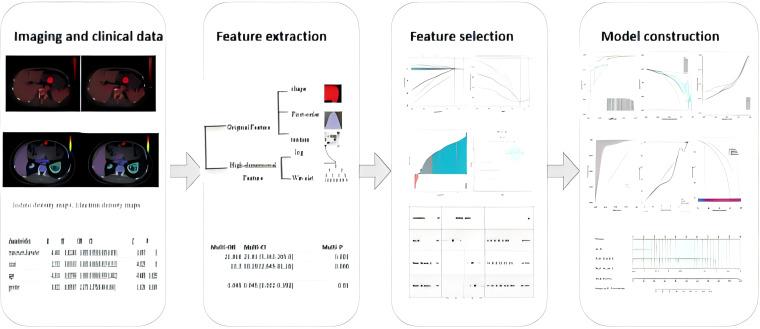
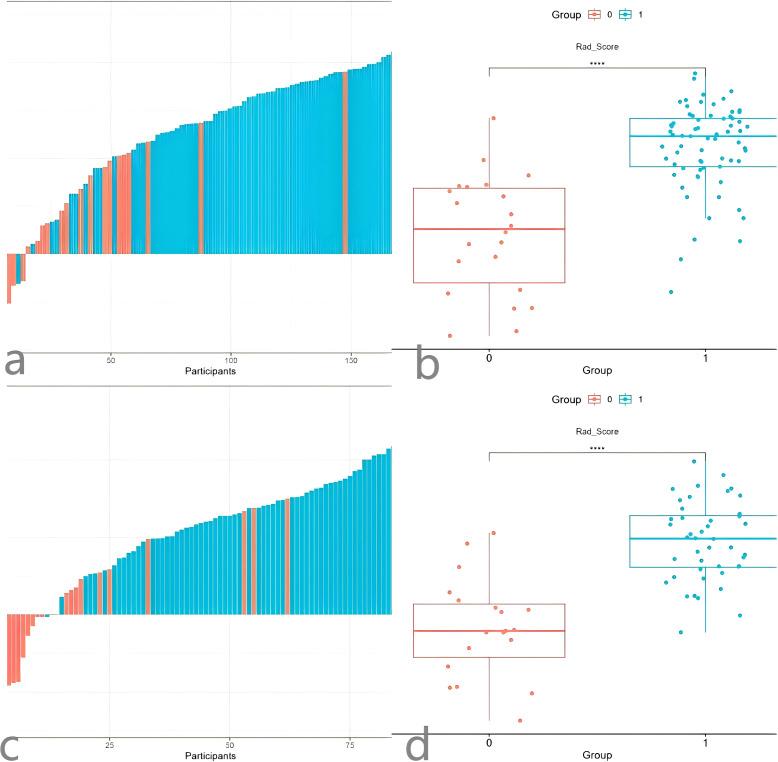
A total of 91 patients with GIST were retrospectively analyzed, including 69 patients with low Ki-67 expression (≤5%) and 22 patients with high Ki-67 expression (>5%). Four clinical features (gender, age, maximum tumor diameter, and tumor location) were extracted to construct a clinical model. The venous phase enhanced CT iodine density maps and effective atomic number maps of DSCT were used to build radiomics models. Logistic regression was used to combine radiomics features with clinical features to build a combined model. Finally, the optimal model's discrimination, calibration, and clinical decision curve were validated using the Bootstrap method.
RESULTS
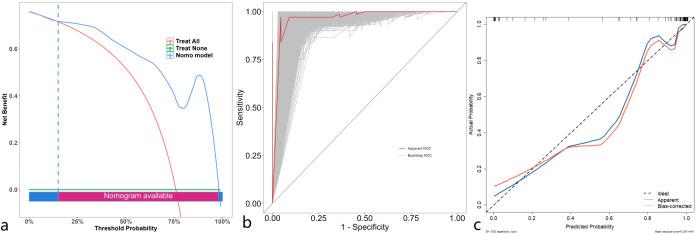
The combined model was identified as the best model, with high predictive performance. The model's discrimination had an AUC of 0.982 (95% CI, 0.9603-1). The calibration test showed a Hosmer-Lemeshow test P-value of 0.99. The clinical decision curve demonstrated a probability threshold range of 15% to 98%, with a high net benefit.
CONCLUSION
The nomogram model combining clinical features and radiomics (iodine density map radscore + effective atomic number map radscore) has the highest accuracy for preoperative prediction of Ki-67 expression in GISTs.
目的
基于双能CT(DECT)静脉期碘密度图和有效原子序数图的特征开发并验证一种放射组学模型,以预测胃肠道间质瘤(GIST)中Ki-67的表达水平。
方法
回顾性分析91例GIST患者,其中69例Ki-67低表达(≤5%),22例Ki-67高表达(>5%)。提取四个临床特征(性别、年龄、肿瘤最大直径和肿瘤位置)以构建临床模型。利用DSCT的静脉期增强CT碘密度图和有效原子序数图构建放射组学模型。采用逻辑回归将放射组学特征与临床特征相结合构建联合模型。最后,使用Bootstrap方法验证最佳模型的鉴别力、校准度和临床决策曲线。
结果
联合模型被确定为最佳模型,具有较高的预测性能。该模型的鉴别力AUC为0.982(95%CI,0.9603 - 1)。校准测试显示Hosmer-Lemeshow检验P值为0.99。临床决策曲线显示概率阈值范围为15%至98%,净效益较高。
结论
结合临床特征和放射组学(碘密度图radscore + 有效原子序数图radscore)的列线图模型对GIST患者术前预测Ki-67表达具有最高的准确性。


 Zotero 插件