
CABS-flex 3.0:一种用于模拟蛋白质结构灵活性和肽建模的在线工具。
CABS-flex 3.0: an online tool for simulating protein structural flexibility and peptide modeling.
作者信息
Wróblewski Karol, Zalewski Mateusz, Kuriata Aleksander, Kmiecik Sebastian
机构信息
University of Warsaw, Biological and Chemical Research Centre, Faculty of Chemistry, 02-089 Warsaw, Poland.
出版信息
Nucleic Acids Res. 2025 Jul 7;53(W1):W95-W101. doi: 10.1093/nar/gkaf412.
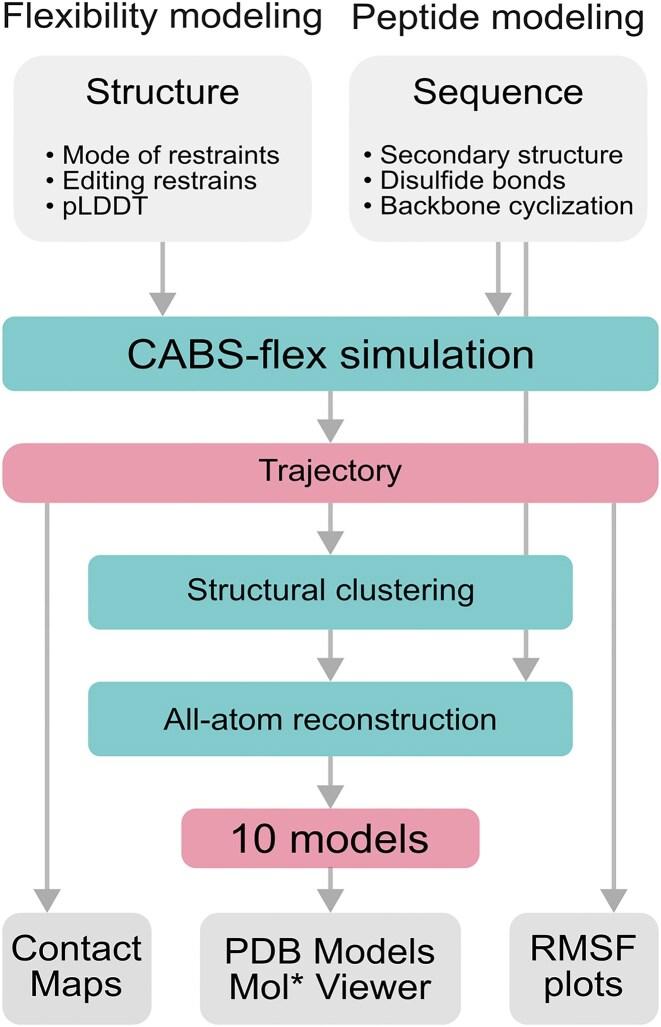
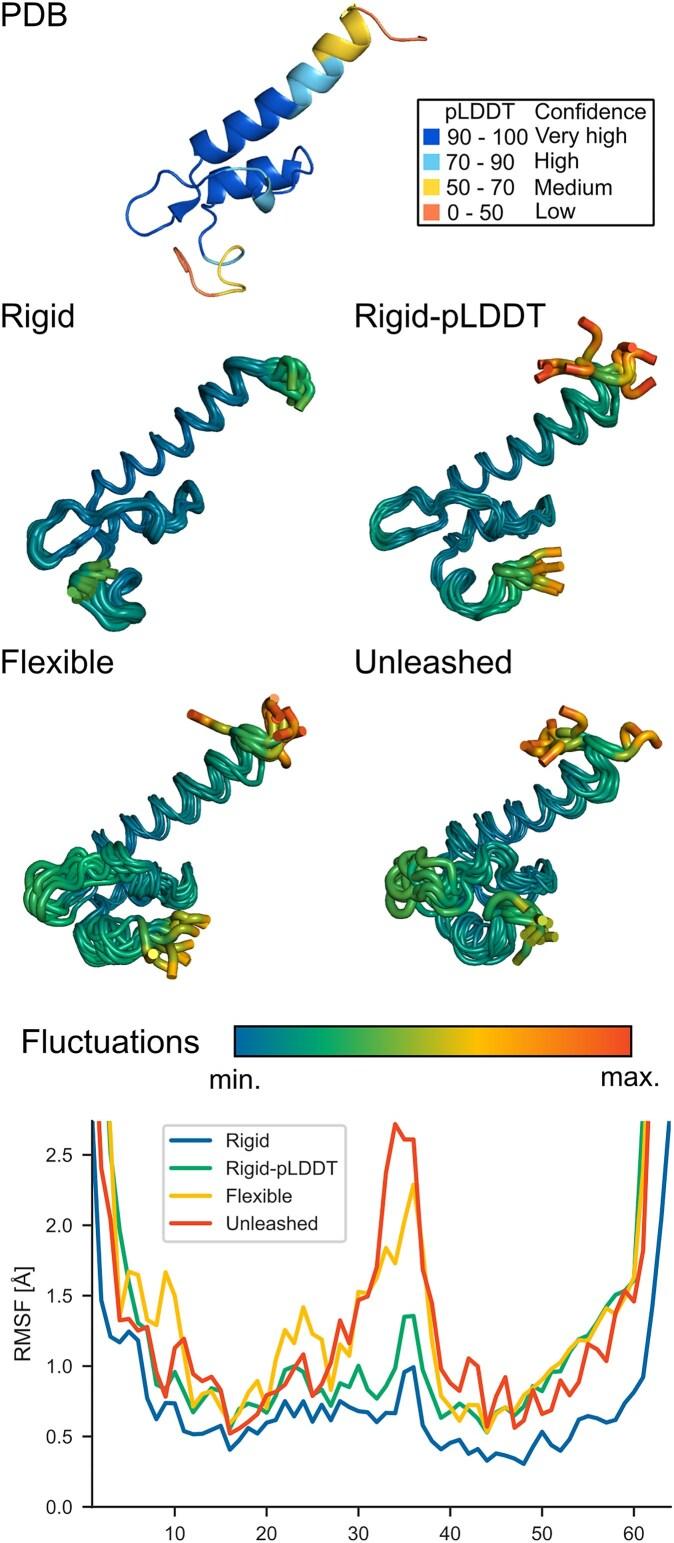
Simulating protein structure flexibility using classical methods is computationally demanding, especially for large proteins. To address this challenge, we have been developing the CABS-flex method, which enables fast simulations of protein structural flexibility by combining a coarse-grained simulation approach with all-atom detail. Previously available as the CABS-flex 2.0 web server, the method has now undergone a major upgrade with the release of CABS-flex 3.0. Key improvements include the introduction of intuitive flexibility modes that simplify the control of distance restraints and allow users to reflect known or expected dynamic regions; improved all-atom reconstruction for higher-quality model generation; a new feature for de novo peptide structure prediction, supporting both linear and cyclic peptides along with their conformational flexibility; and new tools for result analysis and visualization, facilitating deeper insights into structural flexibility. Additionally, AlphaFold pLDDT-derived restraints can be used as optional input for guiding simulations. The method accepts input as either a PDB/mmCIF structure or a sequence (for peptide modeling). Advanced options allow users to incorporate experimental or computational restraints. The CABS-flex 3.0 web server is available at https://lcbio.pl/cabsflex3. This website is free and open to all users, with no login requirement.
使用传统方法模拟蛋白质结构灵活性在计算上要求很高,尤其是对于大型蛋白质。为应对这一挑战,我们一直在开发CABS-flex方法,该方法通过将粗粒度模拟方法与全原子细节相结合,能够快速模拟蛋白质结构灵活性。该方法之前以CABS-flex 2.0网络服务器的形式提供,现在随着CABS-flex 3.0的发布进行了重大升级。主要改进包括引入直观的灵活性模式,简化距离限制的控制并允许用户反映已知或预期的动态区域;改进全原子重建以生成更高质量的模型;用于从头肽结构预测的新功能,支持线性和环状肽及其构象灵活性;以及用于结果分析和可视化的新工具,有助于更深入地了解结构灵活性。此外,源自AlphaFold pLDDT的限制可作为引导模拟的可选输入。该方法接受PDB/mmCIF结构或序列(用于肽建模)作为输入。高级选项允许用户纳入实验或计算限制。CABS-flex 3.0网络服务器可在https://lcbio.pl/cabsflex3上获取。该网站对所有用户免费开放,无需登录。



 Zotero 插件