
2019年冠状病毒病大流行与远程护理在减少床位占用方面的作用:一项系统综述
The COVID-19 Pandemic and the Role of Tele-Nursing in Reducing Bed Occupancy: A Systematic Review.
作者信息
Sheikhi Rahim Ali, Heidari Mohammad, Noorbakhsh Sepehr, Sarpiri Mohammadreza Rezaei
机构信息
Community-Oriented Nursing Midwifery Research Center, Shahrekord University of Medical Sciences, Shahrekord, Iran.
出版信息
Florence Nightingale J Nurs. 2025 Mar 10;33:1-10. doi: 10.5152/FNJN.2025.24210.
AIM
This systematic review examines the tele-nursing methods used during the coronavirus disease-2019 outbreak to manage the increase in patient numbers and investigates strategies for reducing hospital bed occupancy.
METHOD
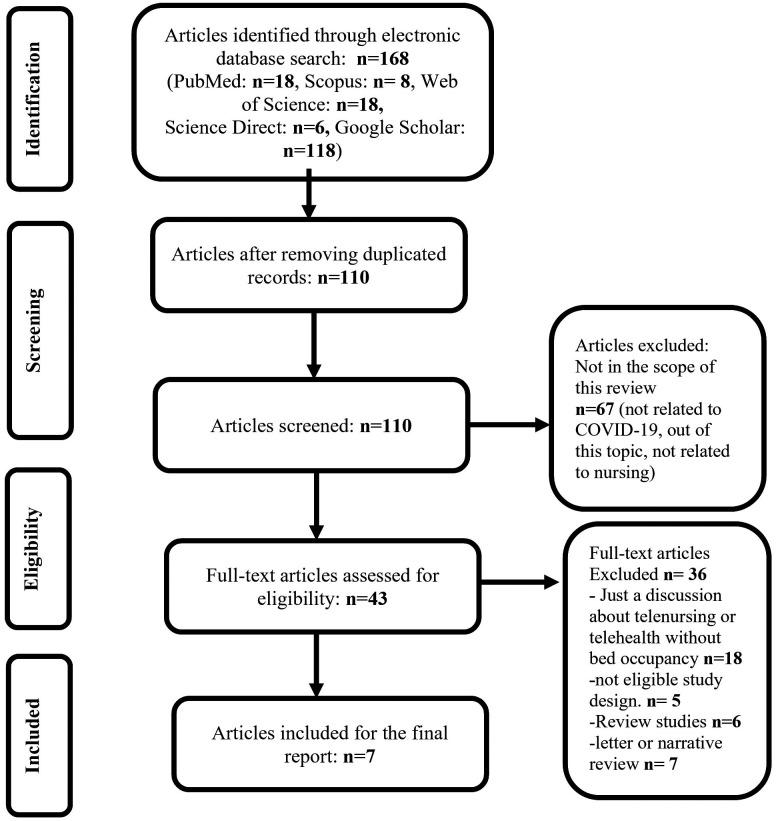
The study followed the Preferred Reporting Items for Systematic Reviews and Meta-Analyses guidelines. The primary databases used to search the literature were PubMed, Web of Science, Scopus, ProQuest, ScienceDirect, and Google Scholar. One hundred sixty eight articles have been reviewed. The keywords for this review included "Coronavirus Disease 2019," "tele-nursing," and "bed occupancy." Equivalent terms were derived from Medical Subject Headings and expert opinions and extracted from related articles.
RESULTS
Out of the 168 records identified through the initial database search, seven articles were ultimately included in the final stage of this review after a thorough analysis of their features and content to address the study questions. The results of this systematic review, based on the content analysis of the selected studies, reveal various approaches used worldwide to manage the influx of patients in hospitals due to COVID-19 infection. The findings also highlight strategies employed to reduce bed occupancy, along with the challenges faced in implementing telenursing. The results are summarized into three main themes: current care models, challenges in establishing telenursing, and strategies to decrease bed occupancy.
CONCLUSION
Tele-nursing and virtual care are crucial for reducing bed occupancy during disasters like coronavirus disease 2019. Creating communication infrastructure, developing distance education through virtual space, licensing the private sector to run tele-nursing, clarifying the medical and legal responsibilities of telehealth, developing protocols of care, community education, and using new technology for remote consultation are ways to facilitate tele-nursing and reduce hospital bed occupancy.
目的
本系统评价考察了在2019年冠状病毒病疫情期间用于应对患者数量增加的远程护理方法,并探讨了减少医院床位占用的策略。
方法
本研究遵循系统评价和Meta分析的首选报告项目指南。用于检索文献的主要数据库有PubMed、科学网、Scopus、ProQuest、ScienceDirect和谷歌学术。共审查了168篇文章。本评价的关键词包括“2019年冠状病毒病”“远程护理”和“床位占用”。从医学主题词表和专家意见中获取等效术语,并从相关文章中提取。
结果
在通过初始数据库检索确定的168条记录中,经过对其特征和内容的全面分析以解决研究问题后,最终有7篇文章被纳入本评价的最后阶段。基于所选研究的内容分析,本系统评价的结果揭示了全球范围内用于管理因COVID-19感染导致的医院患者涌入的各种方法。研究结果还突出了为减少床位占用所采用的策略,以及实施远程护理所面临的挑战。结果总结为三个主要主题:当前护理模式、建立远程护理的挑战以及减少床位占用的策略。
结论
远程护理和虚拟护理对于在2019年冠状病毒病等灾难期间减少床位占用至关重要。创建通信基础设施、通过虚拟空间开展远程教育、许可私营部门开展远程护理、明确远程医疗的医疗和法律责任、制定护理方案、开展社区教育以及使用新技术进行远程会诊是促进远程护理和减少医院床位占用的方法。

 Zotero 插件