
痴呆症患者专科姑息治疗的转诊标准。
Referral Criteria for Specialist Palliative Care for Patients With Dementia.
作者信息
Chang Yuchieh Kathryn, Philip Jennifer, van der Steen Jenny T, Van den Block Lieve, Hum Allyn Yin Mei, Pérez-Cruz Pedro E, Paiva Carlos, Mori Masanori, Chen Ping-Jen, Agar Meera R, Hanson Laura, Evans Catherine J, Hui David
机构信息
Department of Palliative Care, Rehabilitation and Integrative Medicine, University of Texas MD Anderson Cancer Center, Houston.
Department of Medicine, University of Melbourne, Fitzroy, Australia.
出版信息
JAMA Netw Open. 2025 May 1;8(5):e2510298. doi: 10.1001/jamanetworkopen.2025.10298.
IMPORTANCE
Patients with dementia have considerable supportive care needs. Specialist palliative care may be beneficial, but it is unclear which patients are most appropriate for referral and when they should be referred.
OBJECTIVE
To identify a set of consensus referral criteria for specialist palliative care for patients with dementia.
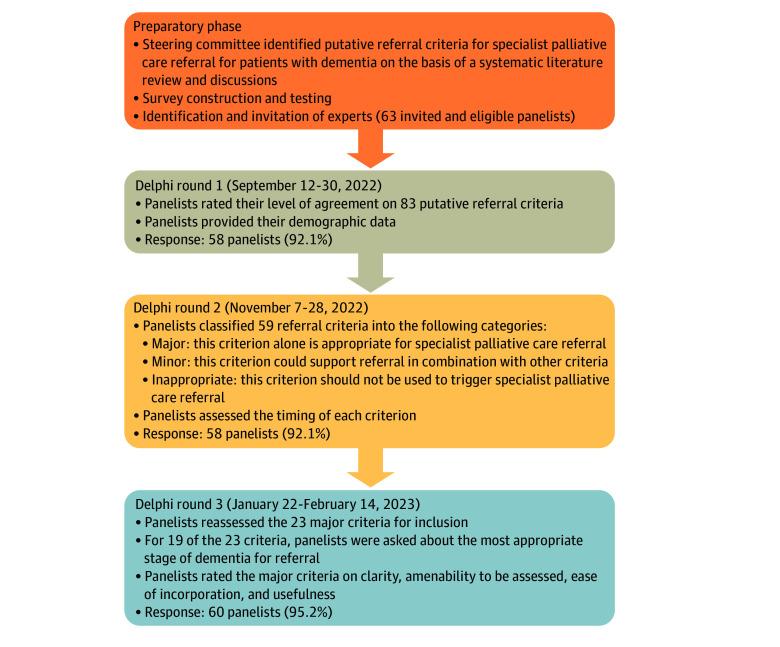
DESIGN, SETTING, AND PARTICIPANTS: In this survey study using 3 rounds of Delphi surveys, an international, multidisciplinary panel of clinicians from 5 continents with expertise in the integration of dementia and palliative care were asked to rate 83 putative referral criteria (generated from a previous systematic review and steering committee discussion). Specialist palliative care was defined as an interdisciplinary team consisting of practitioners with advanced knowledge and skills in palliative medicine offering consultative services for specialist-level palliative care in (nonhospice) inpatient, outpatient, community, and home-based settings.
MAIN OUTCOMES AND MEASURES
Consensus was defined a priori as at least 70% agreement among experts. A criterion was coded as major if the experts advocated that meeting 1 criterion alone was satisfactory to justify a referral. Data were summarized using descriptive statistics.
RESULTS
Of the 63 invited and eligible panelists, the response rate was 58 (92.1%) in round 1, 58 (92.1%) in round 2, and 60 (95.2%) in round 3. Of the 58 panelists who provided demographic data in round 1, most were aged 40 to 49 years (28 of 58 [48.3%]), and 29 panelists (50%) each were men and women. Panelists achieved consensus on 15 major and 42 minor criteria for specialist palliative care referral. The 15 major criteria were grouped under 5 categories, including dementia type (eg, rapidly progressive dementia), symptom distress (eg, severe physical symptoms), psychosocial factors or decision-making (eg, request for hastened death, assisted suicide, or euthanasia), comorbidities or complications (eg, ≥2 episodes of aspiration pneumonia in the past 12 months); and hospital use (eg, ≥2 hospitalizations within the past 3 months).
CONCLUSIONS AND RELEVANCE
In this Delphi survey study, international experts reached consensus on a range of criteria for referral to specialist palliative care. With testing and validation, these criteria may be used to standardize specialist palliative care access for patients with dementia across various care settings.
重要性
痴呆患者有大量的支持性护理需求。专科姑息治疗可能有益,但尚不清楚哪些患者最适合转诊以及何时应进行转诊。
目的
确定一套针对痴呆患者专科姑息治疗的共识性转诊标准。
设计、背景和参与者:在这项采用三轮德尔菲调查的研究中,邀请了来自五大洲的具有痴呆与姑息治疗整合专业知识的国际多学科临床医生小组,要求他们对83条假定的转诊标准(由之前的系统评价和指导委员会讨论得出)进行评分。专科姑息治疗被定义为一个跨学科团队,由在姑息医学方面具有先进知识和技能的从业者组成,为(非临终关怀)住院、门诊、社区和居家环境中的专科水平姑息治疗提供咨询服务。
主要结局和指标
事先将共识定义为专家之间至少70%的一致意见。如果专家主张仅满足1条标准就足以证明转诊合理,则将该标准编码为主要标准。使用描述性统计对数据进行总结。
结果
在63名受邀且符合条件的小组成员中,第一轮的回复率为58人(92.1%),第二轮为58人(92.1%),第三轮为60人(95.2%)。在第一轮提供人口统计学数据的58名小组成员中,大多数年龄在40至49岁之间(58人中有28人[48.3%]),男性和女性各有29名小组成员(50%)。小组成员就专科姑息治疗转诊的15条主要标准和42条次要标准达成了共识。这15条主要标准分为5类,包括痴呆类型(如快速进展性痴呆)、症状困扰(如严重身体症状)、心理社会因素或决策(如请求加速死亡、协助自杀或安乐死)、合并症或并发症(如过去12个月内≥2次吸入性肺炎发作)以及住院情况(如过去3个月内≥2次住院)。
结论及意义
在这项德尔菲调查研究中,国际专家就一系列转诊至专科姑息治疗的标准达成了共识。经过测试和验证后,这些标准可用于规范不同护理环境中痴呆患者获得专科姑息治疗的途径。
 Zotero 插件