
蛋白质组学和磷酸化蛋白质组学揭示了肝纤维化中失调的激酶及潜在治疗方法。
Proteomics and Phosphoproteomics Revealed Dysregulated Kinases and Potential Therapy for Liver Fibrosis.
作者信息
Cheng Xinyu, Kang Li, Liu Jinfang, Wang Qingye, Zhang Zhenpeng, Zhang Li, Xie Yuping, Chang Lei, Zeng Daobing, Tian Lantian, Zhang Lingqiang, Xu Ping, Li Yanchang
机构信息
Anhui Medical University School of Basic Medicine, Anhui, PR China; State Key Laboratory of Medical Proteomics, Beijing Proteome Research Center, National Center for Protein Sciences (Beijing), Beijing Institute of Lifeomics, Beijing, China.
State Key Laboratory of Medical Proteomics, Beijing Proteome Research Center, National Center for Protein Sciences (Beijing), Beijing Institute of Lifeomics, Beijing, China; School of Public Health, China Medical University, Shenyang, China.
出版信息
Mol Cell Proteomics. 2025 May 12;24(6):100991. doi: 10.1016/j.mcpro.2025.100991.
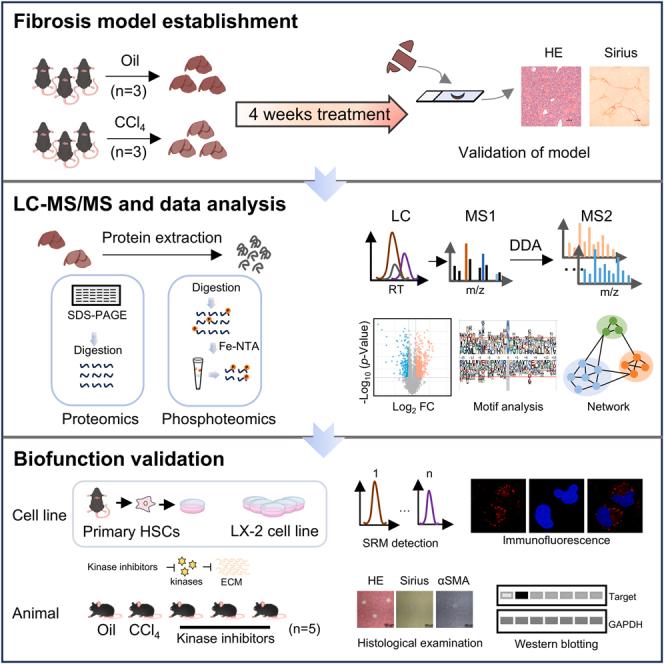
Liver fibrosis is the initial stage of most liver diseases, and it is also a pathological process involving the liver in the late stages of many metabolic diseases. Therefore, it is important to systematically understand the pathological mechanism of liver fibrosis and seek therapeutic approaches for intervention and treatment of liver fibrosis. Disordered proteins and their post-translational modifications, such as phosphorylation, play vital roles in the occurrence and development of liver fibrosis. However, the regulatory mechanisms that govern this process remain poorly understood. In this study, we analyzed and quantified the liver proteome and phosphoproteome of carbon tetrachloride-induced early liver fibrosis model in mice. Proteomic analysis revealed that the pathways involved in extracellular matrix recombination, collagen formation, metabolism and other related disorders, and protein phosphorylation modification pathways were also significantly enriched. In addition, Western blotting and phosphoproteomics demonstrated that phosphorylation levels were elevated in the context of liver fibrosis. A total of 13,152 phosphosites were identified, with 952 sites increased, whereas only 156 sites decreased. Furthermore, the upregulated phosphorylation sites, which exhibited no change at the proteome level, mainly shared a common [xxxSPxxx] motif. Consequently, the kinase-substrate analysis ascertained the overactive kinases of these upregulated substrates, which ultimately led to the identification of 13 significantly altered kinases within this dataset. These kinases were mainly cataloged into the STE, CMGC, and CAMK kinase families. Among them, STK4 (serine/threonine-protein kinase 4), GSK3α (glycogen synthase kinase 3α), and CDK11B (cyclin-dependent kinase 11B) were subsequently validated though cellular and animal experiments, and the results demonstrated that their inhibitors could effectively reduce the activation of hepatic stellate cells and extracellular matrix production. These kinases may represent potential therapeutic targets for liver fibrosis, and their inhibitors may serve as promising antihepatic fibrosis drugs.
肝纤维化是大多数肝脏疾病的初始阶段,也是许多代谢性疾病晚期累及肝脏的病理过程。因此,系统了解肝纤维化的病理机制并寻找干预和治疗肝纤维化的方法具有重要意义。蛋白质紊乱及其翻译后修饰,如磷酸化,在肝纤维化的发生和发展中起着至关重要的作用。然而,调控这一过程的机制仍知之甚少。在本研究中,我们分析并定量了四氯化碳诱导的小鼠早期肝纤维化模型的肝脏蛋白质组和磷酸化蛋白质组。蛋白质组学分析显示,参与细胞外基质重组、胶原蛋白形成、代谢及其他相关紊乱的途径,以及蛋白质磷酸化修饰途径也显著富集。此外,蛋白质免疫印迹和磷酸化蛋白质组学表明,在肝纤维化背景下磷酸化水平升高。共鉴定出13152个磷酸化位点,其中952个位点增加,而只有156个位点减少。此外,在蛋白质组水平上没有变化的上调磷酸化位点,主要共享一个共同的[xxxSPxxx]基序。因此,激酶-底物分析确定了这些上调底物的过度活跃激酶,最终在该数据集中鉴定出13种显著改变的激酶。这些激酶主要归类于STE、CMGC和CAMK激酶家族。其中,STK4(丝氨酸/苏氨酸蛋白激酶4)、GSK3α(糖原合酶激酶3α)和CDK11B(细胞周期蛋白依赖性激酶11B)随后通过细胞和动物实验得到验证,结果表明它们的抑制剂可有效降低肝星状细胞的活化和细胞外基质的产生。这些激酶可能代表肝纤维化的潜在治疗靶点,它们的抑制剂可能成为有前景的抗肝纤维化药物。



 Zotero 插件