
单细胞线粒体形态学揭示细胞异质性并预测复合体I、III和ATP合酶抑制反应。
Single-cell mitochondrial morphomics reveals cellular heterogeneity and predicts complex I, III, and ATP synthase Inhibition responses.
作者信息
Sutharsan Ratneswary, Biaut Hontaas Maddi, Li Yan, Xiong Hao, Preckel Hartwig, Sue Carolyn M, Wali Gautam
机构信息
Neuroscience Research Australia (NeuRA), Sydney, Australia.
School of Biomedical Sciences, University of New South Wales, Sydney, Australia.
出版信息
Sci Rep. 2025 May 14;15(1):16715. doi: 10.1038/s41598-025-99972-z.
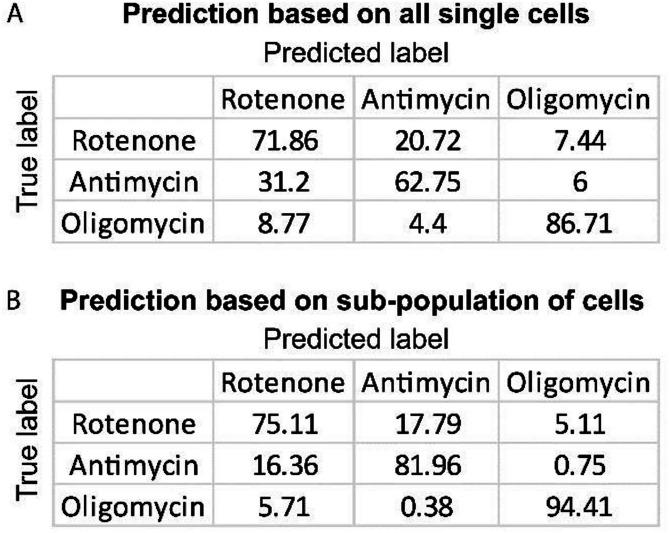
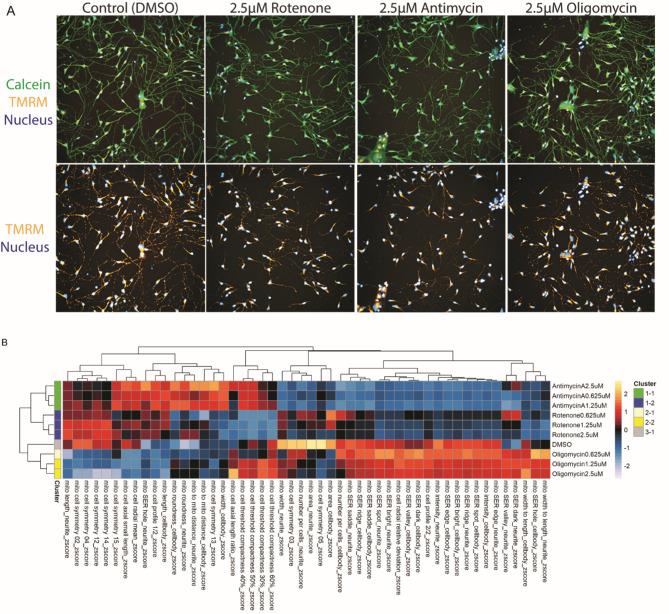
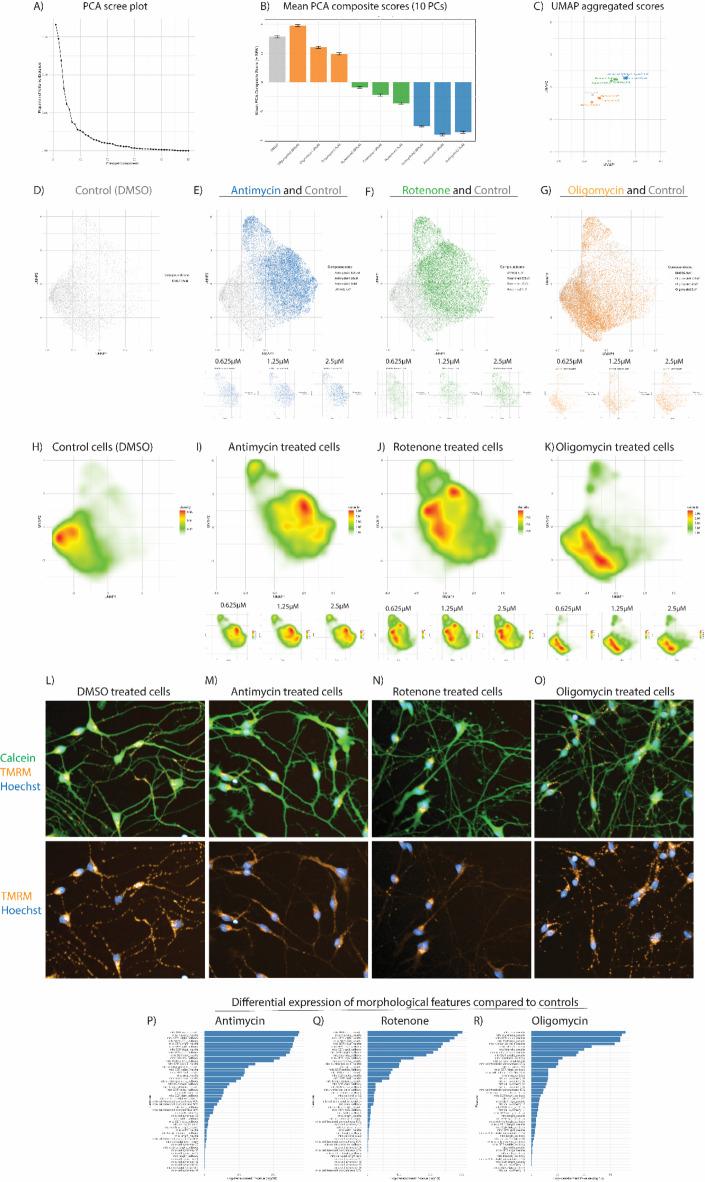
Mitochondrial heterogeneity drives diverse cellular responses in neurodegenerative diseases, complicating the evaluation of mitochondrial dysfunction. In this study, we describe a high-throughput imaging and analysis approach to investigate cell-to-cell mitochondrial variability. We applied known mitochondrial function inhibitors - rotenone, antimycin, and oligomycin to inhibit complexes I, III, and V (ATP synthase) function in human induced pluripotent stem cell-derived cortical neurons, a model commonly used in neurodegenerative disease research. We captured a large number of cell images and extracted a diverse range of mitochondrial morphological features related to shape, size, texture, and spatial distribution, for an unbiased and comprehensive analysis of mitochondrial morphology. Group-level cell analysis, which examines the collective responses of cells exposed to the same mitochondrial inhibitor, showed that cells treated with rotenone, antimycin, or oligomycin clustered together based on their shared morphological changes. Rotenone and antimycin, both targeting different complexes of the electron transport chain, formed sub-clusters within a larger cluster. In contrast, oligomycin, which inhibits ATP synthase, resulted in a distinct cluster likely due to its differing effect on ATP production. Single-cell analysis using dimensionality reduction techniques revealed distinct subpopulations of cells with varying degrees of sensitivity to each mitochondrial inhibitor, identifying the most affected cells. Mitochondrial feature differential expression analysis showed that neurite-related mitochondrial features, such as intensity and size, were more severely impacted than cell body-related mitochondrial features, particularly with rotenone and antimycin, which target the electron transport chain. In contrast, oligomycin which affects ATP synthesis by directly inhibiting ATP synthase showed relatively less severe alterations in neurite-related mitochondrial features, highlighting a distinct effect of the mode of action between inhibitors. By incorporating the most affected cells into machine learning models, we significantly improved the prediction accuracy of mitochondrial dysfunction outcomes - 81.97% for antimycin, 75.12% for rotenone, and 94.42% for oligomycin. This enhancement underscores the value of targeting highly responsive cell subpopulations, offering a more precise method for evaluating mitochondrial modulators and therapeutic interventions in neurodegenerative diseases.
线粒体异质性在神经退行性疾病中驱动多种细胞反应,使线粒体功能障碍的评估变得复杂。在本研究中,我们描述了一种高通量成像和分析方法,用于研究细胞间的线粒体变异性。我们应用已知的线粒体功能抑制剂——鱼藤酮、抗霉素和寡霉素,来抑制人诱导多能干细胞衍生的皮质神经元中复合物I、III和V(ATP合酶)的功能,这是神经退行性疾病研究中常用的一种模型。我们捕获了大量细胞图像,并提取了与形状、大小、纹理和空间分布相关的各种线粒体形态特征,以便对线粒体形态进行无偏且全面的分析。群体水平的细胞分析检查了暴露于相同线粒体抑制剂的细胞的集体反应,结果表明,用鱼藤酮、抗霉素或寡霉素处理的细胞根据其共同的形态变化聚集在一起。鱼藤酮和抗霉素都靶向电子传递链的不同复合物,它们在一个较大的簇中形成了子簇。相比之下,抑制ATP合酶的寡霉素导致形成了一个明显不同的簇,这可能是由于其对ATP产生的不同影响。使用降维技术的单细胞分析揭示了对每种线粒体抑制剂具有不同敏感程度的不同细胞亚群,从而确定了受影响最大的细胞。线粒体特征差异表达分析表明,与神经突相关的线粒体特征,如强度和大小,比与细胞体相关的线粒体特征受到的影响更严重,尤其是在针对电子传递链的鱼藤酮和抗霉素作用下。相比之下,通过直接抑制ATP合酶来影响ATP合成的寡霉素在与神经突相关的线粒体特征方面显示出相对较轻的改变,突出了抑制剂作用方式之间的明显差异。通过将受影响最大的细胞纳入机器学习模型,我们显著提高了线粒体功能障碍结果的预测准确性——抗霉素为81.97%,鱼藤酮为75.12%,寡霉素为94.42%。这种提高强调了针对高反应性细胞亚群的价值,为评估神经退行性疾病中的线粒体调节剂和治疗干预提供了一种更精确的方法。

 Zotero 插件