
通过应用术后加速康复(ERAS)路径缩短初次全膝关节置换术患者的住院时间:一项多中心、前瞻性、随机对照试验。
Reducing the length of hospital stay for patients undergoing primary total knee arthroplasty by application of enhanced recovery after surgery (ERAS) pathway: a multicenter, prospective, randomized controlled trial.
作者信息
Liao Chenxi, Lai Xingning, Zhong Jie, Zeng Wencong, Zhang Jiannan, Deng Wanxin, Shu Jiayun, Zhong Haobo, Cai Liangyu, Liao Ren
机构信息
Department of Anesthesia and Operation Center, Research Unit for Perioperative Stress Assessment and Clinical Decision, Chinese Academy of Medical Sciences (2018RU012), West China Hospital of Sichuan University, No.37 Guo Xue Lane, Chengdu, 610041, China.
Department of Anesthesiology, Huizhou First Hospital, No.20 Jiangbei Sanxin South Road, Huizhou, 516001, China.
出版信息
Eur J Med Res. 2025 May 14;30(1):385. doi: 10.1186/s40001-025-02647-8.
BACKGROUND
The proportion of elderly patients undergoing Total knee arthroplasty (TKA) is growing. Optimizing and accelerating postoperative recovery for TKA patients is critical in clinical practice. Enhanced Recovery After Surgery (ERAS) is a protocol involving a series of evidence-based perioperative optimization strategies to minimize surgical stress and expedite recovery, and a multidisciplinary ERAS pathway was established jointly by anesthesiologists and orthopedic surgeons in this study. The authors hypothesized that application of the ERAS pathway can reduce the length of hospital stay (LOS) for patients undergoing primary TKA.
MATERIALS AND METHODS
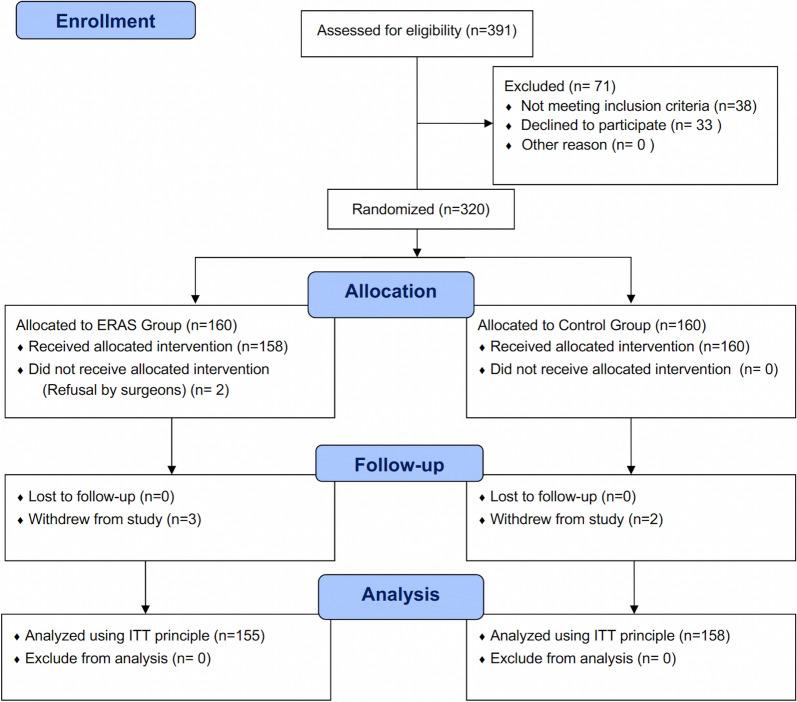
This multicenter, prospective, randomized controlled trial was conducted from February 1, 2021 to January 31, 2023, and included patients undergoing elective primary TKA. 320 patients were randomly assigned to either the ERAS group (practice according to the ERAS pathway) or the control group (without ERAS pathway implementation) in a 1:1 ratio. The primary outcome was the total LOS in hospital.
RESULTS
LOS in the ERAS group was 5.92 ± 1.16 days, significantly shorter than the 8.17 ± 1.76 days in the control group (p < 0.001). Postoperative LOS and time to independent ambulation were significantly shorter in the ERAS group compared to the control group (p < 0.001). On postoperative day 1, significantly less participants reported pain both in rest and during mobilization in the ERAS group than the control group (p < 0.001). The incidences of thirst and postoperative nausea and vomiting (PONV) was significantly reduced in the ERAS group compared to the control group (16.8% vs. 88.6%, and 2.6% vs. 24.7%, respectively, p < 0.001). No perioperative deaths or reoperations within 30 days occurred in either group.
CONCLUSION
The application of an ERAS pathway for primary TKA significantly reduces LOS, alleviates postoperative pain, and lowers the incidence of adverse events compared to perioperative management without ERAS pathway implementation.
TRIAL REGISTRATION
The National Institutes of Health Clinical Trials Registry, NCT03517098. Registered on April 24, 2018.
背景
接受全膝关节置换术(TKA)的老年患者比例正在增加。在临床实践中,优化并加速TKA患者的术后恢复至关重要。术后加速康复(ERAS)是一种包含一系列循证围手术期优化策略的方案,旨在最大程度减少手术应激并加快恢复,本研究中麻醉科医生和骨科医生联合建立了多学科ERAS路径。作者推测,应用ERAS路径可缩短初次TKA患者的住院时间(LOS)。
材料与方法
本多中心、前瞻性、随机对照试验于2021年2月1日至2023年1月31日进行,纳入择期初次TKA患者。320例患者按1:1比例随机分为ERAS组(按照ERAS路径实施)或对照组(未实施ERAS路径)。主要结局指标为总住院时间。
结果
ERAS组的住院时间为5.92±1.16天,显著短于对照组的8.17±1.76天(p<0.001)。与对照组相比,ERAS组术后住院时间和独立行走时间显著缩短(p<0.001)。术后第1天,ERAS组静息和活动时报告疼痛的参与者明显少于对照组(p<0.001)。与对照组相比,ERAS组口渴及术后恶心呕吐(PONV)的发生率显著降低(分别为16.8%对88.6%,2.6%对24.7%,p<0.001)。两组均未发生围手术期死亡或30天内再次手术。
结论
与未实施ERAS路径的围手术期管理相比,应用ERAS路径进行初次TKA可显著缩短住院时间,减轻术后疼痛,并降低不良事件的发生率。
试验注册
美国国立卫生研究院临床试验注册库,NCT03517098。于2018年4月24日注册。
 Zotero 插件