
在CDK4/6抑制剂治疗进展后的HR + /HER2-乳腺癌转移性病变的福尔马林固定石蜡包埋(FFPE)样本上进行ESR1检测。
ESR1 testing on FFPE samples from metastatic lesions in HR + /HER2- breast cancer after progression on CDK4/6 inhibitor therapy.
作者信息
Venetis Konstantinos, Cursano Giulia, Scafetta Roberta, Giachetti Pier Paolo Maria Berton, Concardi Alberto, De Camilli Elisa, D'Ercole Marianna, Mane Eltjona, Frascarelli Chiara, Marra Antonio, Gandini Sara, Pepe Francesco, Scagnoli Simone, Rossi Silvia Maria, Troiano Raffaella, Speziale Elena, De Angelis Carmine, Troncone Giancarlo, Malapelle Umberto, Perrone Giuseppe, Botticelli Andrea, Viale Giuseppe, Curigliano Giuseppe, Guerini Rocco Elena, Criscitiello Carmen, Fusco Nicola
机构信息
Division of Pathology, European Institute of Oncology IRCCS, Milan, Italy.
Department of Oncology and Hemato-Oncology, University of Milan, Milan, Italy.
出版信息
Breast Cancer Res. 2025 May 14;27(1):79. doi: 10.1186/s13058-025-02020-x.
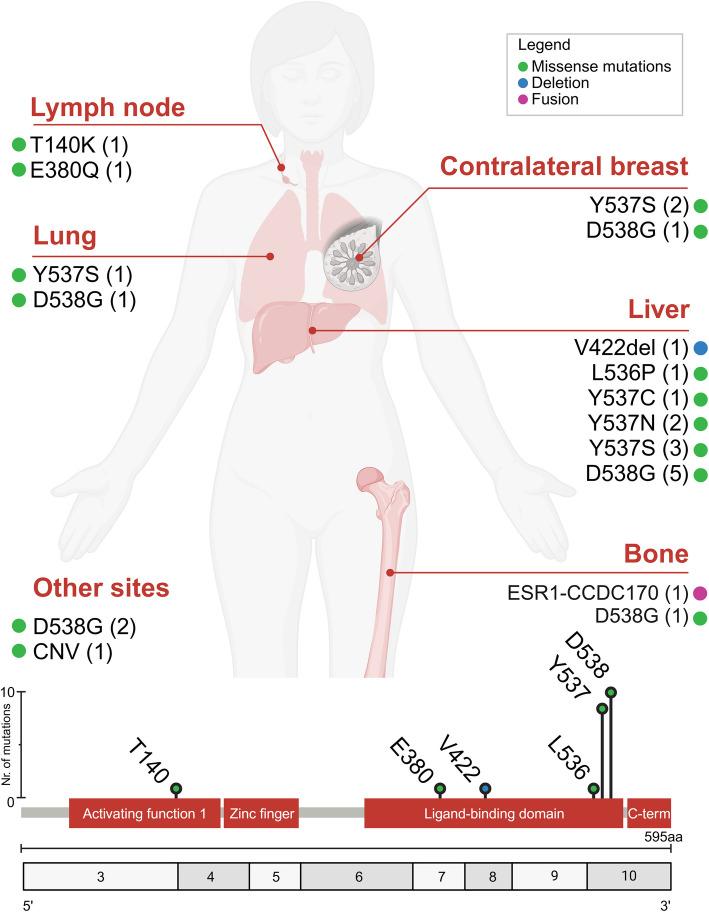
Mutations in ESR1 play a critical role in resistance to endocrine therapy (ET) in hormone receptor-positive (HR +)/HER2- metastatic breast cancer (MBC). Testing for ESR1 mutations is essential for guiding treatment with novel oral selective estrogen receptor degraders (SERDs) like elacestrant or camizestrant. While most studies have utilized liquid biopsy (LB) for mutation detection, the role of formalin-fixed paraffin-embedded (FFPE) tissue biopsy in this context remains unclear. In this study, we analyzed a cohort of HR + /HER2- MBC patients who experienced resistance to ET and CDK4/6 inhibitors. Next-generation sequencing (NGS) was performed on FFPE biopsy samples obtained from metastatic sites at the time of disease progression. ESR1 mutations were detected in 24 out of 38 patients (63.2%), with p.D538G identified in 10 patients (45.5%) and p.Y537S in 6 patients (27.2%) as the most frequent alterations. One patient exhibited dual ESR1 mutations, and a recurrent ESR1-CCDC170 gene fusion was identified, underscoring the diversity and potential interplay of genetic alterations driving resistance in HR + /HER2- MBC. Notably, lung metastases were significantly more common in ESR1 mutant cases (8/24, 33.3%) compared to wild-type cases (1/14, 7.1%), while liver metastases showed no difference between mutant (12/24, 50.0%) and wild-type groups (7/14, 50.0%). Co-mutations in actionable pathways, particularly PIK3CA, were observed in n = 10 ESR1 mutant tumors (41.6%), highlighting their contribution to resistance mechanisms and posing significant challenges for treatment selection, as these alterations may necessitate combination therapies to effectively target multiple resistance pathways. This study presents new insights into the prevalence and clinical significance of ESR1 mutations in HR + /HER2- MBC, highlighting the potential utility of FFPE biopsy samples as a viable alternative or complementary approach to LB for mutation detection, particularly in resource-limited settings where access to ctDNA analysis may be constrained.
ESR1基因的突变在激素受体阳性(HR+)/人表皮生长因子受体2阴性(HER2-)转移性乳腺癌(MBC)对内分泌治疗(ET)的耐药中起着关键作用。检测ESR1基因突变对于指导使用新型口服选择性雌激素受体降解剂(SERD)如艾拉司群或卡米司群进行治疗至关重要。虽然大多数研究采用液体活检(LB)进行突变检测,但在这种情况下福尔马林固定石蜡包埋(FFPE)组织活检的作用仍不明确。在本研究中,我们分析了一组对ET和细胞周期蛋白依赖性激酶4/6(CDK4/6)抑制剂耐药的HR+/HER2-MBC患者。在疾病进展时从转移部位获取的FFPE活检样本上进行了二代测序(NGS)。38例患者中有24例(63.2%)检测到ESR1基因突变,其中最常见的改变是10例患者(45.5%)的p.D538G和6例患者(27.2%)的p.Y537S。1例患者表现出双重ESR1基因突变,并且鉴定出一种复发性ESR1-CCDC170基因融合,这突出了驱动HR+/HER2-MBC耐药的基因改变的多样性和潜在相互作用。值得注意的是,与野生型病例(1/14,7.1%)相比,ESR1突变病例中肺转移明显更常见(8/24,33.3%),而肝转移在突变组(12/24,50.0%)和野生型组(7/14,50.0%)之间没有差异。在n = 10例ESR1突变肿瘤(41.6%)中观察到可操作通路的共突变,特别是磷脂酰肌醇-3激酶催化亚基α(PIK3CA),这突出了它们对耐药机制的贡献,并对治疗选择构成重大挑战,因为这些改变可能需要联合治疗以有效靶向多个耐药通路。本研究为HR+/HER2-MBC中ESR1基因突变的发生率和临床意义提供了新的见解,强调了FFPE活检样本作为LB用于突变检测的可行替代或补充方法潜在的实用性,特别是在获取循环肿瘤DNA(ctDNA)分析可能受限的资源有限的环境中。
 Zotero 插件