
减轻食土癖行为的健康教育与促进干预措施:一项范围综述
Health Education and Promotion Interventions to Mitigate Geophagic Practise: A Scoping Review.
作者信息
Malebatja Mohora Feida, Randa Moreoagae Bertha, Mokgatle Mathildah Mpata, Oguntibeju Oluwafemi Omoniyi
机构信息
Department of Public Health, Environmental and Occupational Health Division, School of Healthcare Sciences, Sefako Makgatho Health Sciences University, Pretoria, South Africa.
Phytomedicine and Phytochemistry Group, Department of Biomedical Sciences, Faculty of Health and Wellness Sciences, Cape Peninsula University, Bellville, South Africa.
出版信息
Public Health Rev. 2025 Apr 30;46:1607614. doi: 10.3389/phrs.2025.1607614. eCollection 2025.
OBJECTIVES
This study aimed to review health education and promotion interventions that will assist in mitigating the practise of geophagy to reduce the potential health risks, mortalities and morbidities that are linked to geophagic practise.
METHODS
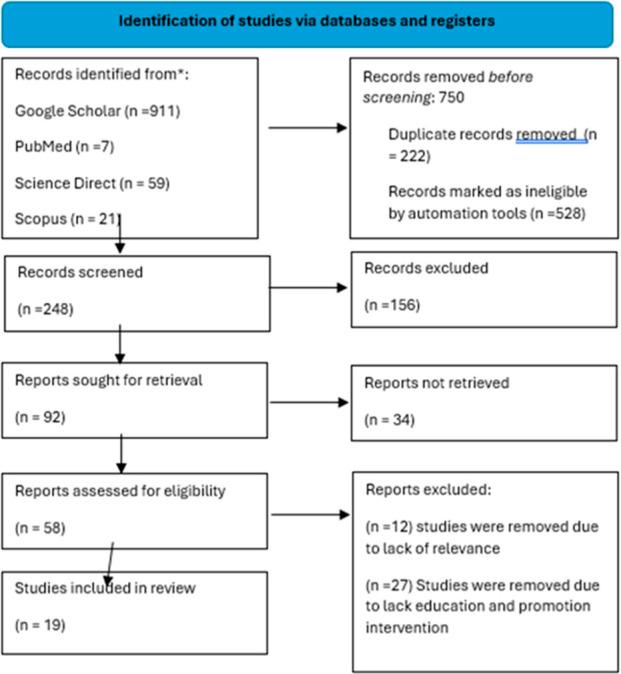
A scoping review was carried out guided by Arksey and O'Malley's (2005) methodological framework and PRISMA reporting flowchart.
RESULTS
This scoping review found that health education and promotion interventions focusing on geophagy, nutrition, the uptake of iron and folic acid supplements, the potential health risks of geophagy, anaemia risk during pregnancy, oral and intravenous iron therapy and randomised trials are some of the methods that are currently used to prevent and control the practise of geophagy amongst women of reproductive age at antenatal care units, school and community level.
CONCLUSION
It is concluded that the existing health education and promotion interventions that can assist women of reproductive age to cease the practise of geophagia are not effective. More emphasis should be given to the establishment of health education awareness programmes on the practise of geophagy, nutrition, and iron and folic acids uptake at community level.
目的
本研究旨在回顾健康教育与促进干预措施,以帮助减少食土癖行为,降低与食土癖相关的潜在健康风险、死亡率和发病率。
方法
在阿克西和奥马利(2005年)的方法框架及PRISMA报告流程图的指导下进行了范围综述。
结果
本次范围综述发现,关注食土癖、营养、铁和叶酸补充剂的摄入、食土癖的潜在健康风险、孕期贫血风险、口服和静脉铁疗法以及随机试验的健康教育与促进干预措施,是目前用于在产前护理单位、学校和社区层面预防和控制育龄妇女食土癖行为的一些方法。
结论
得出的结论是,现有的有助于育龄妇女停止食土癖行为的健康教育与促进干预措施无效。应更加强调在社区层面建立关于食土癖行为、营养以及铁和叶酸摄入的健康教育意识项目。
 Zotero 插件