
卡塔尔烟草控制中心纯吸烟者戒烟率比较:电话咨询与面对面咨询
Comparison of quit rates among exclusive cigarette smokers at Tobacco Control Center in Qatar: telephone versus face-to-face consultation.
作者信息
Aljaafar Muslem M, Kouyoumjian Silva, Mahmoud Gafar, AlMulla Ahmad
机构信息
Tobacco Control Center, WHO Collaborating Center, Department of Medicine, Hamad Medical Corporation, P.O. Box 3050, Doha, Qatar.
出版信息
BMC Prim Care. 2025 May 15;26(1):168. doi: 10.1186/s12875-025-02858-2.
BACKGROUND
During the coronavirus 2019 pandemic, smoking cessation services were delivered by telephone instead of routine face-to-face care. The objective of this study was to (1) determine if telephone care increases smoking quit rate compared to face-to-face intervention and (2) investigate factors associated with successful smoking cessation.
METHODS
A retrospective study design was utilized. Random selection of patients from two groups (face-to-face care and telephone care) that completed 3 follow-up sessions in Tobacco Control Center in Hamad Medical Corporation in Qatar was conducted from April 2020 to September 2021. Quit rates were compared at 4-week, 8-week and 12-week follow-up visits and a multivariable logistic regression analysis was conducted to obtain factors related to successful quitting at 12-week follow-up.
RESULTS
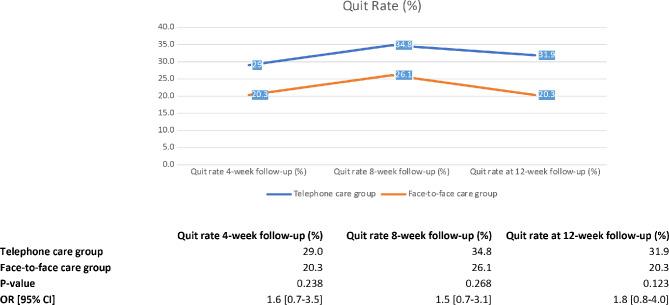
A total of 138 patients were included in this study (69 patients for each group). At 12-week follow-up, 31.9% of patients of telephone care (n = 22) succeeded in quitting smoking, while only 20.3% (n = 14) remained abstinent in the face-to-face care group. Telephone care compared with standard care increased the odds of success in stopping smoking (AOR = 3.279; 95% Cl: 1.191-9.026). Also, smokers with a previous quit attempt were significantly related to stopping smoking successfully (AOR = 4.724; 95% Cl: 1.131-19.727). Higher consumption of self-reported cigarette smoking was statistically associated with lower success rates in smoking cessation (AOR = 0.919; 95% Cl: 0.874-0.966).
CONCLUSION
Our data suggests that providing telephone care seems more effective in smoking cessation treatment compared with routine face-to-face intervention. However, further formal assessment as randomized clinical trial needs to be conducted for more evaluation.
背景
在2019年冠状病毒病大流行期间,戒烟服务通过电话提供,而非常规的面对面护理。本研究的目的是:(1)确定与面对面干预相比,电话护理是否能提高戒烟率;(2)调查与成功戒烟相关的因素。
方法
采用回顾性研究设计。从2020年4月至2021年9月,在卡塔尔哈马德医疗公司烟草控制中心完成3次随访的两组患者(面对面护理组和电话护理组)中随机选取患者。比较4周、8周和12周随访时的戒烟率,并进行多变量逻辑回归分析,以获得与12周随访时成功戒烟相关的因素。
结果
本研究共纳入138例患者(每组69例)。在12周随访时,电话护理组31.9%的患者(n = 22)成功戒烟,而面对面护理组仅有20.3%(n = 14)保持戒烟状态。与标准护理相比,电话护理增加了戒烟成功的几率(调整后比值比[AOR]=3.279;95%置信区间[Cl]:1.191 - 9.026)。此外,既往有戒烟尝试的吸烟者与成功戒烟显著相关(AOR = 4.724;95% Cl:1.131 - 19.727)。自我报告的吸烟量越高,戒烟成功率在统计学上越低(AOR = 0.919;95% Cl:0.874 - 0.966)。
结论
我们的数据表明,与常规的面对面干预相比,提供电话护理在戒烟治疗中似乎更有效。然而,需要进行进一步的正式评估,如随机临床试验,以进行更多评估。
 Zotero 插件