
不同机制可抵消II-C型CRISPR-Cas系统中无关CRISPR RNA的产生。
Disparate mechanisms counteract extraneous CRISPR RNA production in type II-C CRISPR-Cas systems.
作者信息
Feussner Maximilian, Migur Angela, Mitrofanov Alexander, Alkhnbashi Omer S, Backofen Rolf, Beisel Chase L, Weinberg Zasha
机构信息
Bioinformatics Group, Department of Computer Science and Interdisciplinary Centre for Bioinformatics, Leipzig University, D-04107 Leipzig, Germany.
Helmholtz Institute for RNA-based Infection Research (HIRI), Helmholtz-Centre for Infection Research (HZI), D-97080 Würzburg, Germany.
出版信息
Microlife. 2025 May 14;6:uqaf007. doi: 10.1093/femsml/uqaf007. eCollection 2025.
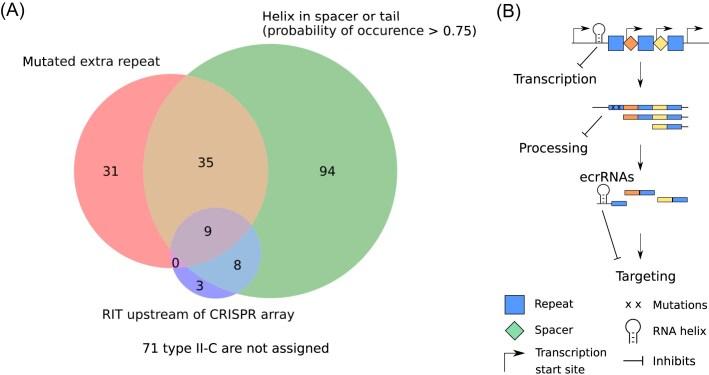
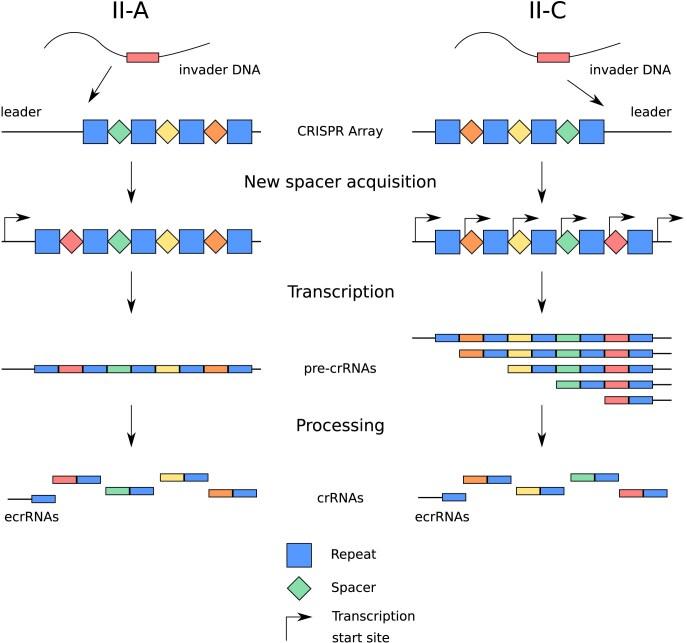
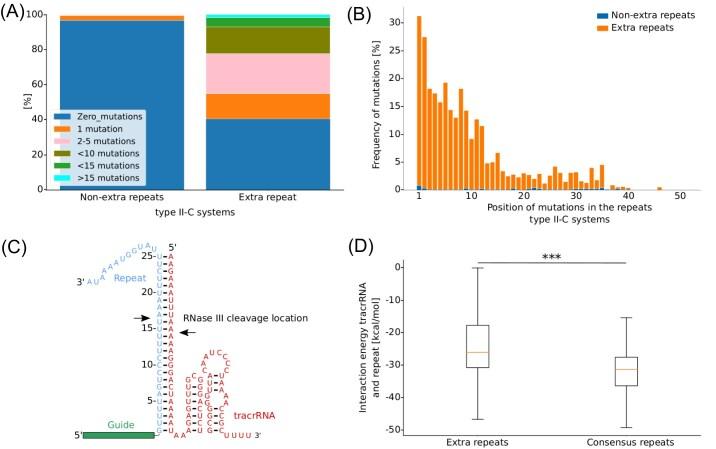
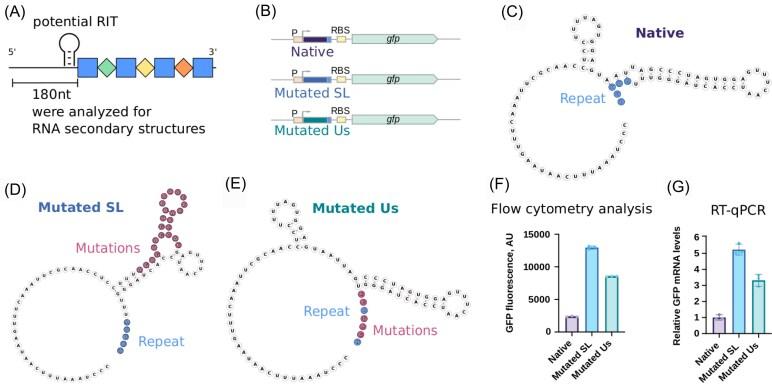
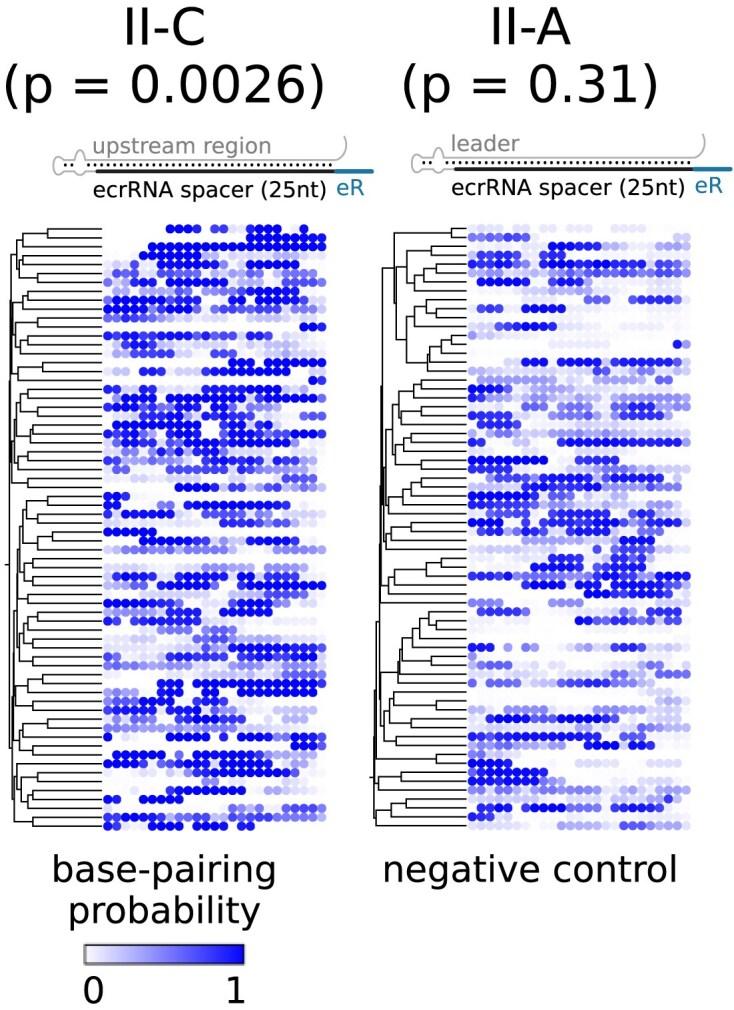
CRISPR-Cas adaptive immune systems in bacteria and archaea enable precise targeting and elimination of invading genetic elements. An inherent feature of these systems is the 'extraneous' CRISPR RNA (ecrRNA), which is produced via the extra repeat in a CRISPR array lacking a corresponding spacer. As ecrRNAs would interact with the Cas machinery yet not direct acquired immunity, they pose a potential barrier to defence. Type II-A CRISPR-Cas systems resolve this barrier through the leader sequence upstream of a CRISPR array, which forms a hairpin structure with the extra repeat that inhibits ecrRNA production. However, the fate of ecrRNAs in other CRISPR types and subtypes remains to be explored. Here, we report that II-C systems likely employ disparate strategies to resolve the ecrRNA due to their distinct configuration in comparison to II-A. Applying bioinformatics analyses to over 650 II-C systems followed by experimental validation, we identified three strategies applicable to these systems: formation of an upstream Rho-independent terminator, formation of a hairpin that sequesters the ecrRNA guide, and mutations in the repeat expected to disrupt ecrRNA formation. These findings expand the list of mechanisms in CRISPR-Cas systems that could resolve the ecrRNA to optimize immune response.
细菌和古生菌中的CRISPR-Cas适应性免疫系统能够精确靶向并消除入侵的遗传元件。这些系统的一个固有特征是“外来”CRISPR RNA(ecrRNA),它是通过CRISPR阵列中缺乏相应间隔序列的额外重复序列产生的。由于ecrRNAs会与Cas机制相互作用,但不直接介导获得性免疫,它们对防御构成了潜在障碍。II-A型CRISPR-Cas系统通过CRISPR阵列上游的前导序列解决了这一障碍,该序列与额外重复序列形成发夹结构,抑制ecrRNA的产生。然而,其他CRISPR类型和亚型中ecrRNAs的命运仍有待探索。在这里,我们报告II-C系统可能由于其与II-A系统不同的结构而采用不同的策略来解决ecrRNA问题。通过对650多个II-C系统进行生物信息学分析并随后进行实验验证,我们确定了适用于这些系统的三种策略:形成上游的不依赖Rho的终止子、形成隔离ecrRNA引导序列的发夹结构以及预期会破坏ecrRNA形成的重复序列中的突变。这些发现扩展了CRISPR-Cas系统中可解决ecrRNA以优化免疫反应的机制列表。
 Zotero 插件