
基于单核细胞与淋巴细胞比值和叶酸受体阳性循环肿瘤细胞的结直肠癌患者预后相关性分析及机器学习生存预测模型的构建
Prognostic correlation analysis of colorectal cancer patients based on monocyte to lymphocyte ratio and folate receptor-positive circulating tumor cells and construction of a machine learning survival prediction models.
作者信息
Pan Siying, Lu Chi, Lu Hongda, Zhang Hongfeng
机构信息
Department of Oncology, The Central Hospital of Wuhan, Tongji Medical College, Huazhong University of Science and Technology, Wuhan, China.
Hubei Provincial Engineering Research Center of Intestinal Microecological Diagnostics, Therapeutics, and Clinical Translation, Wuhan, China.
出版信息
Front Oncol. 2025 May 1;15:1531836. doi: 10.3389/fonc.2025.1531836. eCollection 2025.
PURPOSE
To evaluate the prognostic value of the monocyte to lymphocyte ratio (MLR) and folate receptor-positive circulating tumor cells (FR+CTCs) in patients with colorectal cancer (CRC) and to develop predictive model for post-treatment survival using machine learning (ML) algorithms.
METHODS
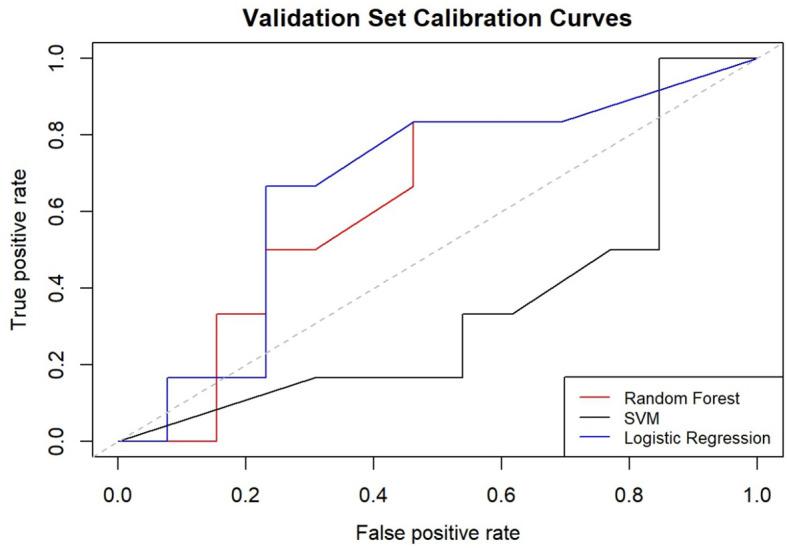
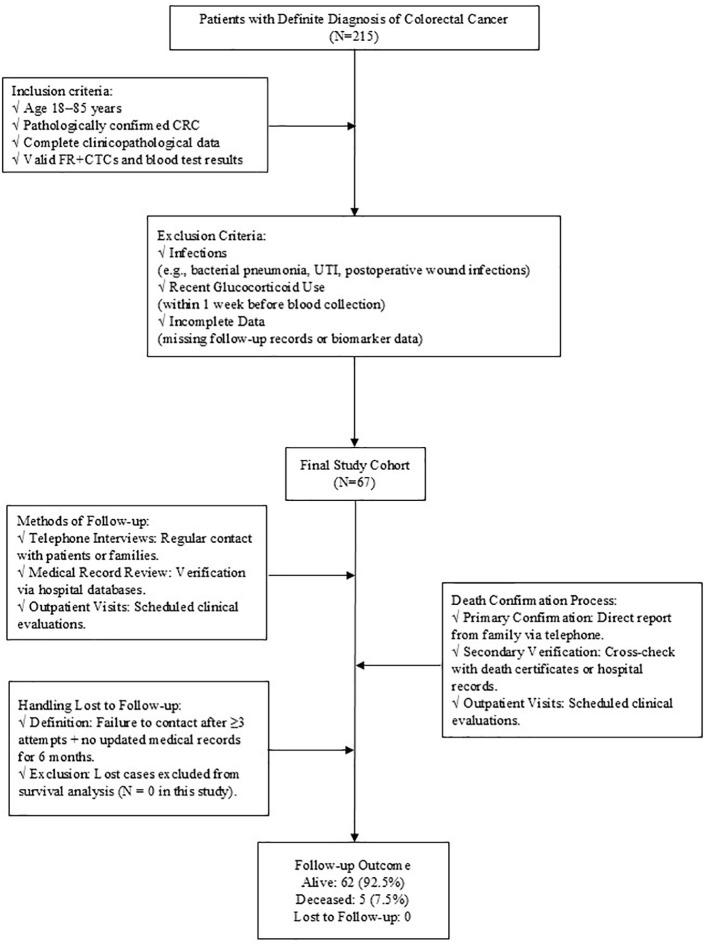
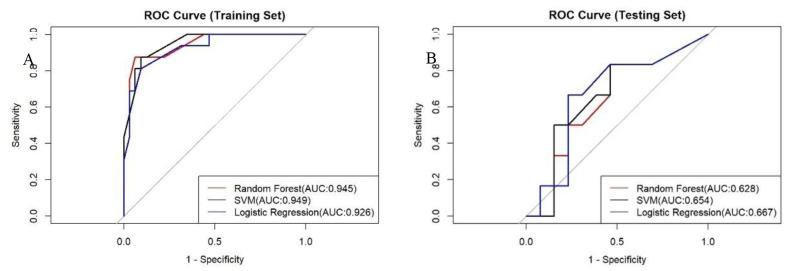
We retrospectively analyzed 67 CRC patients treated with radical surgery or chemoradiotherapy at The Central Hospital of Wuhan from January 2020 to December 2022. MLR, neutrophil to lymphocyte ratio (NLR), platelet to lymphocyte ratio (PLR) and FR+CTCs were categorized into high and low groups and clinicopathologic features were compared. Progression-Free Survival (PFS) and Overall Survival (OS) were analyzed using COX analysis and the Kaplan-Meier survival curve. Three ML algorithms, namely, random forest (RF), support vector machine (SVM), and logistic regression (LR), were utilized to construct the predictive models, and their performance metrics including accuracy, sensitivity, specificity, positive predictive value (PPV), negative predictive value (NPV), precision, recall, F1 value, AUC, and calibration curve were compared.
RESULTS
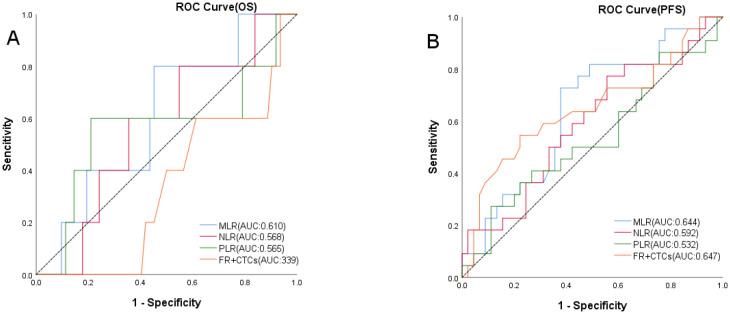
MLR, FR+ CTCs, and T stage independently predicted PFS (P<0.05), both higher MLR and FR+CTCs levels indicating a significantly shorter PFS (P=0.004). The T stage was the only factor predictive of OS (P=0.043). NLR and PLR did not show significant prognostic effects on PFS or OS (P > 0.05). The RF model demonstrated superior performance with an accuracy of 0.63, sensitivity of 0.69, PPV of 0.75, a precision of 0.43, a recall of 0.5, and an F1 value of 0.43, outperforming the other models.
CONCLUSION
High MLR and high FR+CTCs are associated with a poorer PFS in CRC patients, suggesting their utility in prognostic assessment. NLR and PLR did not show significant prognostic value in this study. The RF algorithm-based model showed the best predictive performance for post-radical treatment outcomes in CRC.
目的
评估单核细胞与淋巴细胞比值(MLR)和叶酸受体阳性循环肿瘤细胞(FR+CTCs)在结直肠癌(CRC)患者中的预后价值,并使用机器学习(ML)算法建立预测治疗后生存的模型。
方法
我们回顾性分析了2020年1月至2022年12月在武汉市中心医院接受根治性手术或放化疗的67例CRC患者。将MLR、中性粒细胞与淋巴细胞比值(NLR)、血小板与淋巴细胞比值(PLR)和FR+CTCs分为高分组和低分组,并比较临床病理特征。使用COX分析和Kaplan-Meier生存曲线分析无进展生存期(PFS)和总生存期(OS)。利用三种ML算法,即随机森林(RF)、支持向量机(SVM)和逻辑回归(LR)构建预测模型,并比较它们的性能指标,包括准确性、敏感性、特异性、阳性预测值(PPV)、阴性预测值(NPV)、精确率、召回率、F1值、AUC和校准曲线。
结果
MLR、FR+CTCs和T分期独立预测PFS(P<0.05),较高的MLR和FR+CTCs水平均表明PFS显著缩短(P=0.004)。T分期是唯一预测OS的因素(P=0.043)。NLR和PLR对PFS或OS未显示出显著的预后影响(P>0.05)。RF模型表现出卓越的性能,准确性为0.63,敏感性为0.69,PPV为0.75,精确率为0.43,召回率为0.5,F1值为0.43,优于其他模型。
结论
高MLR和高FR+CTCs与CRC患者较差的PFS相关,表明它们在预后评估中的效用。在本研究中,NLR和PLR未显示出显著的预后价值。基于RF算法的模型对CRC根治性治疗后的结果显示出最佳的预测性能。

 Zotero 插件