
重复经颅磁刺激左侧背外侧前额叶皮质治疗暴饮暴食症:一项双盲随机对照试验
Repetitive transcranial magnetic stimulation of the left dorsolateral prefrontal cortex in binge eating disorder: a double-blind randomized controlled trial.
作者信息
Maranhão Mara F, Estella Nara, Cury Maria Elisa G, Schmidt Ulrike, Campbell Iain C, Claudino Angélica M
机构信息
Department of Psychiatry and Psychological Medicine, Universidade Federal de São Paulo (UNIFESP), São Paulo, Brazil.
Centre for Research in Eating and Weight Disorders, Department of Psychological Medicine, Institute of Psychiatry, Psychology & Neuroscience, King's College London, London, UK.
出版信息
Psychol Med. 2025 May 16;55:e149. doi: 10.1017/S0033291725000492.
BACKGROUND
Binge-eating disorder (BED) is characterized by highly distressing episodes of loss-of-control over-eating. We have examined the use of repetitive transcranial magnetic stimulation (rTMS) for the treatment of people with BED and associated obesity. Such non-invasive brain stimulation (NIBS) techniques are used therapeutically in several psychiatric conditions and there is an associated scientific rationale.
METHODS
Sixty participants were randomly allocated to receive 20 sessions of neuronavigated 10 Hz rTMS administered to the left dorsolateral prefrontal cortex (dlPFC) or sham treatment. Primary outcomes were the frequency of binge eating episodes (BEE) and the 'urge to eat' (craving) evaluated at baseline and end-of-treatment (8 weeks post-randomization). Secondary outcomes included body mass index (BMI), hunger, general and specific eating disorder psychopathology. Follow-up analyses were conducted for most outcomes at 16 weeks post-randomization. Multilevel models were used to evaluate group, time, and group-by-time interactions for the association between rTMS exposure and outcomes.
RESULTS
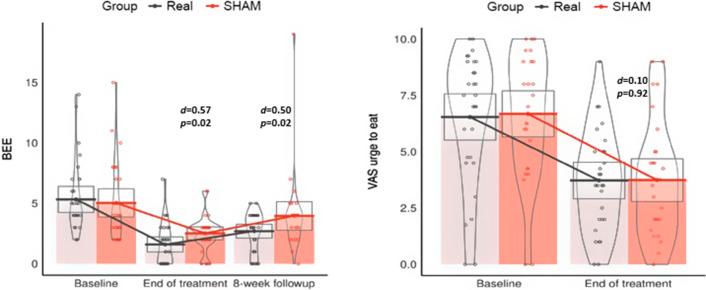
The real rTMS group (compared with sham treatment), showed a significantly greater decrease in the number of BEE at the end of treatment (Estimated Mean [EM]: 2.41 95% CI: 1.84-3.15 versus EM: 1.45 95% CI: 1.05-1.99, p = 0.02), and at follow-up (EM: 3.79 95% CI: 3-4.78 versus EM: 2.45 95% CI: 1.88-3.17, p = 0.02; group × time interaction analysis p = 0.02). No group differences were found for other comparisons.
CONCLUSION
rTMS was associated with reduced BEE during and after treatment: it suggests rTMS is a promising intervention for BED.
背景
暴饮暴食症(BED)的特征是反复出现令人极度苦恼的失控性暴饮暴食发作。我们研究了重复经颅磁刺激(rTMS)用于治疗患有BED及相关肥胖症患者的效果。这种非侵入性脑刺激(NIBS)技术已被用于多种精神疾病的治疗,且有相关科学依据。
方法
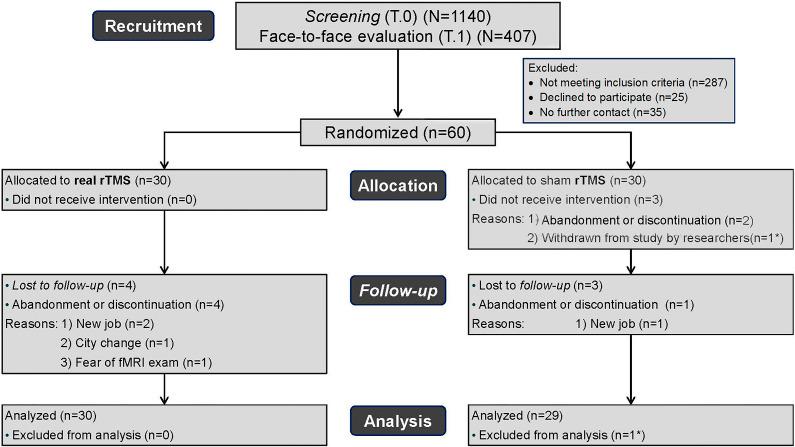
60名参与者被随机分配,接受20次经神经导航的10赫兹rTMS治疗,刺激部位为左侧背外侧前额叶皮质(dlPFC),或接受假治疗。主要结局指标是在基线和治疗结束时(随机分组后8周)评估的暴饮暴食发作频率(BEE)和“进食冲动”(渴望)。次要结局指标包括体重指数(BMI)、饥饿感、一般及特定饮食失调精神病理学。在随机分组后16周对大多数结局指标进行随访分析。使用多水平模型评估rTMS暴露与结局之间的组间、时间及组间×时间交互作用。
结果
与假治疗组相比,真正接受rTMS治疗的组在治疗结束时BEE数量显著减少(估计均值[EM]:2.41,95%置信区间:1.84 - 3.15;相比之下,假治疗组EM:1.45,95%置信区间:1.05 - 1.99,p = 0.02),在随访时也显著减少(EM:3.79,95%置信区间:3 - 4.78;相比之下,假治疗组EM:2.45,95%置信区间:1.88 - 3.17,p = 0.02;组×时间交互作用分析p = 0.02)。其他比较未发现组间差异。
结论
rTMS与治疗期间及治疗后BEE减少相关:这表明rTMS是一种有前景的BED干预措施。
 Zotero 插件