
甘油三酯葡萄糖体质指数与4期慢性肾脏病综合征患者1年全因死亡率之间的关联。
Association between triglyceride glucose body mass index and 1 year all cause mortality in stage 4 CKM syndrome patients.
作者信息
Pan Wen, Ji Teng-Fei, Hu Bing-Tao, Yang Jing, Lu Lei, Wei Jin
机构信息
Department of Cardiovascular Internal Medicine, The Second Affiliated Hospital of Xi 'an Jiaotong University, Xi 'an, China.
Department of Rehabilitation Medicine, The Second Affiliated Hospital of Xi 'an Jiaotong University, Xi 'an, China.
出版信息
Sci Rep. 2025 May 16;15(1):17019. doi: 10.1038/s41598-025-01549-3.
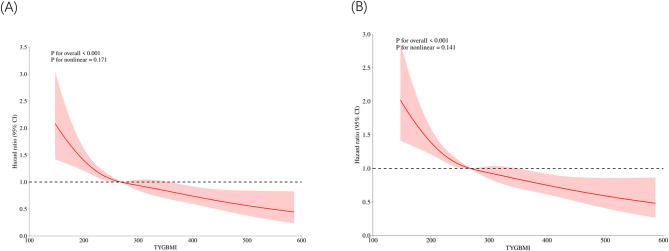
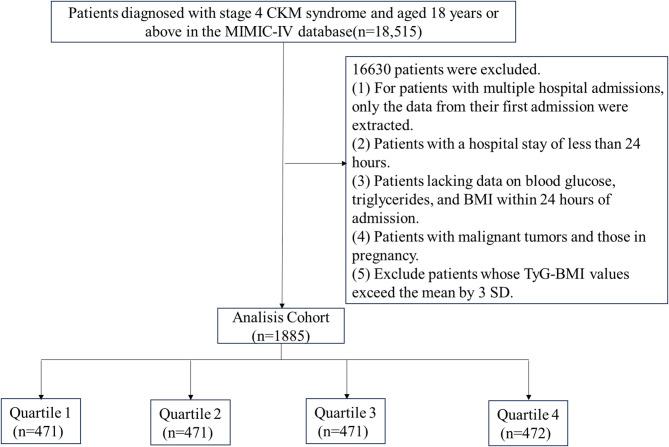
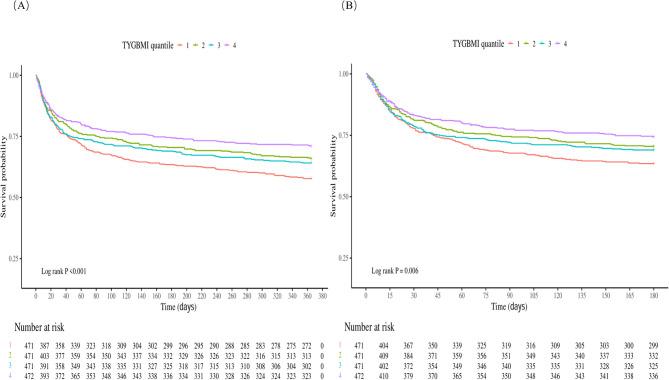
The triglyceride-glucose body mass index (TyG-BMI) is acknowledged as a dependable surrogate biomarker for the evaluation of insulin resistance (IR). Current research indicates a significant correlation between TyG-BMI and the risk of subsequent cardiovascular events in individuals diagnosed with cardiovascular-kidney-metabolic syndrome (CKM) at stages 0-3. Nevertheless, the prognostic significance of TyG-BMI in patients with CKM stage 4 has not been extensively investigated, and there is a paucity of evidence available on this topic. The study utilized patient data from the Medical Information Mart for Intensive Care (MIMIC-IV) database, categorizing the data into quartiles based on the TyG-BMI index. The primary outcomes of interest were all-cause mortality at 180 days and at one year. To assess the relationship between the TyG-BMI index and these outcomes in patients diagnosed with stage 4 CKM, a Cox proportional hazards model was employed. Additionally, a restricted cubic splines(RCS) model was applied to further investigate the associations between the TyG-BMI index and the specified outcomes. A total of 1,885 patients participated in the study, with 62.49% of the cohort being male. The all-cause mortality rates were recorded at 30.50% at 180 days and 35.12% at one year. Analysis using a multivariate Cox proportional hazards model revealed that an increase in the TyG-BMI index was significantly correlated with a reduction in the risk of all-cause mortality at both the 180-day and one-year marks. Specifically, for each standard deviation increase in the TyG-BMI index, the risk of all-cause mortality decreased by 17% within 180 days (HR = 0.83, 95% CI: 0.76-0.91) and by 21% within one year (HR = 0.79, 95% CI: 0.71-0.87). Furthermore, regression analysis utilizing RCS indicated a linear decrease in all-cause mortality rates associated with increasing TyG-BMI index values over both the 180-day and one-year periods (P for nonlinearity = 0.171 and P for nonlinearity = 0.141, respectively). In patients diagnosed with stage 4 CKM syndrome, a reduced TyG-BMI index was found to be significantly correlated with a heightened risk of all-cause mortality within both 180 days and one year. Consequently, the TyG-BMI index may be utilized as an effective instrument for risk stratification and prognostic assessment in this patient population.
甘油三酯-葡萄糖体质指数(TyG-BMI)被公认为是评估胰岛素抵抗(IR)的可靠替代生物标志物。目前的研究表明,TyG-BMI与0-3期心血管-肾脏-代谢综合征(CKM)患者随后发生心血管事件的风险之间存在显著相关性。然而,TyG-BMI在CKM 4期患者中的预后意义尚未得到广泛研究,关于这一主题的证据也很少。该研究利用了重症监护医学信息集市(MIMIC-IV)数据库中的患者数据,并根据TyG-BMI指数将数据分为四分位数。感兴趣的主要结局是180天和1年时的全因死亡率。为了评估TyG-BMI指数与4期CKM患者这些结局之间的关系,采用了Cox比例风险模型。此外,应用限制立方样条(RCS)模型进一步研究TyG-BMI指数与特定结局之间的关联。共有1885名患者参与了该研究,其中62.49%为男性。180天时的全因死亡率记录为30.50%,1年时为35.12%。使用多变量Cox比例风险模型进行分析显示,TyG-BMI指数的升高与180天和1年时全因死亡风险的降低显著相关。具体而言,TyG-BMI指数每增加一个标准差,180天内全因死亡风险降低17%(HR = 0.83,95% CI:0.76-0.91),1年内降低21%(HR = 0.79,95% CI:0.71-0.87)。此外,利用RCS进行的回归分析表明,在180天和1年期间,全因死亡率随着TyG-BMI指数值的增加呈线性下降(非线性P值分别为0.171和0.141)。在诊断为4期CKM综合征的患者中,发现TyG-BMI指数降低与180天和1年内全因死亡风险升高显著相关。因此,TyG-BMI指数可作为该患者群体风险分层和预后评估的有效工具。
 Zotero 插件