
关于代谢组学方法在鉴定阿霉素诱导的心脏毒性生物标志物中的叙述性综述。
A narrative review of metabolomics approaches in identifying biomarkers of doxorubicin-induced cardiotoxicity.
作者信息
Singh Amarnath, Bakhtyar Maham, Jun Se-Ran, Boerma Marjan, Lan Renny S, Su L Joseph, Makhoul Sam, Hsu Ping-Ching
机构信息
Department of Environmental Health Sciences, Fay W. Boozman College of Public Health, University of Arkansas for Medical Sciences, Little Rock, AR, USA.
Department of Internal Medicine, College of Medicine, University of Arkansas for Medical Sciences, Little Rock, AR, USA.
出版信息
Metabolomics. 2025 May 17;21(3):68. doi: 10.1007/s11306-025-02258-8.
BACKGROUND
While anthracyclines, commonly used in cancer treatment, are well known to cause cardiotoxicity, no validated biomarkers currently exist that can predict the early development of doxorubicin-induced cardiotoxicity (DIC). Therefore, identifying early biomarkers of DIC is urgently needed. Metabolomics approaches have been used to elucidate this relationship and identified related metabolite markers. However, differences in pre-clinical model systems make it challenging to draw definitive conclusions from the discoveries and translate findings into clinical applications.
AIM OF REVIEW
A systematic literature search on metabolomics studies of DIC was conducted with the goal to identify and compare study results reported using in vitro models, animal models, and studies from clinical patients. Metabolites identified across all studies were pooled to uncover biologically meaningful patterns that are significantly enriched in the data. Finally, pooled metabolites perturbed by DIC were mapped to metabolic pathways to explore potential pathological implications.
RESULTS
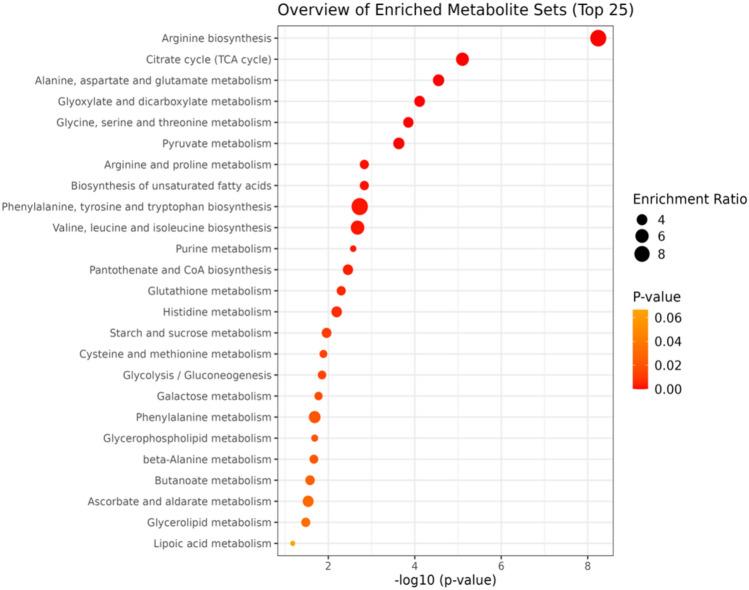
We reviewed 28 studies published between 2000 and 2024 that utilized metabolomics approaches to investigate DIC. The included studies used a variety of analytical techniques, including LC-MS, GC-MS, and NMR. The analysis revealed that metabolites such as inosine, phenylalanine, arginine, and tryptophan were commonly perturbed across all study models, with carnitine metabolism and purine and pyrimidine metabolism being the most affected pathways. Metabolite Set Enrichment Analysis (MSEA) using MetaboAnalyst identified the arginine biosynthesis, citrate cycle, and alanine, aspartate, and glutamate metabolism pathways as significantly enriched.
CONCLUSION
These findings underscore the potential of metabolomics in identifying early biomarkers for DIC, providing a foundation for future studies aimed at preventing cardiotoxicity and improving treatment strategies for cancer patients receiving DOX-containing therapies.
KEY SCIENTIFIC CONCEPTS OF REVIEW
Altogether, metabolomics studies suggest metabolic alterations in DIC, albeit little overlap between studies especially with animal and human studies. Attempts at intercepting these pathways have shown that intervention in DIC may be possible. Future research should focus on developing precise cardiotoxicity models that incorporate cancer metabolism, as these will be crucial in bridging the gap between laboratories (in vitro and animal models) and clinical studies to identify subclinical biomarkers in the early stage of DIC that can effectively identify new targets for interventions to reduce lethal cardiovascular disease risk.
背景
虽然常用于癌症治疗的蒽环类药物众所周知会导致心脏毒性,但目前尚无经过验证的生物标志物能够预测阿霉素诱导的心脏毒性(DIC)的早期发展。因此,迫切需要确定DIC的早期生物标志物。代谢组学方法已被用于阐明这种关系并确定相关的代谢物标志物。然而,临床前模型系统的差异使得从这些发现中得出明确结论并将研究结果转化为临床应用具有挑战性。
综述目的
对DIC的代谢组学研究进行系统的文献检索,目的是识别和比较使用体外模型、动物模型以及临床患者研究报告的研究结果。汇总所有研究中鉴定出的代谢物,以揭示数据中显著富集的具有生物学意义的模式。最后,将受DIC干扰的汇总代谢物映射到代谢途径,以探索潜在的病理意义。
结果
我们回顾了2000年至2024年间发表的28项利用代谢组学方法研究DIC的研究。纳入的研究使用了多种分析技术,包括液相色谱-质谱联用(LC-MS)、气相色谱-质谱联用(GC-MS)和核磁共振(NMR)。分析表明,肌苷、苯丙氨酸、精氨酸和色氨酸等代谢物在所有研究模型中普遍受到干扰,肉碱代谢以及嘌呤和嘧啶代谢是受影响最大的途径。使用MetaboAnalyst进行的代谢物集富集分析(MSEA)确定精氨酸生物合成、柠檬酸循环以及丙氨酸、天冬氨酸和谷氨酸代谢途径显著富集。
结论
这些发现强调了代谢组学在识别DIC早期生物标志物方面的潜力,为未来旨在预防心脏毒性和改善接受含阿霉素治疗的癌症患者治疗策略的研究奠定了基础。
综述的关键科学概念
总的来说,代谢组学研究表明DIC存在代谢改变,尽管研究之间特别是动物和人类研究之间几乎没有重叠。拦截这些途径的尝试表明,对DIC进行干预可能是可行的。未来的研究应专注于开发结合癌症代谢的精确心脏毒性模型,因为这些对于弥合实验室(体外和动物模型)与临床研究之间的差距至关重要,以便在DIC早期识别亚临床生物标志物,从而有效确定新的干预靶点以降低致命性心血管疾病风险。

 Zotero 插件