
免疫印记和疫苗接种间隔决定了对单价XBB.1.5新冠疫苗接种的抗体反应。
Immune imprinting and vaccine interval determine antibody responses to monovalent XBB.1.5 COVID-19 vaccination.
作者信息
Wrynla Xammy Huu, Bates Timothy A, Trank-Greene Mila, Wahedi Mastura, Hinchliff Audrey, Curlin Marcel E, Tafesse Fikadu G
机构信息
Department of Biomedical Engineering, Oregon Health and Science University, Portland, OR, USA.
Department of Molecular Microbiology and Immunology, Oregon Health and Science University, Portland, OR, USA.
出版信息
Commun Med (Lond). 2025 May 17;5(1):182. doi: 10.1038/s43856-025-00898-4.
BACKGROUND
As COVID-19 becomes endemic and vaccines are annually adapted, exposure intervals and immune imprinting become critical considerations for vaccination strategy. Imprinting by the ancestral spike protein affected bivalent Wuhan-Hu-1/BA.4-5 vaccine responses. We assess the persistence of imprinting in antibody responses to the more recent XBB.1.5 monovalent formulation.
METHODS
We quantified live virus-neutralizing antibodies by focus reduction neutralization test and ancestral spike receptor-binding isotype titers by immunosorbent assay in individuals before and after XBB.1.5 vaccination. We compared responses between those who previously received three to four doses of Wuhan-Hu-1 vaccine and one dose of bivalent Wuhan-Hu-1/BA.4-5 (bivalent recipients) and those who received three to four doses of Wuhan-Hu-1 (bivalent non-recipients).
RESULTS
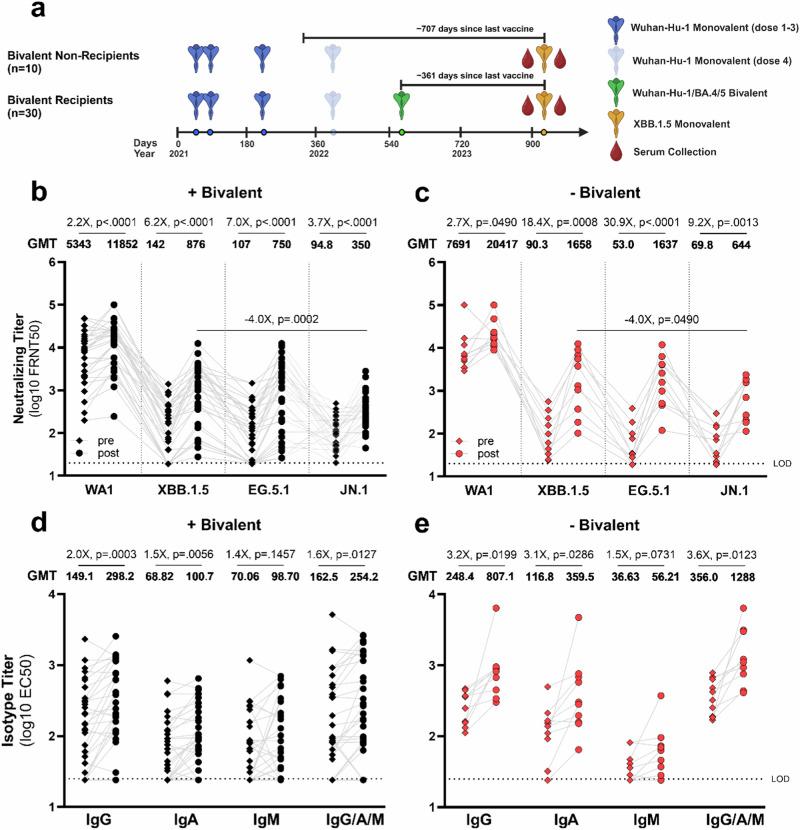
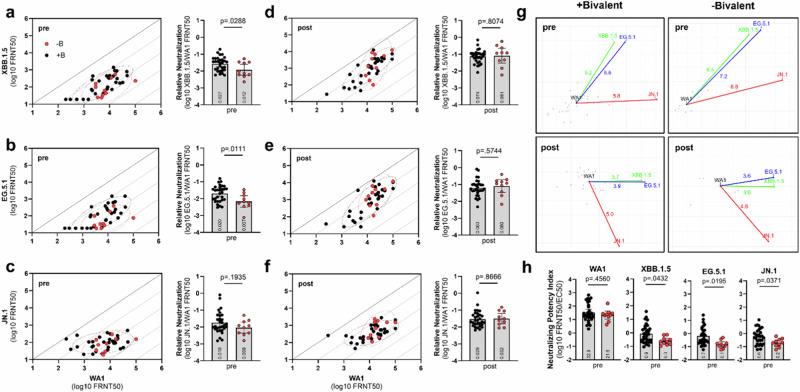
We report that before XBB.1.5 vaccination, bivalent non-recipients have decreased breadth and potency of neutralization. At post-vaccination, non-recipients exhibit greater boosting of neutralizing antibodies against XBB.1.5 (18.4X versus 6.2X), EG.5.1 (30.9X versus 7.0X), and JN.1 (9.2X versus 3.7X) variants with comparable breadth and trends toward greater potency. Greater boosting in non-recipients is similarly observed for spike-binding IgA and total IgG/A/M but not IgG nor IgM. Bivalent non-recipients had longer intervals between vaccination, which may enhance antibody responses; however, bivalent receipt and interval are tightly linked, preventing isolation of individual contributions to boosting. Nonetheless, back-boosting of ancestral SARS-CoV-2 titers in both participant groups provides interval-independent evidence that imprinting persists.
CONCLUSIONS
Our findings indicate that immune imprinting continues to affect humoral immunity elicited by the XBB.1.5 vaccine. Both imprinting and exposure intervals are important phenomena underlying immunogenicity of future variant-adapted COVID-19 vaccines.
背景
随着新冠病毒成为地方性流行病毒且疫苗每年进行调整,暴露间隔和免疫印记成为疫苗接种策略的关键考量因素。祖先刺突蛋白产生的印记影响了二价武汉-胡-1/BA.4-5疫苗的反应。我们评估了在针对最新的XBB.1.5单价疫苗的抗体反应中印记的持续性。
方法
我们通过蚀斑减少中和试验对XBB.1.5疫苗接种前后个体的活病毒中和抗体进行定量,并通过免疫吸附试验对祖先刺突受体结合同种型滴度进行定量。我们比较了之前接种过三到四剂武汉-胡-1疫苗和一剂二价武汉-胡-1/BA.4-5(二价疫苗接种者)的个体与接种过三到四剂武汉-胡-1(非二价疫苗接种者)的个体之间的反应。
结果
我们报告称,在接种XBB.1.5疫苗之前,非二价疫苗接种者的中和广度和效力有所下降。接种疫苗后,非二价疫苗接种者针对XBB.1.5(18.4倍 vs 6.2倍)、EG.5.1(30.9倍 vs 7.0倍)和JN.1(9.2倍 vs 3.7倍)变体的中和抗体增强幅度更大,中和广度相当且效力有增强趋势。在刺突结合IgA和总IgG/A/M方面,非二价疫苗接种者也有类似的更大增强幅度,但IgG和IgM没有。二价疫苗非接种者的接种间隔更长,这可能会增强抗体反应;然而,二价疫苗接种情况和间隔紧密相关,无法区分各自对增强反应的贡献。尽管如此,两个参与者组中祖先SARS-CoV-2滴度的反向增强提供了与间隔无关的证据,表明印记持续存在。
结论
我们的研究结果表明,免疫印记继续影响XBB.1.5疫苗引发的体液免疫。印记和暴露间隔都是未来适应变体的新冠疫苗免疫原性的重要潜在现象。

 Zotero 插件