
2型糖尿病患者的循环短链脂肪酸水平与身体组成
Circulating short chain fatty acid levels and body composition in type 2 diabetes mellitus.
作者信息
Hsu Ching-Hua, Tsai Yi-Chun, Yu Ping-Shaou, Hung Wei-Wen, Hung Wei-Chun, Hwang Shang-Jyh, Tsai Hui-Ju
机构信息
School of Medicine, College of Medicine, Kaohsiung Medical University, Kaohsiung, Taiwan.
Department of Internal Medicine, School of Medicine, College of Medicine, Kaohsiung Medical University, Kaohsiung, Taiwan.
出版信息
Int J Med Sci. 2025 Apr 22;22(10):2289-2297. doi: 10.7150/ijms.111920. eCollection 2025.
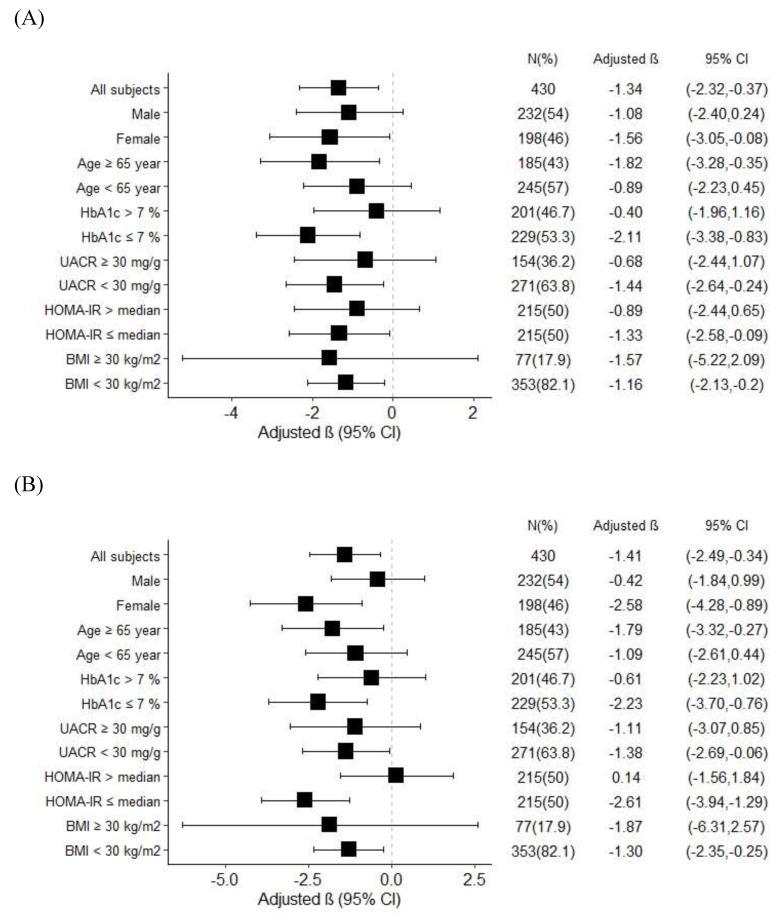
Short-chain fatty acids (SCFAs) may play key functional roles in the pathophysiology of type 2 diabetes (T2D) through regulating energy intake and substrate metabolism. Body composition, including fat tissue, muscle tissue and the pattern of their distribution in the body, can represent health status and be the cause or consequence of T2D complications. The aim of this study was to explore the relationship between serum SCFA levels and body composition distribution in patients with T2D. This observational cross-sectional study enrolled 430 patients with T2D from October 2016 to June 2020. The levels of nine kinds of SCFAs in serum were measured using liquid chromatography mass spectrometry. Body composition, including lean tissue and fat tissue, was measured once using bioimpedance spectroscopy at enrollment. The mean age of the patients was 61.7 ± 12.3 years and 54.0% were male. Multivariate linear analysis revealed that the patients with the highest tertile of serum methylbutyrate level (β = -0.81, 95% CI = -1.56, -0.06, p = 0.03) and valerate/isovalerate ratio (β = -1.15, 95% CI = -1.86, -0.44, p = 0.002) had a lower fat tissue index (FTI). In subgroup analysis, the negative association of FTI with serum methylbutyrate level and valerate/isovalerate ratio was only found in the patients who were older, female, and had glycated hemoglobin ≤ 7%, urinary albumin-creatinine ratio < 30 mg/g, homeostatic model assessment for insulin resistance ≤ median value, and body mass index < 30 kg/m. Conversely, none of the nine SCFAs were associated with lean tissue index. This study found that T2D patients with a higher circulating methylbutyrate level and serum valerate/isovalerate ratio had lower FTI. The relationship was consistent in older, female patients with well-controlled glucose. Further research is needed to analyze the interactions between SCFAs and body composition with clinical metabolic outcomes in T2D patients.
短链脂肪酸(SCFAs)可能通过调节能量摄入和底物代谢在2型糖尿病(T2D)的病理生理学中发挥关键功能作用。身体组成,包括脂肪组织、肌肉组织及其在体内的分布模式,可代表健康状况,并可能是T2D并发症的原因或结果。本研究的目的是探讨T2D患者血清SCFA水平与身体组成分布之间的关系。这项观察性横断面研究于2016年10月至2020年6月纳入了430例T2D患者。使用液相色谱质谱法测量血清中九种SCFAs的水平。在入组时使用生物电阻抗光谱法测量一次身体组成,包括瘦组织和脂肪组织。患者的平均年龄为61.7±12.3岁,男性占54.0%。多变量线性分析显示,血清丁酸甲酯水平处于最高三分位数的患者(β = -0.81,95%CI = -1.56,-0.06,p = 0.03)以及戊酸/异戊酸比值的患者(β = -1.15,95%CI = -1.86,-0.44,p = 0.002)的脂肪组织指数(FTI)较低。在亚组分析中,仅在年龄较大、女性、糖化血红蛋白≤7%、尿白蛋白-肌酐比值<30 mg/g、胰岛素抵抗的稳态模型评估≤中位数以及体重指数<30 kg/m²的患者中发现FTI与血清丁酸甲酯水平和戊酸/异戊酸比值呈负相关。相反,九种SCFAs中没有一种与瘦组织指数相关。本研究发现,循环丁酸甲酯水平和血清戊酸/异戊酸比值较高的T2D患者的FTI较低。这种关系在年龄较大、血糖控制良好的女性患者中是一致的。需要进一步研究来分析SCFAs与身体组成之间的相互作用以及T2D患者的临床代谢结局。
 Zotero 插件