
经动脉化疗栓塞联合阿替利珠单抗和贝伐单抗治疗不可切除肝细胞癌的生物标志物、疗效及安全性分析
Biomarker, efficacy and safety analysis of transcatheter arterial chemoembolization combined with atezolizumab and bevacizumab for unresectable hepatocellular carcinoma.
作者信息
Zhang Shaobo, Zhu Zebin, Liu Lianxin, Nashan Björn, Zhang Shugeng
机构信息
Department of Liver Transplantation, Division of Life Science and Medicine, The First Affiliated Hospital of USTC, University of Science and Technology of China, Hefei, 230000, Anhui, China.
出版信息
Cancer Immunol Immunother. 2025 May 19;74(7):209. doi: 10.1007/s00262-025-04058-4.
OBJECTIVE
Transcatheter arterial chemoembolization (TACE) combined with atezolizumab and bevacizumab (Atezo-Bev) [Atezo-Bev-TACE] has shown promising therapeutic efficacy in patients with unresectable hepatocellular carcinoma (uHCC). However, there is currently no published research on biomarkers that can predict the treatment outcomes of Atezo-Bev-TACE. This study aims to evaluate the predictive value of the baseline neutrophil-to-lymphocyte ratio (NLR) and platelet-to-lymphocyte ratio (PLR) in uHCC patients undergoing Atezo-Bev-TACE treatment.
METHODS
This retrospective study included uHCC patients who received Atezo-Bev-TACE and tyrosine kinase inhibitors (TKIs) at the First Affiliated Hospital of the University of Science and Technology of China between November 1, 2020, and November 1, 2023. The primary endpoint of the study was the correlation between baseline NLR and PLR with overall survival (OS) and progression-free survival (PFS). The secondary endpoints were the efficacy and safety of the Atezo-Bev-TACE regimen.
RESULTS
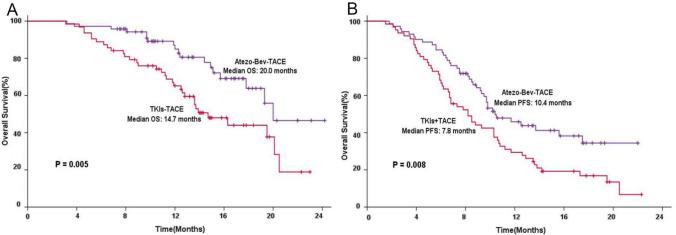
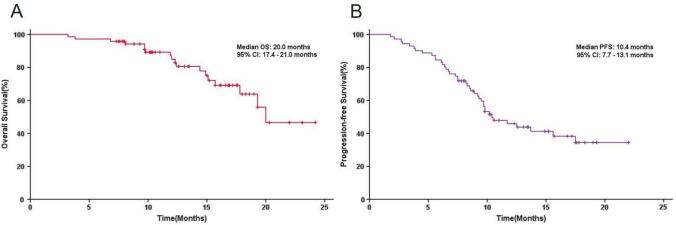
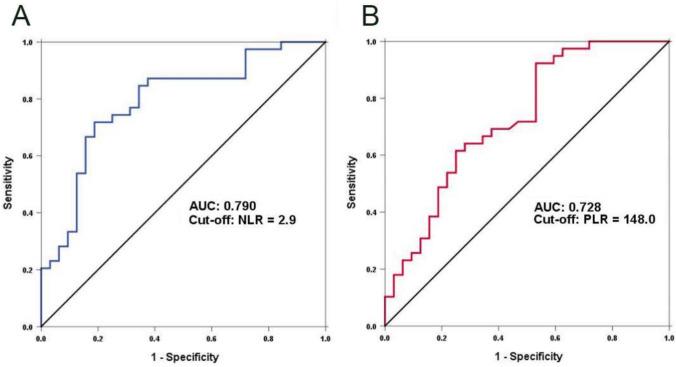
Among the 71 enrolled patients with uHCC who received Atezo-Bev-TACE therapy, the objective response rate was 55.0%, with a median OS of 20.0 months (95% confidence interval [CI] 17.4-21.0 months) and a median PFS of 10.4 months (95% CI 7.7-13.1 months). Patients with tumor response had significantly lower baseline NLR and PLR values compared to those without response (2.5 vs. 4.0, P < 0.001; 106.9 vs. 131.3, P = 0.001). The optimal cut-off values for NLR and PLR were determined to be 2.9 and 148.0, respectively, based on receiver operating characteristic curves. Patients with baseline NLR < 2.9 had significantly longer median OS (not reached vs. 17.8 months, P = 0.014) and improved median PFS (15.6 months vs. 9.3 months, P = 0.034) compared to those with NLR ≥ 2.9. Similarly, patients with baseline PLR < 148.0 had a significantly better median OS (20.0 months vs. 12.0 months, P = 0.004) and longer median PFS (13.7 months vs. 6.4 months, P < 0.001) compared to those with PLR ≥ 148.0. Univariate and multivariate Cox regression analyses identified baseline PLR ≥ 148.0 as an independent risk factor for poorer survival outcomes. Additionally, most adverse events (AEs) observed during Atezo-Bev-TACE treatment were grade 1-2, with fewer grade 3-4 AEs, and no grade 5 AEs were reported. Comparative analysis between the Atezo-Bev-TACE group (71 patients) and the TKIs-TACE group (63 patients) demonstrated that the ORR of the TKIs-TACE group was 34.9%, lower than that of the Atezo-Bev-TACE group (55.0%). No statistically significant differences were observed in baseline characteristics between the two groups before treatment. The median OS in the Atezo-Bev-TACE group was 20.0 months, significantly superior to the 14.7 months in the TKIs-TACE group (P = 0.005). Similarly, the median PFS in the Atezo-Bev-TACE group was 10.4 months, significantly better than the 7.8 months in the TKIs-TACE group (P = 0.008).
CONCLUSION
A baseline NLR ≥ 2.9 and PLR ≥ 148.0 may serve as predictive factors for poor OS and PFS in uHCC patients receiving Atezo-Bev-TACE treatment. Furthermore, the Atezo-Bev-TACE regimen demonstrates good efficacy and safety in the clinical management of uHCC patients.
目的
经动脉化疗栓塞术(TACE)联合阿替利珠单抗和贝伐珠单抗(阿替利珠单抗 - 贝伐珠单抗)[阿替利珠单抗 - 贝伐珠单抗 - TACE]在不可切除肝细胞癌(uHCC)患者中显示出有前景的治疗效果。然而,目前尚无关于可预测阿替利珠单抗 - 贝伐珠单抗 - TACE治疗结果的生物标志物的已发表研究。本研究旨在评估基线中性粒细胞与淋巴细胞比值(NLR)和血小板与淋巴细胞比值(PLR)在接受阿替利珠单抗 - 贝伐珠单抗 - TACE治疗的uHCC患者中的预测价值。
方法
本回顾性研究纳入了2020年11月1日至2023年11月1日期间在中国科学技术大学附属第一医院接受阿替利珠单抗 - 贝伐珠单抗 - TACE和酪氨酸激酶抑制剂(TKIs)治疗的uHCC患者。研究的主要终点是基线NLR和PLR与总生存期(OS)和无进展生存期(PFS)之间的相关性。次要终点是阿替利珠单抗 - 贝伐珠单抗 - TACE方案的疗效和安全性。
结果
在71例接受阿替利珠单抗 - 贝伐珠单抗 - TACE治疗的纳入uHCC患者中,客观缓解率为55.0%,中位OS为20.0个月(95%置信区间[CI] 17.4 - 21.0个月),中位PFS为10.4个月(95% CI 7.7 - 13.1个月)。与无反应的患者相比,有肿瘤反应的患者基线NLR和PLR值显著更低(2.5对4.0,P < 0.001;106.9对131.3,P = 0.001)。根据受试者工作特征曲线,确定NLR和PLR的最佳截断值分别为2.9和148.0。与NLR≥2.9的患者相比,基线NLR < 2.9的患者中位OS显著更长(未达到对17.8个月,P = 0.014),中位PFS有所改善(15.6个月对9.3个月,P = 0.034)。同样,与PLR≥148.0的患者相比,基线PLR < 148.0的患者中位OS显著更好(20.0个月对12.0个月,P = 0.004),中位PFS更长(13.7个月对6.4个月,P < 0.001)。单因素和多因素Cox回归分析确定基线PLR≥148.0是生存结果较差的独立危险因素。此外,在阿替利珠单抗 - 贝伐珠单抗 - TACE治疗期间观察到的大多数不良事件(AE)为1 - 2级,3 - 4级AE较少,未报告5级AE。阿替利珠单抗 - 贝伐珠单抗 - TACE组(71例患者)与TKIs - TACE组(63例患者)的比较分析表明,TKIs - TACE组的ORR为34.9%,低于阿替利珠单抗 - 贝伐珠单抗 - TACE组(55.0%)。治疗前两组的基线特征无统计学显著差异。阿替利珠单抗 - 贝伐珠单抗 - TACE组的中位OS为20.0个月,显著优于TKIs - TACE组的14.7个月(P = 0.005)。同样,阿替利珠单抗 - 贝伐珠单抗 - TACE组的中位PFS为10.4个月,显著优于TKIs - TACE组的7.8个月(P = 0.008)。
结论
基线NLR≥2.9和PLR≥148.0可能作为接受阿替利珠单抗 - 贝伐珠单抗 - TACE治疗的uHCC患者OS和PFS较差的预测因素。此外,阿替利珠单抗 - 贝伐珠单抗 - TACE方案在uHCC患者的临床管理中显示出良好的疗效和安全性。

 Zotero 插件