
一名有头部外伤史、携带种系POT1和EPHB2突变的美国陆军退伍军人,其神经轴钙化性假肿瘤进展为G5/PDGFRA亚组胶质母细胞瘤:病例说明
Calcifying pseudoneoplasm of the neuraxis progressing to G5/PDGFRA subgroup glioblastoma in a United States Army veteran with a history of head trauma and germline POT1 and EPHB2 mutations: illustrative case.
作者信息
Georgescu Maria-Magdalena, Olar Adriana, Zollinger William Daniel
机构信息
NeuroMarkers, Houston, Texas.
NOMIX Laboratories, Denver, Colorado.
出版信息
J Neurosurg Case Lessons. 2025 May 19;9(20). doi: 10.3171/CASE25152.
BACKGROUND
Trauma-associated glioblastoma has been previously described, albeit without molecular characterization.
OBSERVATIONS
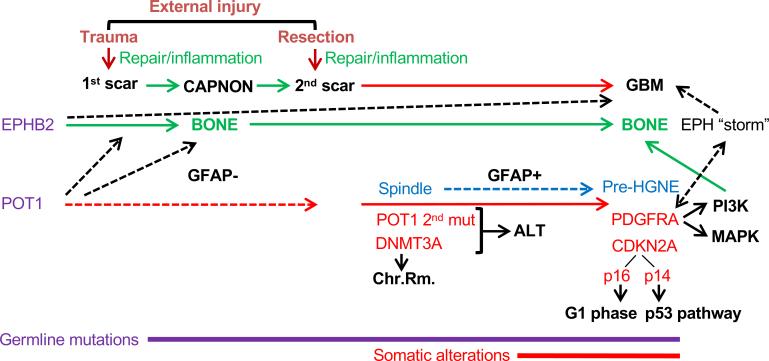
The authors show the integrated clinical/pathologic/molecular analysis of a glioblastoma developing 43 years after head trauma sustained by a United States veteran. An epileptogenic benign lesion developed at the trauma site, followed 34 years later by a calcified lesion diagnosed as calcifying pseudoneoplasm of the neuraxis (CAPNON) that recurred 9 years later as glioblastoma with heterotopic/metaplastic ossification. Genomic analysis showed novel germline mutations in the telomere maintenance factor POT1 p.W184* and receptor tyrosine kinase (RTK) EPHB2 p.W792*. The somatic alterations included second-hit POT1 p.D163Y mutation, CDKN2A/2B homozygous loss, DNMT3A mutation and PDGFRA amplification, classifying this glioblastoma in the G5/PDGFRA molecular subgroup. Proliferation markers, PDGFRA, MAPK feedback inhibitors, and EPHB1 showed high expression, whereas EPHB3 and EPHA7 showed the highest expression of all glioblastomas. Following gross-total resection, the patient received adjuvant radiotherapy and temozolomide and died 16.3 months later.
LESSONS
This is the first report of CAPNON progression to glioblastoma and of molecularly characterized glioma occurring decades after head trauma. A multifactorial etiology including genetic predisposition and posttraumatic repair is hypothesized. The discussion presents possible roles of EPH RTKs in posttraumatic repair and CAPNON, and of POT1 and PDGFRα in subsequent progression to glioblastoma. https://thejns.org/doi/10.3171/CASE25152.
背景
创伤相关的胶质母细胞瘤此前已有描述,尽管未进行分子特征分析。
观察结果
作者展示了对一名美国退伍军人头部创伤43年后发生的胶质母细胞瘤进行的综合临床/病理/分子分析。创伤部位出现了一个致痫性良性病变,34年后出现一个钙化病变,诊断为神经轴索钙化性假肿瘤(CAPNON),9年后复发为伴有异位/化生骨化的胶质母细胞瘤。基因组分析显示端粒维持因子POT1 p.W184和受体酪氨酸激酶(RTK)EPHB2 p.W792存在新的种系突变。体细胞改变包括第二次打击的POT1 p.D163Y突变、CDKN2A/2B纯合缺失、DNMT3A突变和PDGFRA扩增,将该胶质母细胞瘤归类为G5/PDGFRA分子亚组。增殖标志物、PDGFRA、MAPK反馈抑制剂和EPHB1表达较高,而EPHB3和EPHA7在所有胶质母细胞瘤中表达最高。在进行大体全切术后,患者接受了辅助放疗和替莫唑胺治疗,16.3个月后死亡。
经验教训
这是关于CAPNON进展为胶质母细胞瘤以及头部创伤数十年后发生的分子特征明确的胶质瘤的首例报告。推测其病因是多因素的,包括遗传易感性和创伤后修复。讨论了EPH RTKs在创伤后修复和CAPNON中的可能作用,以及POT1和PDGFRα在随后进展为胶质母细胞瘤中的可能作用。https://thejns.org/doi/10.3171/CASE25152 。


 Zotero 插件