
戈尔甘省新冠疫情过渡阶段之前及期间心血管和脑部疾病风险趋势分析
Analysis of cardiovascular and cerebral disease risk trends before and during the COVID-19 transition phase in Golestan province.
作者信息
Jahani Mohammad-Ali, Safaie Somayeh, Gharayagh-Zandi Mansooreh, Soltani Seyed-Amir, Hashemi Seyedeh-Nikoo, Mahmoudi Amir-Reza, Mahmoudi Ghahraman
机构信息
Social Determinants of Health Research Center Health Research Institute, Babol University of Medical Sciences, Babol, I. R. of Iran.
Master of Science of Healthcare Services Management, Golestan University of Medical Sciences, Gorgan, I. R. of Iran.
出版信息
BMC Res Notes. 2025 May 19;18(1):223. doi: 10.1186/s13104-025-07283-3.
OBJECTIVE
Morbidity and mortality caused by cardiovascular and cerebrovascular diseases are increasing worldwide. This study aimed to analyze the factors affecting the risk assessment of cardiovascular and cerebrovascular diseases before COVID-19 and during the COVID-19 transition phase.
RESULTS
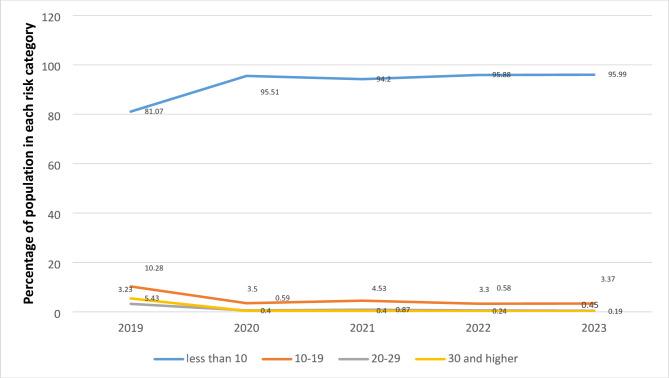
Among 132,305 individuals (mean age: 50.11 ± 12.21 years), 65.84% were women. Regression analysis indicated that age, overweight, smoking, diabetes, hypertension, and high cholesterol significantly increased 10-year cardiovascular disease risk (p < 0.001). No significant trend in risk levels was found between pre-COVID-19 and COVID-19 transition periods (p = 0.063). Given the impact of these factors, national-level planning, appropriate policies, and intersectoral coordination are essential to reduce cardiovascular and cerebrovascular risk.
目的
心血管疾病和脑血管疾病所致的发病率和死亡率在全球范围内呈上升趋势。本研究旨在分析2019冠状病毒病(COVID-19)之前及COVID-19过渡阶段影响心血管疾病和脑血管疾病风险评估的因素。
结果
在132305名个体(平均年龄:50.11±12.21岁)中,65.84%为女性。回归分析表明,年龄、超重、吸烟、糖尿病、高血压和高胆固醇显著增加了10年心血管疾病风险(p<0.001)。在COVID-19之前和COVID-19过渡阶段之间未发现风险水平有显著趋势(p=0.063)。鉴于这些因素的影响,国家级规划、适当政策和部门间协调对于降低心血管和脑血管风险至关重要。
 Zotero 插件