
在硬质和软质生物材料基底上进行微图案化光导肽组装
Micropatterning Photoconductive Peptide Assemblies on Stiff and Soft Biomaterial Substrates.
作者信息
Lundqvist Emil M, Lee Kathryn K, Le Lanie, Nguyen Krystal, Lim Sujeung, Celt Natalie, Kuang Yuyao, Yao Ze-Fan, Wu Haotian, Tang Sheng Wei, Pei Jian, Ardoña Herdeline Ann M
机构信息
Department of Biomedical Engineering, University of California Irvine, Irvine, California 92617, United States.
Department of Chemical and Biomolecular Engineering, University of California Irvine, Irvine, California 92617, United States.
出版信息
ACS Appl Mater Interfaces. 2025 Jun 4;17(22):31982-31992. doi: 10.1021/acsami.5c05693. Epub 2025 May 20.
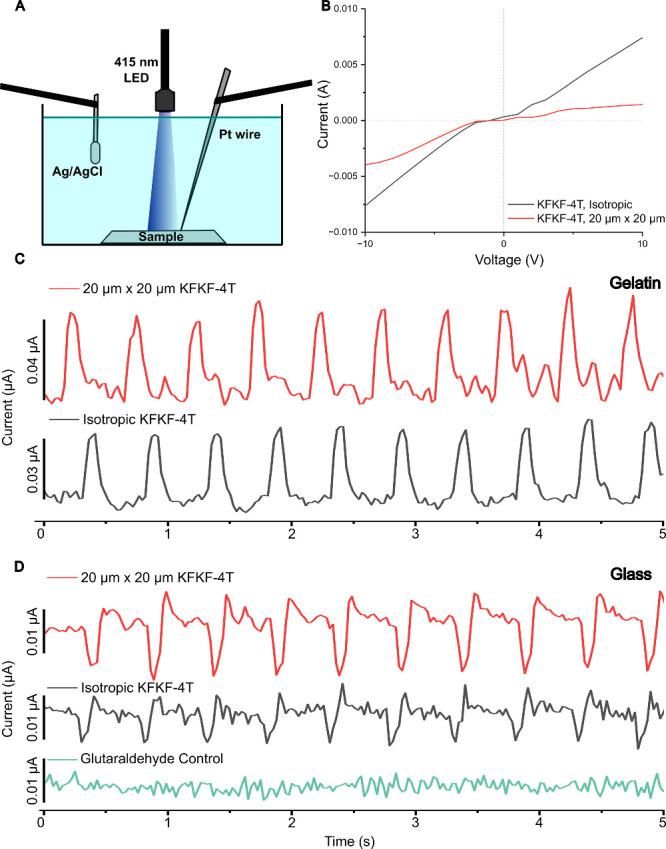
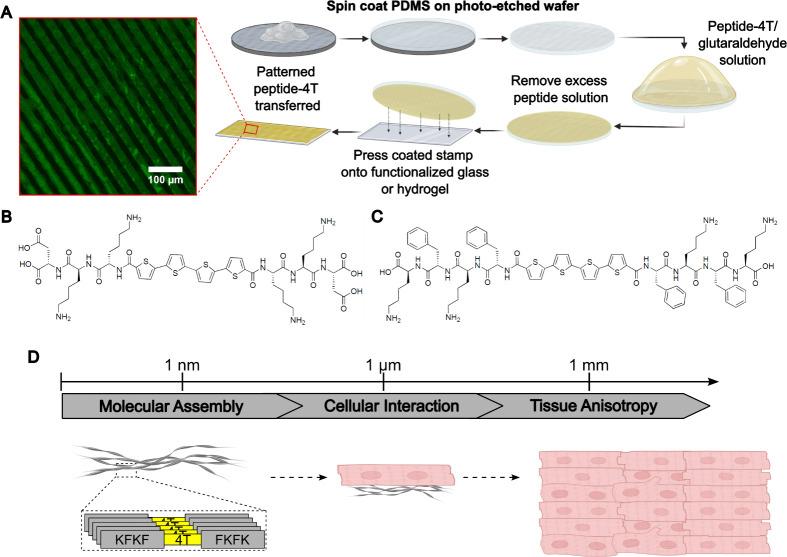
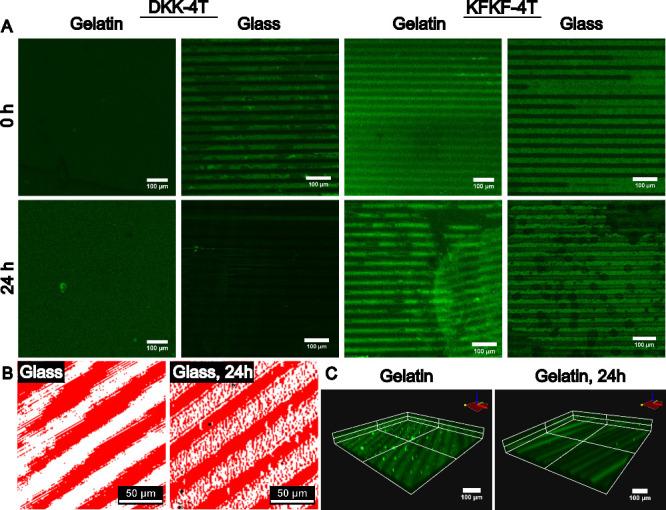
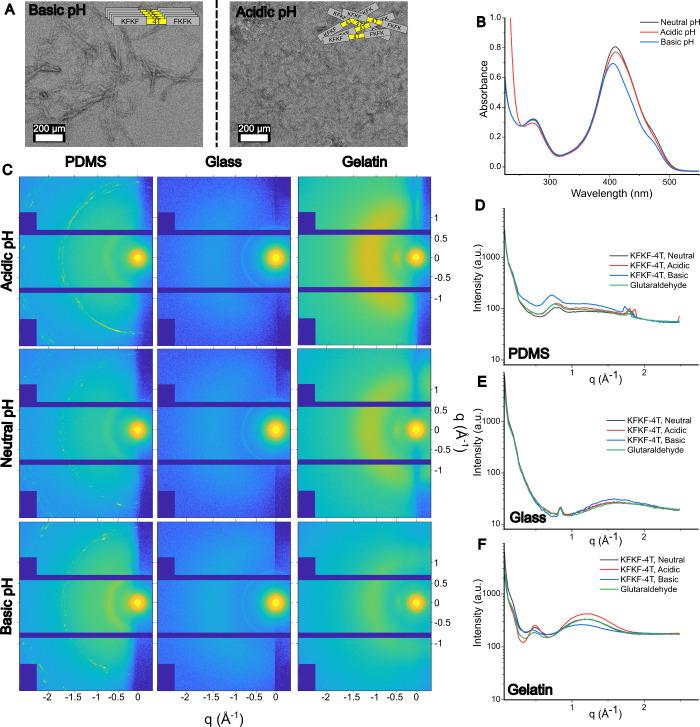
The propagation of electrical signals in the human heart relies on organized conduction pathways to optimally function and pump blood into the rest of the body. Mimicking this directionality across interconnected myocytes is currently achieved by patterning the cells themselves, which are often subjected to external stimulatory cues that are rarely localized or have controlled anisotropy. Here, we demonstrate an approach to interface micropatterned optoelectronic peptides with cardiomyocytes, whereby the engineered biomolecular structures dictate the organization of cells in a substrate, while also presenting photocurrent-generating electrodes of defined microscale geometries. To this end, we utilized surface modification strategies that allowed for the creation of stable micropatterns of quaterthiophene-bearing peptide assemblies on both glass (∼GPa range) and gelatin hydrogel (∼20 kPa) substrates that last for multiple days within an aqueous environment. The pH-sensitive assembly behavior of π-conjugated peptides was also investigated as to how it evolves at various stages of the patterning process and impacts material scattering once they are imprinted on different substrates. Neonatal rat ventricular myocytes (NRVMs) seeded on gelatin scaffolds that had been interfaced with π-conjugated peptide micropatterns saw improvements to their orientational order parameter (OOP) of both the actin cytoskeleton and z-lines, which were not observed for those cultured on isotropic controls or on microgrooved gelatin samples. Additionally, the micropatterned π-conjugated peptide platform was shown to exhibit photocurrent-generating properties on both gelatin and glass substrates in aqueous cell culture environments. The peptide-based platform discussed here provides a potential approach to confine conductive biomaterials within microscale features while simultaneously providing an avenue for light-based localized stimulation of electroactive tissues.
人体心脏中电信号的传播依赖于有组织的传导通路,以实现最佳功能并将血液泵入身体其他部位。目前,通过对细胞本身进行图案化来模拟跨相互连接的心肌细胞的这种方向性,而这些细胞通常会受到外部刺激信号的影响,这些信号很少是局部化的,也没有可控的各向异性。在这里,我们展示了一种将微图案化的光电肽与心肌细胞连接的方法,通过这种方法,工程化的生物分子结构决定了底物中细胞的组织方式,同时还展示了具有确定微尺度几何形状的光电流产生电极。为此,我们利用表面修饰策略,在玻璃(约吉帕范围)和明胶水凝胶(约20千帕)底物上创建了含四硫代噻吩肽组装体的稳定微图案,这些图案在水性环境中能持续存在数天。还研究了π共轭肽的pH敏感组装行为,以及它在图案化过程的各个阶段如何演变,以及一旦印刻在不同底物上对材料散射的影响。接种在与π共轭肽微图案连接的明胶支架上 的新生大鼠心室肌细胞(NRVMs),其肌动蛋白细胞骨架和Z线的取向序参数(OOP)都有所改善,而在各向同性对照或微槽明胶样品上培养的细胞则未观察到这种情况。此外,微图案化的π共轭肽平台在水性细胞培养环境中的明胶和玻璃底物上均显示出光电流产生特性。这里讨论的基于肽的平台提供了一种潜在的方法,可将导电生物材料限制在微尺度特征内,同时为基于光的电活性组织局部刺激提供了一条途径。

 Zotero 插件