
协同共代谢增强DR1对原油的降解及其代谢潜力。
Synergistic co-metabolism enhancing the crude oil degradation by DR1 and its metabolic potential.
作者信息
Singha Lairenjam Paikhomba, Kumari Renuka, Singha Keisam Malabika, Pandey Piyush, Shukla Pratyoosh
机构信息
Enzyme Technology and Protein Bioinformatics Laboratory, School of Biotechnology, Institute of Science, Banaras Hindu University, Varanasi, Uttar Pradesh, India.
Department of Microbiology, Central University of Rajasthan, Ajmer, Rajasthan, India.
出版信息
Microbiol Spectr. 2025 Jul;13(7):e0302324. doi: 10.1128/spectrum.03023-24. Epub 2025 May 21.
UNLABELLED
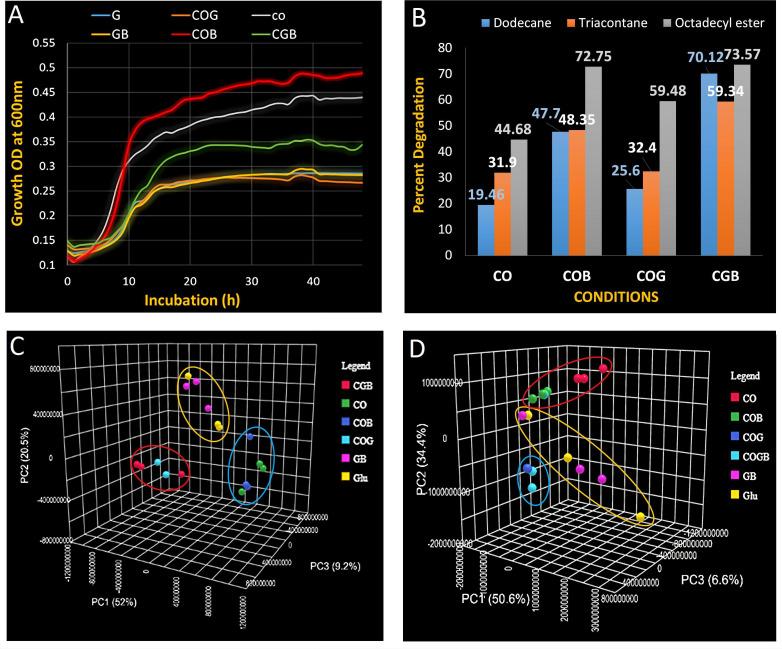
Bacterial degradation of hydrocarbons during co-metabolism with glucose often resulted in variable degradation efficiency. This study explored the mechanistic understanding of the metabolic response during co-metabolism in DR1 using a metabolomics approach. We reported that glucose slowed the growth rate of DR1 with a 7-h lag phase in a combined media containing crude oil, glucose, and biosurfactant, yet glucose supplement enhanced the degradation rates by 31% for dodecane and 18% for triacontane compared to culture amended with crude oil and biosurfactant. This demonstrated that glucose may not be the preferred carbon and energy source, but it still significantly influences hydrocarbon metabolism through increased synthesis of fatty acids and low molecular weight organic acids (glutaric, citric, and tartaric acid, etc.). Principal component analysis revealed the distinct clusters of metabolites among the culture conditions, highlighting the minimal effect of biosurfactant. Our study reports the role of significant metabolites in crude oil culture, proving the gluconeogenesis capability of DR1. The pre-screening of the metabolic pathway concluded that trehalose was crucial in combating stress imposed during hydrocarbon degradation. Hence, DR1 can be used to degrade hydrocarbons and has a pivotal role in synergistic co-metabolism during crude oil degradation.
IMPORTANCE
In hydrocarbon-contaminated soil, the presence of easily metabolizable carbon sources can lead to carbon catabolite repression. This repression reduces the activity of hydrocarbon-degrading bacteria, slowing down the rate of bioremediation. In this study, the most robust yet underexplored tool-liquid chromatography-high resolution accurate mass spectrometry system-was used to study the metabolic response and functional state of A. oleivorans DR1 during the crude oil degradation in the presence or absence of either biosurfactant or glucose supplementation. Here, synergistic co-metabolism by DR1 for crude oil degradation is reported. DR1 preferred hydrocarbons over glucose since glucose was not readily utilizable due to lack of enzymes (e.g., glucokinase). However, the glucose enhanced the hydrocarbon degradation in DR1 through the high production of organic acids that reacted on hydrocarbon chains and underwent fatty acid synthesis. This study added DR1's strength towards hydrocarbon utilization and proposed it as an effective agent for bioremediation.
未标记
在与葡萄糖共代谢过程中,细菌对烃类的降解效率常常参差不齐。本研究采用代谢组学方法,探究了DR1在共代谢过程中代谢反应的机制。我们发现,在含有原油、葡萄糖和生物表面活性剂的混合培养基中,葡萄糖使DR1的生长速率减慢,出现7小时的延迟期,但与添加了原油和生物表面活性剂的培养物相比,添加葡萄糖使十二烷的降解率提高了31%,使三十烷的降解率提高了18%。这表明葡萄糖可能不是首选的碳源和能源,但它仍通过增加脂肪酸和低分子量有机酸(戊二酸、柠檬酸和酒石酸等)的合成,显著影响烃类代谢。主成分分析揭示了不同培养条件下代谢物的明显聚类,突出了生物表面活性剂的最小影响。我们的研究报告了原油培养中重要代谢物的作用,证明了DR1的糖异生能力。对代谢途径的预筛选得出结论,海藻糖在对抗烃类降解过程中施加的压力方面至关重要。因此,DR1可用于降解烃类,在原油降解的协同共代谢中起关键作用。
重要性
在受烃类污染的土壤中,易代谢碳源的存在会导致碳分解代谢物阻遏。这种阻遏会降低烃类降解细菌的活性,减缓生物修复速率。在本研究中,使用了最强大但尚未充分探索的工具——液相色谱-高分辨率精确质谱系统,来研究在添加或不添加生物表面活性剂或葡萄糖的情况下,食油嗜油菌DR1在原油降解过程中的代谢反应和功能状态。在此,报告了DR1对原油降解的协同共代谢作用。由于缺乏酶(如葡萄糖激酶),葡萄糖不易被利用,因此DR1优先利用烃类而非葡萄糖。然而,葡萄糖通过大量产生与烃链反应并进行脂肪酸合成的有机酸,增强了DR1对烃类降解的能力。本研究增加了DR1在烃类利用方面的优势,并将其作为生物修复的有效试剂。




 Zotero 插件