
对……的毒力没有影响。
does not impact virulence in .
作者信息
Robinson Rachel E, Robertson Joshua K, Moustafa Dina A, Goldberg Joanna B
机构信息
Microbiology and Molecular Genetics Program, Graduate Division of Biological and Biomedical Sciences, Laney Graduate School, Emory University, Atlanta, Georgia, USA.
Department of Pediatrics, Division of Pulmonary, Asthma, Cystic Fibrosis, and Sleep, Emory University School of Medicine, Atlanta, Georgia, USA.
出版信息
Microbiol Spectr. 2025 Jul;13(7):e0281124. doi: 10.1128/spectrum.02811-24. Epub 2025 May 21.
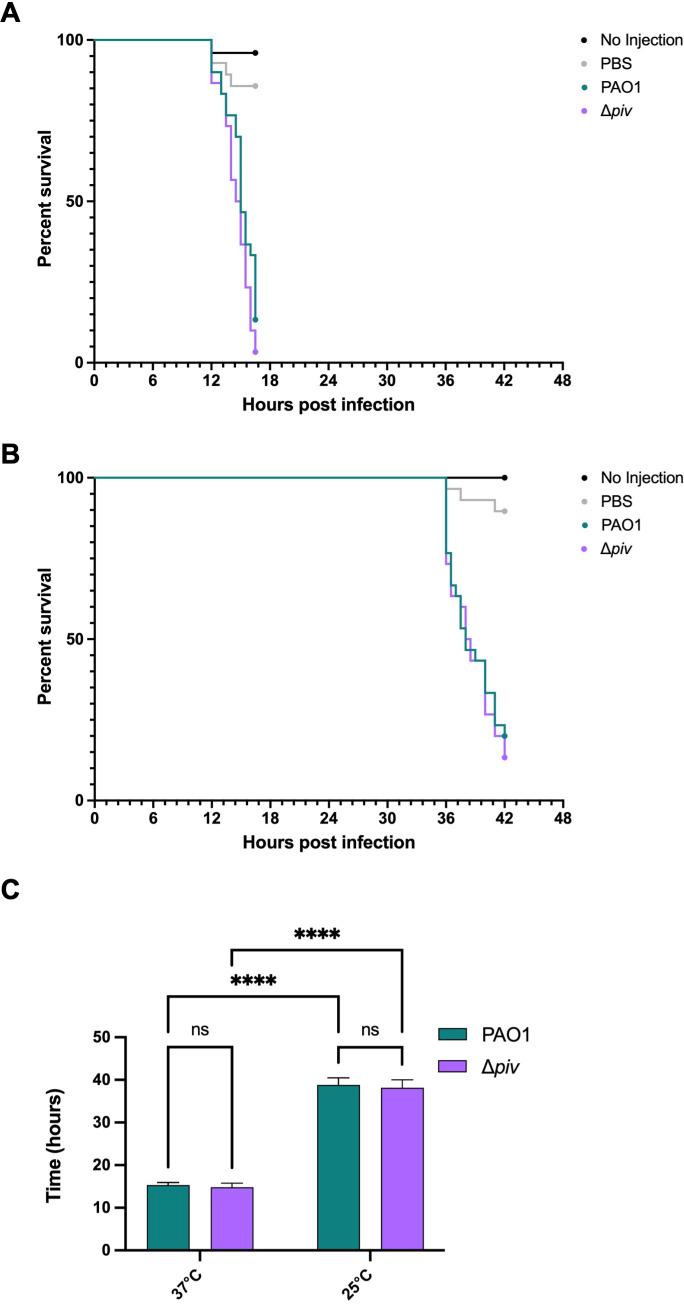
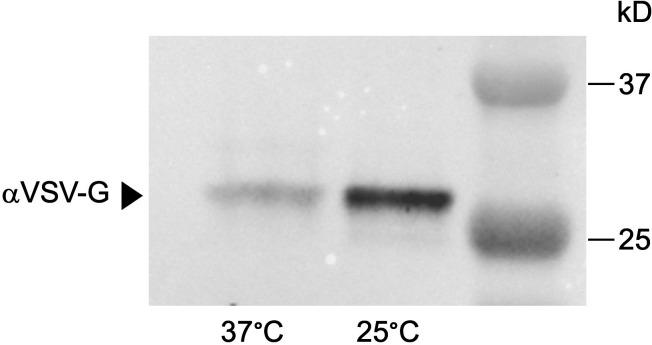
is an opportunistic human pathogen that can also infect mammals, invertebrates, and plants. Protease IV (PIV) is a secreted protease shown to be important in mammalian cornea, lung, and wound models of infection. It also contributes to virulence in many invertebrate models. Previous studies have shown that the expression of the gene encoding PIV is higher at 25°C than at 37°C. Thus, we hypothesized that would be more important for virulence at 25°C than at 37°C. To test this, we first demonstrated that more PIV is secreted by PAO1 cells grown at 25°C than at 37°C. We then determined the survival of larvae of the greater wax moth infected by PAO1 and an isogenic Δ mutant at both 25°C and 37°C. We found no significant difference in virulence between PAO1 and Δ at either 25°C or 37°C, although both strains were more virulent at 37°C than 25°C as measured by a decrease in median survival time. possesses an arsenal of virulence factors besides PIV, and thus loss of this single virulence factor may not result in attenuation in the highly susceptible larvae.IMPORTANCEPathogenesis of the important opportunistic pathogen is often investigated using model organisms. Larvae of the greater wax moth, , are a popular non-mammalian model organism for infections that have been used to study highly attenuated mutants and characterize their defects in virulence. Our study shows that small differences in the virulence of , such as those caused by deleting the gene encoding a single virulence factor, may not be detectable in the model of infection. This is an important finding for researchers considering the choice of model organisms for virulence studies.
是一种机会性人类病原体,也可感染哺乳动物、无脊椎动物和植物。蛋白酶IV(PIV)是一种分泌型蛋白酶,已证明其在哺乳动物角膜、肺部和伤口感染模型中很重要。它在许多无脊椎动物模型中也有助于毒力。先前的研究表明,编码PIV的基因在25°C时的表达高于37°C。因此,我们假设在25°C时对毒力的重要性高于37°C。为了验证这一点,我们首先证明,在25°C下生长的PAO1细胞比在37°C下生长的细胞分泌更多的PIV。然后,我们测定了在25°C和37°C下被PAO1和同基因Δ突变体感染的大蜡螟幼虫的存活率。我们发现,在25°C或37°C下,PAO1和Δ之间的毒力没有显著差异,尽管通过中位生存时间的缩短来衡量,两种菌株在37°C时都比25°C时更具毒力。除了PIV之外,还拥有一系列毒力因子,因此这种单一毒力因子的缺失可能不会导致在高度易感的大蜡螟幼虫中出现毒力减弱。重要性重要机会性病原体的发病机制通常使用模式生物进行研究。大蜡螟的幼虫是一种流行的非哺乳动物模式生物,用于感染研究,已被用于研究高度减毒的突变体并表征其毒力缺陷。我们的研究表明,在感染模型中,毒力的微小差异,例如由删除单个毒力因子编码基因引起的差异,可能无法检测到。对于考虑选择模式生物进行毒力研究的研究人员来说,这是一个重要的发现。

 Zotero 插件