
脑小血管病患者中性粒细胞/淋巴细胞比值与MRI负荷及认知功能的相关性
The correlation between neutrophil/lymphocyte ratio and the MRI burden and cognitive function in patients with cerebral small vessel disease.
作者信息
Zhao Mengyao, Xie Xiaohua, Hao Zhiwei, Ren Mengsi, Teng Zhenjie, Xu Jing, Shan Chunhui, Dong Yanhong, Lv Peiyuan
机构信息
Department of Neurology, Graduate School of Hebei Medical University, Shijiazhuang, China.
Department of Neurology, Hebei General Hospital, Shijiazhuang, China.
出版信息
Front Neurol. 2025 May 7;16:1546076. doi: 10.3389/fneur.2025.1546076. eCollection 2025.
OBJECTIVE
Aims to explore the relationship between neutrophil/lymphocyte ratio (NLR) and the total burden of imaging markers and cognitive function in patients with cerebral small vessel disease (CSVD).
METHODS
A retrospective study was conducted on 148 hospitalized CSVD patients at Hebei General Hospital from January 2022 to September 2024, with complete clinical and laboratory data. NLR was calculated as neutrophil count/lymphocyte count. According to the Mini-Mental State Examination (MMSE) score, patients were divided into a cognitive impairment group ( = 89) and a non-cognitive impairment group ( = 59). The total CSVD burden was assessed based on magnetic resonance imaging (MRI). We used logistic regression models, restricted cubic spline plots, Spearman correlation, and mediation analysis to evaluate the relationship between NLR in CSVD patients and CSVD burden and cognitive impairment.
RESULTS
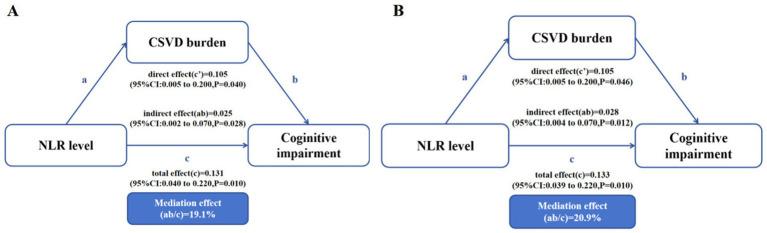
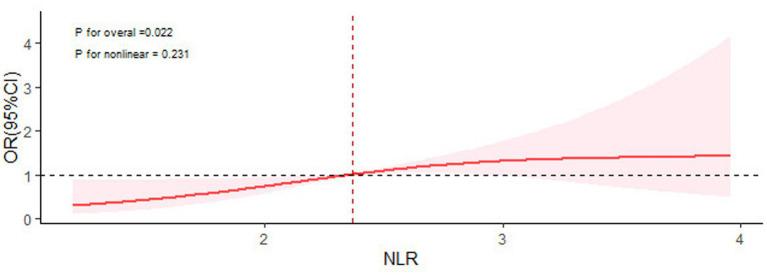
The results of the multivariate logistic regression showed that after adjusting for all potential confounding factors, an elevated NLR in CSVD patients was significantly associated with the risk of cognitive impairment (OR: 3.263; 95% CI: 1.577 to 6.752; = 0.001) and severe CSVD burden (OR = 2.246, 95% CI: 1.346 ~ 3.750, = 0.002). The restricted cubic spline plot shows that after adjusting for confounding factors, the NLR level is linearly associated with the risk of CI ( for total = 0.022, for non-linear = 0.231) and the total burden of CSVD ( for total = 0.005, for non-linear = 0.448). Correlation analysis shows that NLR is positively correlated with the CSVD score (rs = 0.246, = 0.003). Furthermore, the results of the mediation analysis indicate that after adjusting for confounding factors, the burden of CSVD has a significant mediating effect on the relationship between NLR levels and cognitive impairment (ab = 0.028, 95% CI: 0.004 to 0.070, = 0.012); 20.9% of the total effect of NLR on cognitive impairment in CSVD patients can be attributed to the presence of CSVD burden.
CONCLUSION
Elevated NLR in CSVD patients is associated with the burden of CSVD and cognitive impairment. The mediating role of CSVD burden suggests that elevated NLR may lead to cognitive impairment by exacerbating the burden of CSVD.
目的
探讨中性粒细胞/淋巴细胞比值(NLR)与脑小血管病(CSVD)患者影像学标志物总负担及认知功能之间的关系。
方法
对2022年1月至2024年9月在河北医科大学第一医院住院的148例CSVD患者进行回顾性研究,这些患者具有完整的临床和实验室数据。NLR计算为中性粒细胞计数/淋巴细胞计数。根据简易精神状态检查表(MMSE)评分,将患者分为认知障碍组(n = 89)和非认知障碍组(n = 59)。基于磁共振成像(MRI)评估CSVD总负担。我们使用逻辑回归模型、受限立方样条图、Spearman相关性分析和中介分析来评估CSVD患者的NLR与CSVD负担及认知障碍之间的关系。
结果
多因素逻辑回归结果显示,在调整所有潜在混杂因素后,CSVD患者NLR升高与认知障碍风险显著相关(OR:3.263;95%CI:1.577至6.752;P = 0.001)以及严重CSVD负担(OR = 2.246,95%CI:1.346~3.750,P = 0.002)。受限立方样条图显示,在调整混杂因素后,NLR水平与CI风险呈线性相关(总P = 0.022,非线性P = 0.231)以及CSVD总负担(总P = 0.005,非线性P = 0.448)。相关性分析显示,NLR与CSVD评分呈正相关(rs = 0.246,P = 0.003)。此外,中介分析结果表明,在调整混杂因素后,CSVD负担对NLR水平与认知障碍之间的关系具有显著中介作用(ab = 0.028,95%CI:0.004至0.070,P = 0.012);NLR对CSVD患者认知障碍的总效应中,20.9%可归因于CSVD负担的存在。
结论
CSVD患者NLR升高与CSVD负担及认知障碍相关。CSVD负担的中介作用表明,NLR升高可能通过加重CSVD负担导致认知障碍。

 Zotero 插件