
外源性粒细胞-巨噬细胞集落刺激因子治疗自身免疫性肺泡蛋白沉积症:一项系统文献综述
Exogenous GM-CSF therapy for autoimmune pulmonary alveolar proteinosis: a systematic literature review.
作者信息
Chen Wushu, Feng Xin, Yao Lun-Kai, Li Xingpei, Yang Zhen-Ming, Qin Xiu-Yu, Li Yu, Qiu Ye
机构信息
State Key Laboratory of Respiratory Disease, National Clinical Research Center for Respiratory Disease, Guangzhou Institute of Respiratory Health, The First Affiliated Hospital of Guangzhou Medical University, Guangzhou, China.
Gastroenterology and Respiratory Internal Medicine Department, Guangxi Medical University Cancer Hospital, Nanning, Guangxi, China.
出版信息
Front Med (Lausanne). 2025 May 8;12:1552566. doi: 10.3389/fmed.2025.1552566. eCollection 2025.
BACKGROUND
Granulocyte-macrophage colony-stimulating factor (GM-CSF) therapy is an important treatment for autoimmune pulmonary alveolar proteinosis (aPAP). Exogenous GM-CSF treatment can be administered either through subcutaneous injection or nebulized inhalation. However, data on the effectiveness and safety of these two approaches are lacking.
METHOD
We conducted a systematic literature review of different methods, including subcutaneous injection and nebulized inhalation of GM-CSF, for the treatment of aPAP patients. Patients were divided into a subcutaneous injection group (SIG) and a nebulized inhalation group (NIG) according to the route of administration. Treatment efficacy and safety, including adverse events, were statistically assessed. We analyzed different GM-CSF treatment cycles with different time intervals. The analyses were performed using chi-square tests, unpaired -tests, and Kruskal-Wallis -tests.
RESULTS
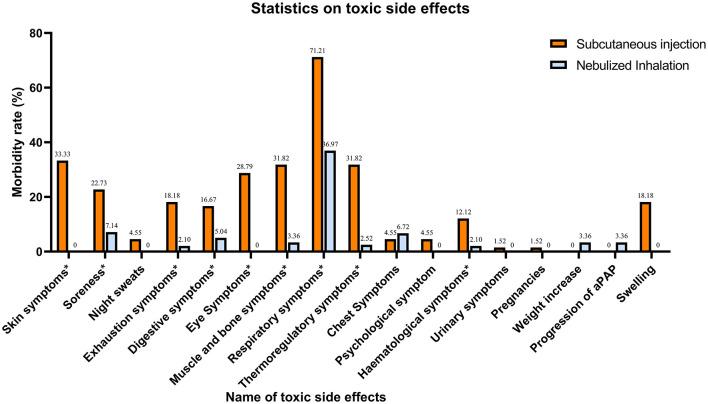
A total of 304 aPAP patients were treated with GM-CSF, including 66 (21.7%) in the SIG and 238 (78.3%) in the NIG. In total, we identified 220 (72.37%) patients whose treatment was effective and 84 (27.63%) patients whose treatment was ineffective. Efficacy was achieved in 54.55% (36/66) of the SIG patients and 77.31% (184/238) of the NIG patients ( < 0.001). More metrics were changed than in the NIG than SIG, suggesting the superior effectiveness of nebulized inhalation. The nebulized inhalation of GM-CSF was more effective ( < 0.001) and caused fewer adverse events than its subcutaneous injection. A significant difference in the NIG was noted across treatment durations, with an efficacy rate of 88% for those treated for over 24 weeks, compared with 48% in the SIG ( < 0.001). Among the NIG patients, the optimal efficacy was found to be at a dosage of 300-400 μg/d, with diminishing efficacy at higher doses ( < 0.036).
CONCLUSION
Nebulized inhalation is a more effective and safer route of GM-CSF administration than subcutaneous injection is, with a potential optimal dosage of 300-400 μg/day, and the duration of GM-CSF treatment via nebulized inhalation with the greatest efficacy is >24 weeks.
背景
粒细胞-巨噬细胞集落刺激因子(GM-CSF)疗法是自身免疫性肺泡蛋白沉积症(aPAP)的重要治疗方法。外源性GM-CSF治疗可通过皮下注射或雾化吸入给药。然而,缺乏关于这两种给药途径有效性和安全性的数据。
方法
我们对治疗aPAP患者的不同方法进行了系统的文献综述,包括皮下注射和雾化吸入GM-CSF。根据给药途径将患者分为皮下注射组(SIG)和雾化吸入组(NIG)。对治疗效果和安全性,包括不良事件进行了统计学评估。我们分析了不同时间间隔的不同GM-CSF治疗周期。分析采用卡方检验、非配对t检验和Kruskal-Wallis H检验。
结果
共有304例aPAP患者接受了GM-CSF治疗,其中SIG组66例(21.7%),NIG组238例(78.3%)。我们总共确定了220例(72.37%)治疗有效的患者和84例(27.63%)治疗无效的患者。SIG组54.55%(36/66)的患者和NIG组77.31%(184/238)的患者取得了疗效(P<0.001)。与SIG组相比,NIG组更多的指标发生了变化,表明雾化吸入的有效性更高。GM-CSF雾化吸入比皮下注射更有效(P<0.001),且不良事件更少。NIG组在不同治疗持续时间上存在显著差异,治疗超过24周的患者有效率为88%,而SIG组为48%(P<0.001)。在NIG组患者中,发现最佳疗效的剂量为300-400μg/d,剂量越高疗效越低(P<0.036)。
结论
雾化吸入是一种比皮下注射更有效、更安全的GM-CSF给药途径,潜在最佳剂量为300-400μg/天,通过雾化吸入GM-CSF治疗的最佳疗程为>24周。



 Zotero 插件